Synthetic diamond vs moissanite is a comparison between two lab-created stones that look similar but are chemically distinct. A synthetic diamond is pure crystallized carbon, identical to a mined diamond. Moissanite is silicon carbide, a separate gemstone with its own optical personality.
Picture yourself at a candlelit dinner in Positano, a delicate ring catching the warm glow of the Mediterranean evening. Whether that stone is a synthetic diamond or moissanite, it was born in a laboratory rather than a mine. But that shared origin is where the similarities end. One is a genuine diamond in every scientific sense. The other throws rainbow fire like nothing else in the jewelry world. Understanding the synthetic diamond vs moissanite distinction means you can choose the stone that truly matches your style, your values, and your budget before you invest.
Key Takeaways
- Synthetic diamonds are real diamonds, chemically identical to mined stones; moissanite is a distinct gemstone composed of silicon carbide.
- Moissanite costs dramatically less than a comparable synthetic diamond: roughly $599 for a 1 ct moissanite versus $3,400–$4,300 for a 1 ct lab diamond, according to Do Amore.
- Diamond scores 10 on the Mohs scale; moissanite scores 9.25, making both excellent choices for daily wear.
- Moissanite produces more colorful fire thanks to a dispersion of 0.104, compared to diamond’s 0.044.
- Synthetic diamonds carry full 4C grading reports from labs like IGI, GCAL, and GIA; moissanite is graded on color only.
- Both are ethical, lab-created alternatives to mined diamonds, with minimal environmental footprint.
What Are Synthetic Diamonds (Lab-Grown)?
The Real Diamond, Grown in a Lab
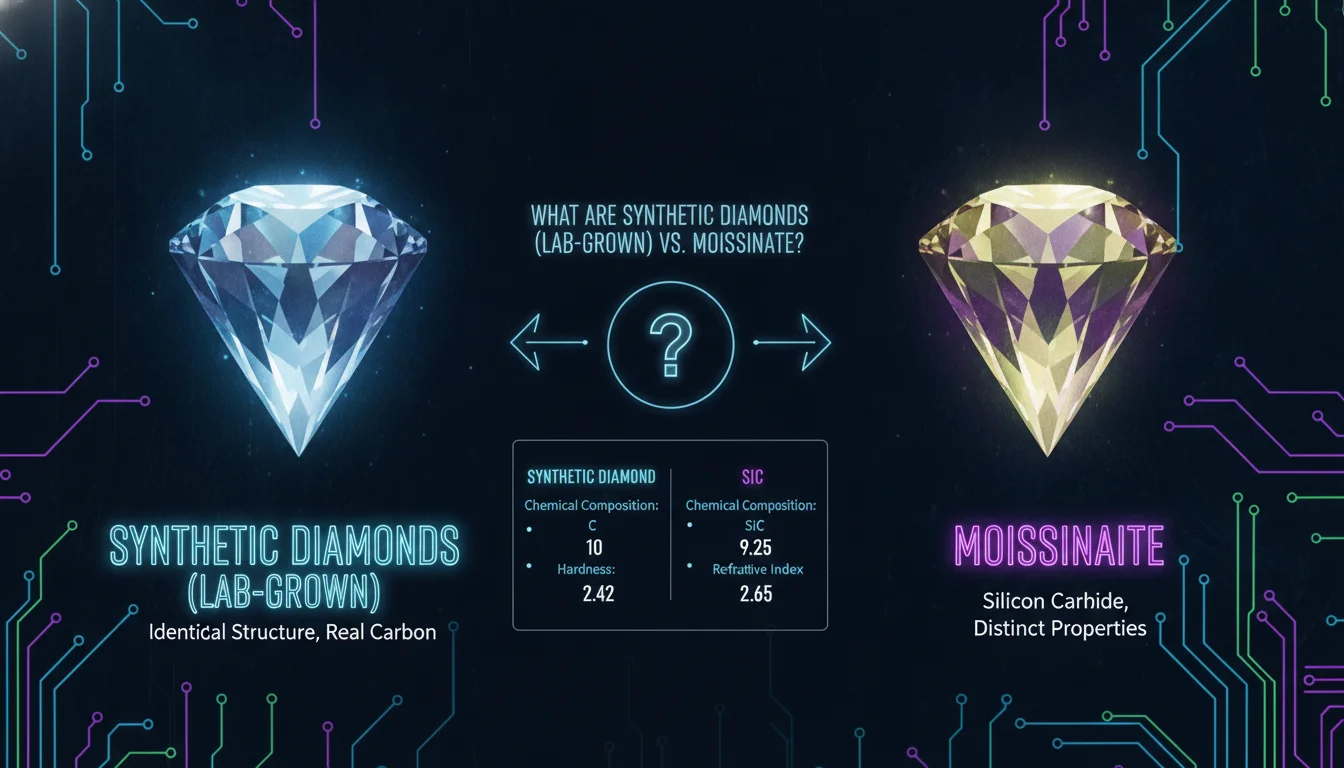
A synthetic diamond is a genuine diamond grown in a controlled laboratory environment rather than extracted from the earth. It shares the exact chemical composition of a mined diamond: pure crystallized carbon arranged in the same crystal structure. As Do Amore explains, “there is no chemical difference between a Lab Grown Diamond and a natural, mined diamond: they are both simply crystal-clear carbon.” Even a trained gemologist cannot tell them apart without advanced testing equipment.
Hardness and Durability
Synthetic diamonds score a perfect 10 on the Mohs scale, making them the hardest known material on earth. That rating means your stone resists scratches through decades of daily wear, from morning coffee to sunset cocktails on a St. Barts terrace. When weighing synthetic diamond vs moissanite for an engagement ring, this maximum hardness is a meaningful long-term advantage.
Sparkle and Optical Properties
The sparkle of a synthetic diamond comes from two qualities: brilliance (white light reflections) and fire (colored flashes). With a dispersion of 0.044 and single refraction, light bends uniformly through the stone, producing crisp, sharp facets and a classic white-light glow. That optical clarity is the look most people picture when they think “diamond.”
Color and Clarity
Lab-grown diamonds are available across the full color spectrum, from D (completely colorless) to Z (light yellow), plus fancy colors like blue and pink. They are graded on all four of the familiar 4Cs: cut, color, clarity, and carat weight. Reputable stones come with a grading report from IGI or GCAL. Per Stienhardt’s education guide, as of October 1, 2025, GIA now issues Premium and Standard descriptive tiers for lab-grown diamonds, adding another layer of consumer confidence.
Price and Certification
Synthetic diamonds cost significantly less than mined stones. According to Do Amore’s price comparison, a 1.00 ct lab-grown diamond runs between $3,400 and $4,300, while a 1.90 ct stone ranges from $5,500 to $6,500. Every stone should arrive with an independent grading certificate that verifies its quality and confirms its lab-grown origin.
Pros and Cons of Synthetic Diamonds
Pros
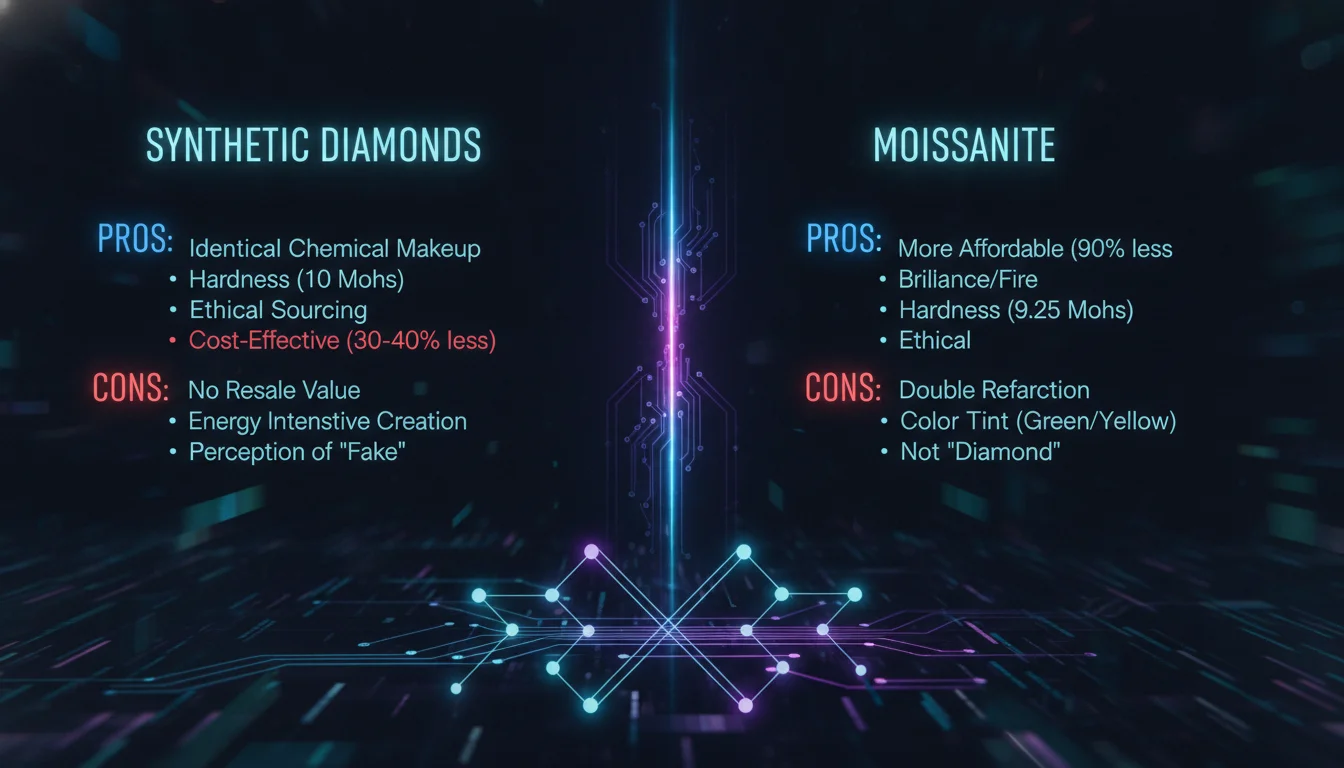
- 100% real diamond, chemically identical to mined stones.
- Hardest gemstone available, scoring 10 on the Mohs scale.
- Classic white-light brilliance with crisp, sharp facets.
- Available in every color grade and clarity level.
- Full 4C grading reports from IGI, GCAL, or GIA.
- Ethical and eco-conscious alternative to mining.
Cons
- Higher cost than moissanite, though still far less than a mined diamond.
- Some buyers feel it lacks the romantic narrative of an earth-formed stone.
- Lab-grown diamond resale values have softened as supply has grown.
What Is Moissanite?
A Gemstone With Its Own Story
Moissanite is a lab-created gemstone composed of silicon carbide (SiC), and it has one of the most extraordinary origin stories in the jewelry world. In 1893, chemist Henri Moissan discovered tiny crystals in a meteor crater in Canyon Diablo, Arizona, and initially believed he had found diamonds. By 1904, after years of close examination, he confirmed the crystals were silicon carbide, a completely different material. The gem was named in his honor. As Brilliant Earth clarifies, “Moissanite is not a lab-grown diamond. While both are lab-created gemstones, their chemical compositions differ.” Natural moissanite is so rare that virtually every stone sold in jewelry today is produced in a laboratory.
Hardness and Durability
Moissanite scores 9.25 on the Mohs scale, making it exceptionally durable and second only to diamond among gemstones suited for everyday wear. It handles scratches and impacts far better than softer alternatives, so your ring will still look stunning after years of adventures from Tulum to Santorini.
Spectacular Fire and Sparkle
The most striking quality of moissanite is its fire. Its dispersion of 0.104 is more than double diamond’s 0.044. Do Amore reports that moissanite reflects about twice as much colored sparkle as a diamond, giving it a firework-like effect in direct light. Moissanite is also doubly refractive: viewed from certain angles, facet edges appear doubled, which creates a softer, more fragmented look compared to diamond’s crisp single refraction. Some wearers love this quality; others prefer the cleaner lines of a diamond.
Color and Appearance
Older moissanite often carried a noticeable yellow or green tint, but advanced manufacturing has changed that. Charles and Colvard’s Forever One line produces colorless moissanite that reads bright white in most lighting. Even so, larger stones can pick up a faint warm undertone in certain conditions. Moissanite is not graded on clarity because it is virtually flawless by default. Instead, it is sold in color categories: Premium (equivalent to G-H on the diamond color scale) and Super Premium (D-F), as noted by VRAI’s buying guide.
Price and Value
Price is where the synthetic diamond vs moissanite comparison becomes most dramatic. A 1.00 ct moissanite typically costs around $599, while a 1.90 ct stone runs about $1,349, per Do Amore’s published pricing. That represents a saving of roughly 82–86% compared to synthetic diamonds of similar visual size. For anyone who wants a large, show-stopping center stone without the diamond price tag, moissanite is a genuinely compelling option.
Pros and Cons of Moissanite
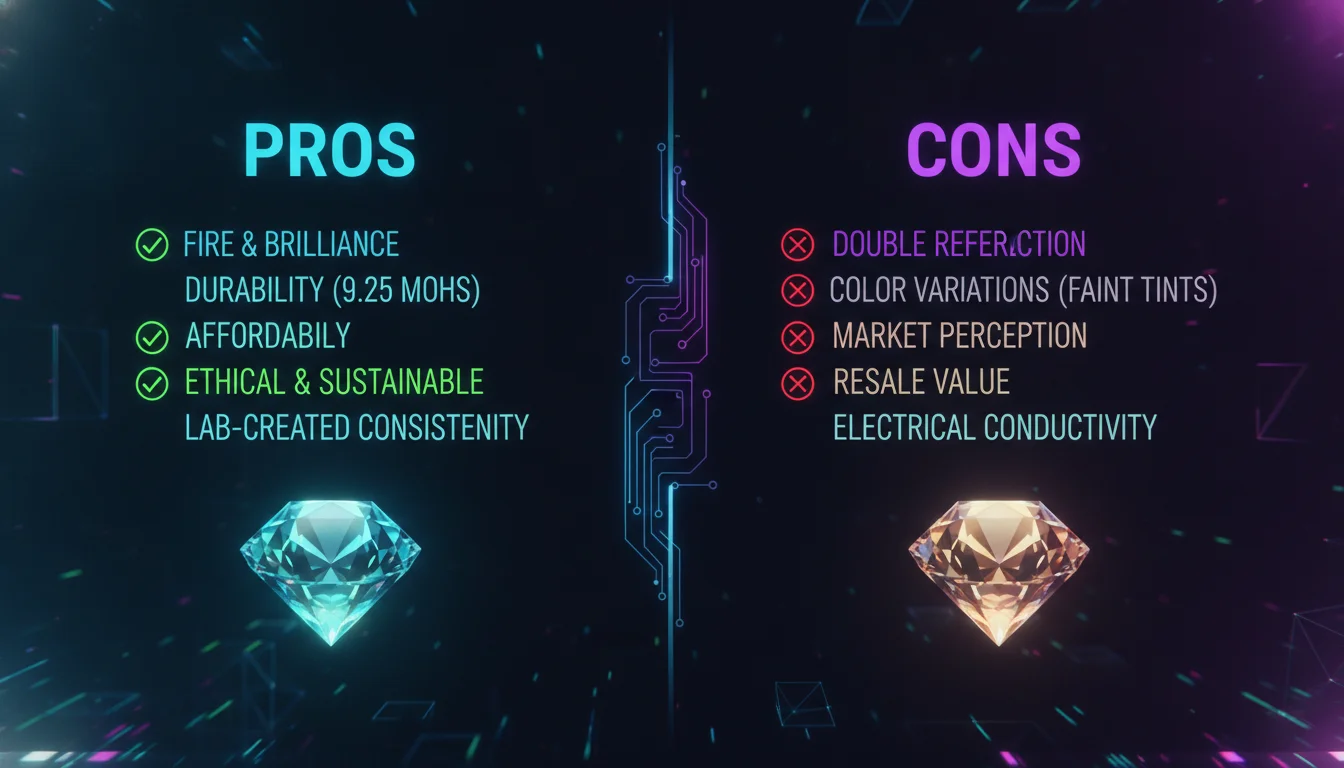
Pros
- Dramatically more affordable than synthetic diamonds.
- Dazzling, colorful fire that catches every light source.
- Mohs 9.25 hardness ensures excellent long-term durability.
- Virtually flawless clarity as standard.
- Ethically produced in labs with a minimal environmental footprint.
- Allows you to choose a larger center stone for the same budget.
Cons
- Not a diamond: some wearers feel it lacks the prestige of a genuine stone.
- Double refraction can give facets a slightly hazy or doubled appearance.
- Intense rainbow fire is recognizable to those familiar with both stones.
- Lower resale value compared to diamonds.
Synthetic Diamond vs Moissanite: Side-by-Side Comparison
| Feature | Synthetic Diamond | Moissanite |
|---|---|---|
| Composition | Pure carbon (C) | Silicon carbide (SiC) |
| Hardness (Mohs) | 10 | 9.25 |
| Dispersion (Fire) | 0.044 (white-light brilliance) | 0.104 (about 2x more rainbow fire) |
| Refraction | Single (crisp, sharp facets) | Double (facets may appear doubled) |
| Color Range | D to Z, plus fancy colors | Colorless to near-colorless; may show warm tint |
| 1.00 ct Price (approx.) | $3,400–$4,300 | $599 |
| 1.90 ct Price (approx.) | $5,500–$6,500 | $1,349 |
| Certification | Full 4C grading report (IGI, GCAL, GIA) | Graded by color only |
| Tests as Diamond? | Yes | No |
Ethical and Environmental Considerations
Both synthetic diamonds and moissanite sidestep the ethical concerns tied to traditional diamond mining. Neither requires large-scale earth excavation, and both are produced in controlled laboratory settings. For the conscious jewelry buyer, this is a meaningful distinction from mined stones. Charles and Colvard, the pioneering brand behind Forever One moissanite, has built its entire identity around lab-created gemstones as a responsible choice. VRAI, known for its Caydia lab-grown diamond line, similarly positions its stones as a conscientious alternative. If ethical sourcing matters to you, both options deliver, and the choice comes down to the stone itself rather than its origin.
Resale Value: What to Expect
Resale value is worth understanding before you buy. Synthetic diamonds generally hold more resale value than moissanite, though the lab-grown diamond market has seen prices soften as production has scaled. Moissanite carries a lower resale value by comparison, largely because it is not a diamond and the secondary market for it is smaller. If long-term investment value matters to you, a synthetic diamond is the stronger choice. If you view your jewelry as a personal expression rather than a financial asset, moissanite’s price advantage at purchase may outweigh any resale consideration.
Maintenance and Care
Both stones are low-maintenance by fine jewelry standards. Clean your synthetic diamond or moissanite ring with warm water, a drop of mild dish soap, and a soft brush. Avoid ultrasonic cleaners for moissanite if your setting includes delicate prongs, and always remove your ring before applying sunscreen or chemical products. Because both stones score above 9 on the Mohs scale, everyday scratching is not a concern. A professional cleaning once or twice a year keeps either stone looking its best.
How to Tell Synthetic Diamond from Moissanite
Telling synthetic diamond vs moissanite apart often requires gemological tools, but there are a few practical steps you can take at home or with a jeweler.
- Observe the fire. In bright light, compare the colored flashes. Intense rainbow sparkle points to moissanite; a predominantly white-light brilliance suggests a synthetic diamond.
- Check for double refraction. Use a loupe and look through the crown facets toward the back facet junctions. Doubled or fuzzy edges indicate moissanite. Diamond facets stay crisp and clean.
- Use a specialized tester. Basic thermal diamond testers can give a false positive for moissanite because both stones conduct heat similarly. A moissanite-specific electrical conductivity tester will separate them definitively.
- Review the certificate. A synthetic diamond arrives with a full 4C grading report from IGI, GCAL, or GIA. Moissanite does not carry a diamond-style certificate.
“There is no chemical difference between a Lab Grown Diamond and a natural, mined diamond: they are both simply crystal-clear carbon.” – Do Amore
“Moissanite is not a lab-grown diamond. While both are lab-created gemstones, their chemical compositions differ.” – Brilliant Earth Gemologists
When to Choose Each Stone
Choose a Synthetic Diamond If You Want:
- The authentic diamond experience, with identical chemistry and optics to a mined stone.
- Maximum hardness, a 10/10 Mohs rating that handles daily wear without compromise.
- Classic white-light brilliance, the sparkle universally recognized as a diamond.
- Third-party certification, a detailed 4C report that confirms quality and origin.
- A ring that passes every test, ideal if you want no questions about whether it is a real diamond.
Choose Moissanite If You Want:
- Maximum fire and color, a stone that throws rainbow flashes in every light.
- A significantly larger gem for your budget, moissanite lets you go bigger without the diamond price.
- A unique, modern alternative, a gemstone with its own heritage and optical personality.
- Top-tier durability at an accessible price, virtually scratch-proof for everyday adventures.
- An ethical, lab-created choice that does not compromise on beauty.
The Final Word on Synthetic Diamond vs Moissanite
In the synthetic diamond vs moissanite debate, there is no universal winner. Only the stone that best matches your priorities. If owning a genuine diamond, complete with a lab report and timeless white brilliance, matters most to you, a synthetic diamond is the clear answer. But if you want extraordinary fire, a larger stone, and significant savings, moissanite is a stunning choice in its own right. Both offer ethical, lab-created origins and impressive durability. As of summer 2026, both categories are more accessible than ever, with brands like Charles and Colvard (Forever One moissanite) and VRAI (Caydia lab-grown diamonds) raising the standard for quality and transparency. The synthetic diamond vs moissanite decision becomes straightforward once you know exactly what each stone is and what you value most.
Ready to find your perfect stone? Shop the jewelry collection at Lexazi, where curated fine jewelry meets resort-ready style. Free shipping on orders over $75.
Frequently Asked Questions
Should I buy moissanite or lab diamond?
The right choice depends on your budget and what the stone means to you. Choose a lab-grown synthetic diamond if you want a genuine diamond with classic white-light sparkle, full 4C certification, and maximum hardness. Choose moissanite if you prefer a more affordable stone with spectacular colorful fire and are happy with a gemstone that is not a diamond.
How much is 1 carat of moissanite worth?
A 1 ct moissanite gemstone typically costs around $599, according to Do Amore’s published price comparison. Prices vary based on cut quality and color grade, but moissanite is consistently a fraction of the cost of a comparable synthetic diamond.
Are synthetic diamonds worth buying?
Yes. Synthetic diamonds are real diamonds with the same physical and optical properties as mined stones, and they cost significantly less than earth-mined equivalents. They come with independent grading certificates and offer an ethical alternative to traditional mining, making them excellent value for anyone who wants a genuine diamond.
What is the downside of moissanite?
The main drawbacks are that moissanite is not a diamond, its double refraction can create a slightly blurred or doubled facet appearance, and its intense rainbow fire looks noticeably different from a diamond’s sparkle to a trained eye. Some wearers also find that moissanite carries less prestige than a genuine diamond stone.
Can moissanite pass for a diamond?
To an untrained eye, moissanite can resemble a diamond, particularly in smaller sizes. However, its colorful fire and occasional double-facet effect can give it away in direct light, and it will not test as a diamond with a specialized gemological tester. A full grading certificate is the clearest way to confirm what you have.
Is moissanite a good engagement ring stone?
Moissanite is an excellent engagement ring choice thanks to its 9.25 Mohs hardness, brilliant fire, and accessible price point. It is a popular option for couples who want a large, beautiful center stone without the cost of a synthetic diamond, and brands like Charles and Colvard have refined the quality significantly in recent years.