Diamond vs moissanite is a comparison of two distinct gemstones: carbon-based diamond and silicon carbide moissanite, each with its own brilliance, price point, and story. One carries billions of years of geological history; the other was born from the stars and grown in a lab with a conscience.
Key Takeaways
- Diamond vs moissanite comes down to carbon versus silicon carbide, two completely different gemstones with surprisingly similar looks.
- Moissanite has a higher refractive index (2.64–2.69 vs diamond’s 2.417–2.419), producing more intense rainbow fire and white brilliance.
- Diamond scores a perfect 10 on the Mohs hardness scale; moissanite scores 9.25, making both excellent choices for everyday jewelry.
- A one-carat equivalent moissanite typically costs $300–$800, while a comparable natural diamond can run $2,000 to well over $10,000.
- Moissanite is exclusively lab-created, giving it a clear ethical edge over mined diamonds.
- Color matters: classic moissanite carries a greenish-yellow tint, while top-grade Forever One™ colorless moissanite rivals a GIA E-color diamond.
There is a moment, usually standing in a jewelry store with your heart already decided, when the stone in the case catches the light and everything else disappears. That feeling is exactly what both diamond and moissanite deliver, just in different ways. One throws a cool, classic white flash. The other erupts in rainbow fire like a prism catching afternoon sun. Knowing which one speaks to you is the whole point of this guide.
| Feature | Diamond | Moissanite |
|---|---|---|
| Composition | Carbon (C) | Silicon carbide (SiC) |
| Hardness (Mohs scale) | 10 | 9.25 |
| Refractive Index | 2.417–2.419 | 2.64–2.69 |
| Dispersion (Fire) | 0.044 | 0.104 |
| Brilliance | High white light return | Slightly higher white light, plus more rainbow sparkle |
| Color Range | D-to-Z scale, plus fancy colors | Colorless (D-E-F equivalent) to near-colorless, teal, grey, green, yellow, black |
| Price (1 carat equivalent) | $2,000–$20,000+ (natural) | $300–$800 |
| Ethical | Natural: mining concerns; lab-grown: more ethical | Lab-created, minimal environmental footprint |
| Long-term value | Holds value, especially natural | Little resale value, but forever durable |
What Is Moissanite?
A Gemstone Born from the Stars
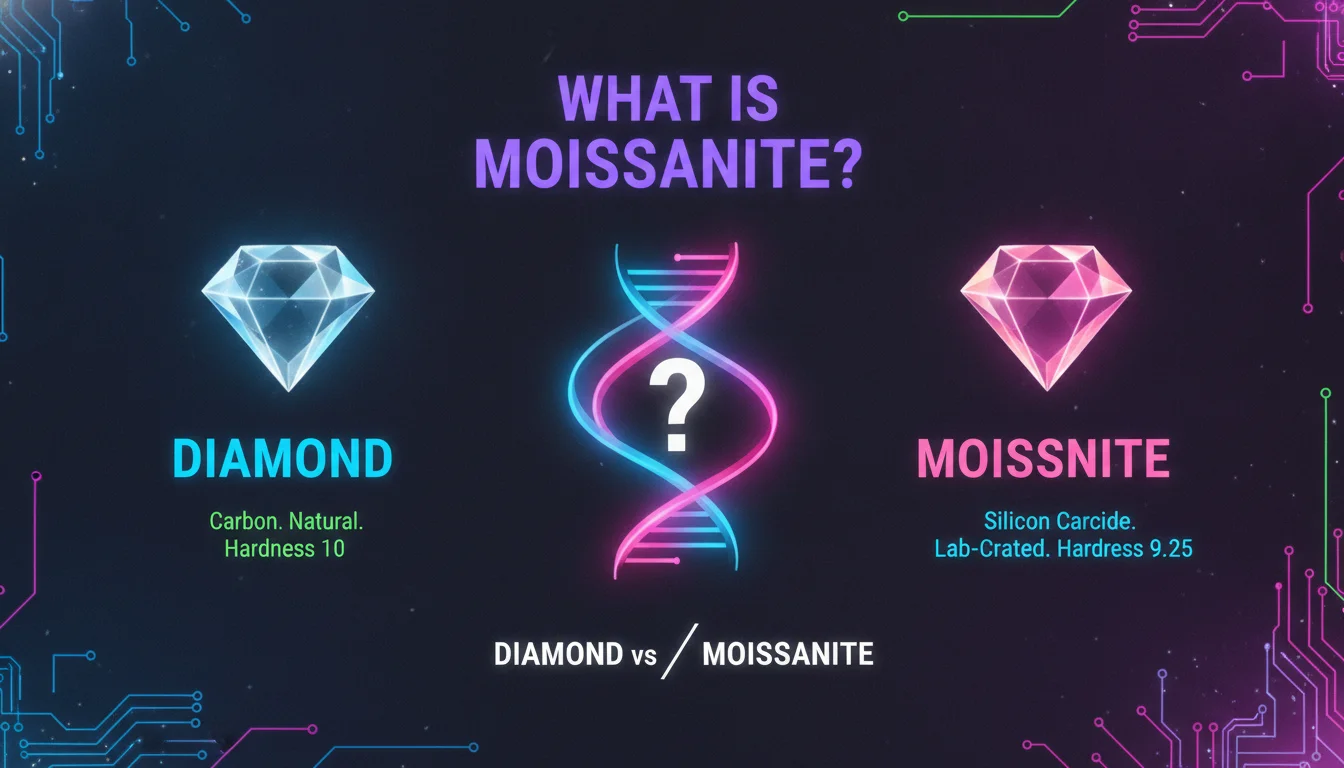
Moissanite is a mineral composed of silicon carbide (SiC), and its origin story is genuinely extraordinary. According to Brilliant Earth’s gemstone guide, it was discovered in 1893 by Nobel Prize-winning chemist Henri Moissan inside a meteorite that fell in Canyon Diablo, Arizona. He initially mistook the crystals for diamonds; it wasn’t until 1904 that he correctly identified them as silicon carbide. Naturally occurring moissanite remains extraordinarily rare. Beyond meteorites, geologists found it outside of space rock for the first time in 1958, in the Earth’s upper mantle near Wyoming. Today, every moissanite used in jewelry is grown in a laboratory using advanced technology that replicates natural formation under controlled conditions.
Ethical and Sustainable Choice
Because moissanite is lab-grown, it sidesteps the environmental and ethical concerns tied to diamond mining. As Brilliant Earth notes, moissanite has a smaller carbon footprint and requires no mining, making it a genuinely traceable gem from lab to jeweler’s case. For eco-conscious shoppers, that transparency is a significant part of the appeal. Every stone can be tracked through its supply chain, which is something mined diamonds still struggle to guarantee fully.
What Is Diamond?
Natural Diamond: A Miracle of Nature
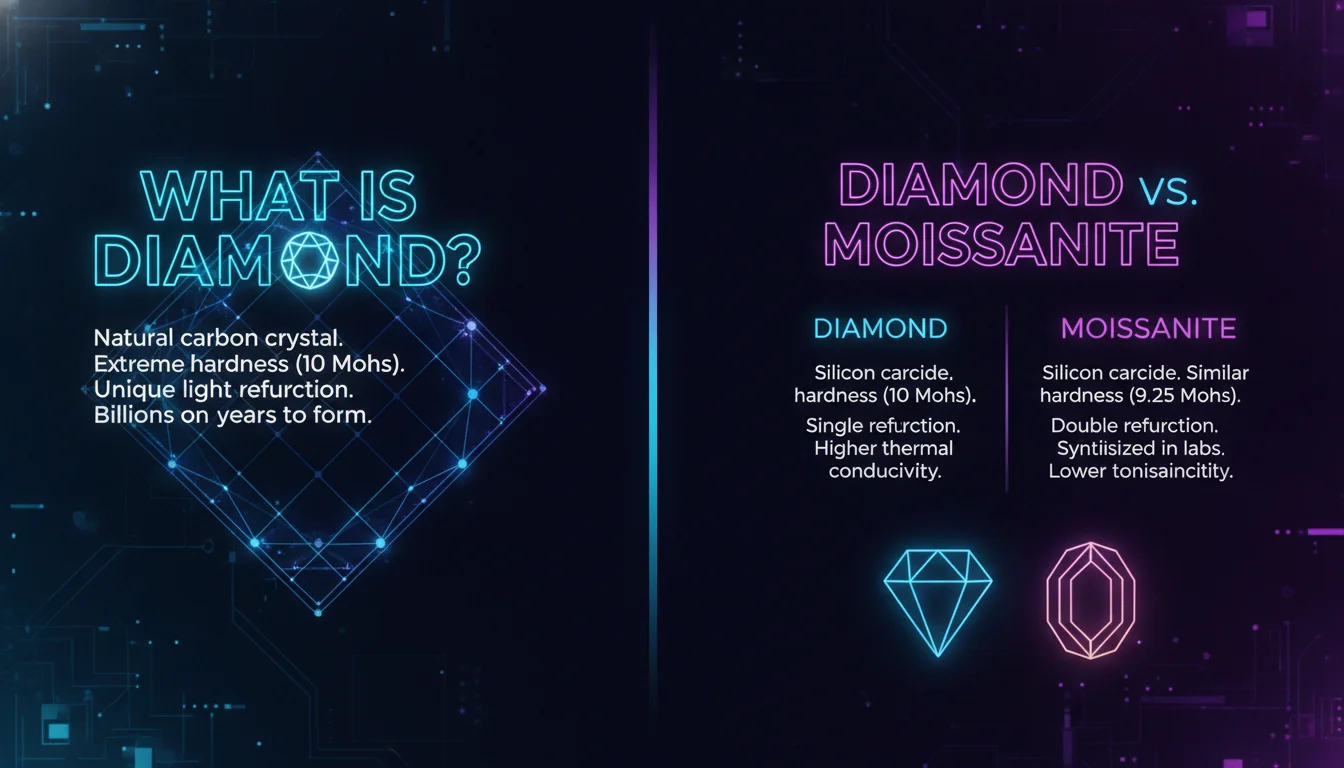
Diamond is a mineral composed of nearly pure carbon, formed deep within the Earth’s mantle under extreme heat and pressure over billions of years. It is the hardest naturally occurring substance known, scoring a perfect 10 on the Mohs scale. Diamonds have anchored engagement ring culture since the late 19th century, valued for their brilliance, durability, and the weight of meaning we place on them. Major sources include Russia, Botswana, Canada, and Australia.
Lab-Grown Diamond: The Modern Alternative
Lab-grown diamonds are chemically, physically, and optically identical to natural diamonds. They are produced using either High Pressure High Temperature (HPHT) or Chemical Vapor Deposition (CVD) methods, and both natural and lab-grown diamonds can be graded by gemological institutes like GIA, IGI, and AGS. Lab diamonds share the same hardness (10 on the Mohs scale) and the same classic white sparkle as their mined counterparts, but at a lower price and with a clearer ethical origin. In the diamond vs moissanite conversation, lab-grown diamond sits interestingly in the middle: more ethical than mined diamond, but still more expensive than moissanite.
Diamond vs Moissanite: Appearance and Sparkle
Brilliance: White Light Return
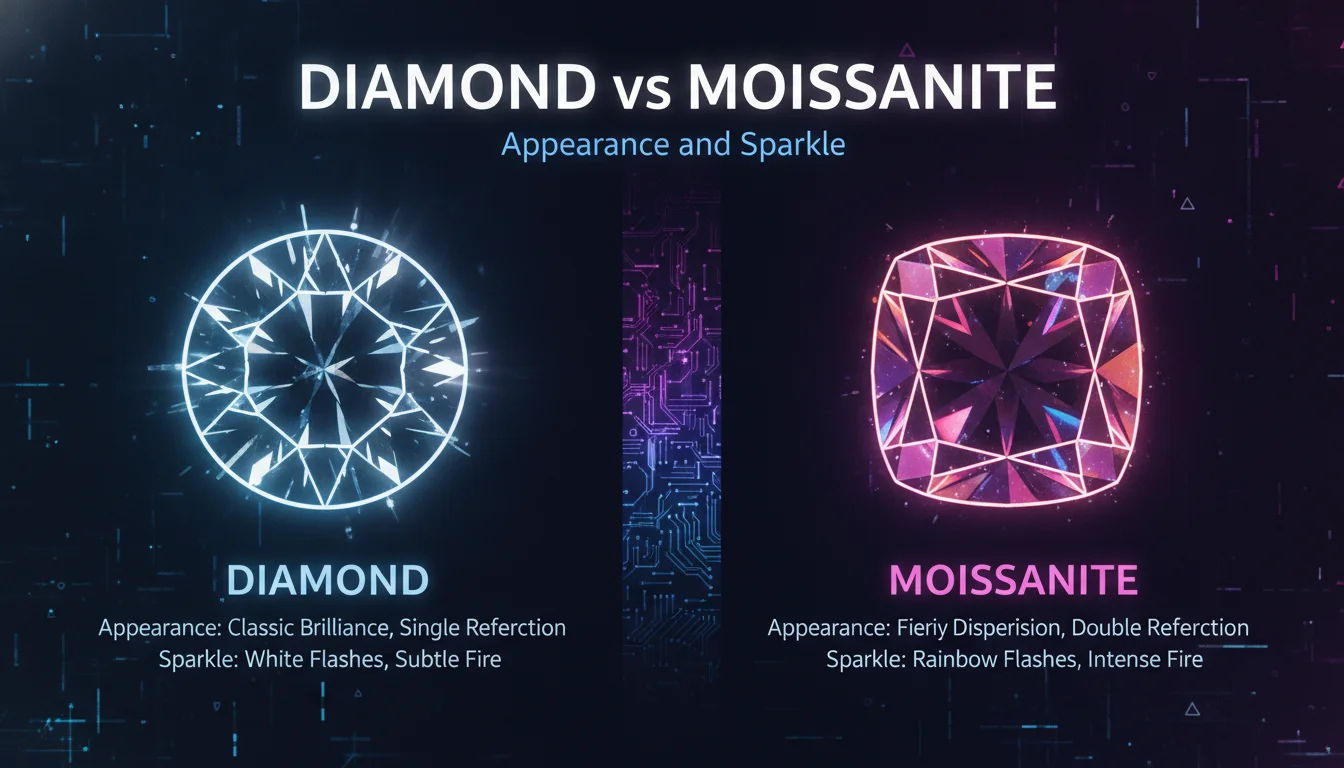
Brilliance refers to the white light that bounces back from a gemstone’s interior, and in the diamond vs moissanite comparison, moissanite has a measurable edge. Per Brilliant Earth’s certified gemologists, moissanite’s refractive index of 2.64–2.69 outpaces diamond’s 2.417–2.419, meaning it bends light more intensely for a brighter overall appearance. The difference is subtle in stones under one carat, but as Brilliant Earth notes, in stones larger than one carat the gap in fire becomes very noticeable. Both gems are cut to maximize brilliance, but moissanite’s natural optical properties give it a consistently dazzling look.
Fire: Rainbow Flashes
Fire, or dispersion, is a gemstone’s ability to split white light into spectral colors. According to competitor data from Little Sky Stone, moissanite’s dispersion index is 0.104, more than twice diamond’s 0.044. As Do Amore’s diamond vs moissanite guide describes it, moissanite will look like a firework next to a diamond. Under direct light, moissanite throws vivid rainbow sparks while diamond delivers a more balanced mix of white and colored light. Some people love that extra dazzle; others find it too flashy and prefer diamond’s cooler, more restrained brilliance.
The Double Refraction Effect
One lesser-known aspect of diamond vs moissanite optics is double refraction. Diamond is singly refractive, meaning light travels through it as a single ray. Moissanite is doubly refractive, so if you look closely through the side of the stone, you may see a doubling of the back facets. In high-quality moissanite like Charles & Colvard’s Forever One™, this effect is minimized and nearly invisible to the naked eye from a face-up view, though it can be observed under magnification. Other doubly refractive gems include sapphire, alexandrite, and tanzanite, so moissanite is in good company. This characteristic does not affect sparkle but is one way gemologists distinguish the two stones.
Color: Classic Moissanite vs Colorless Grades
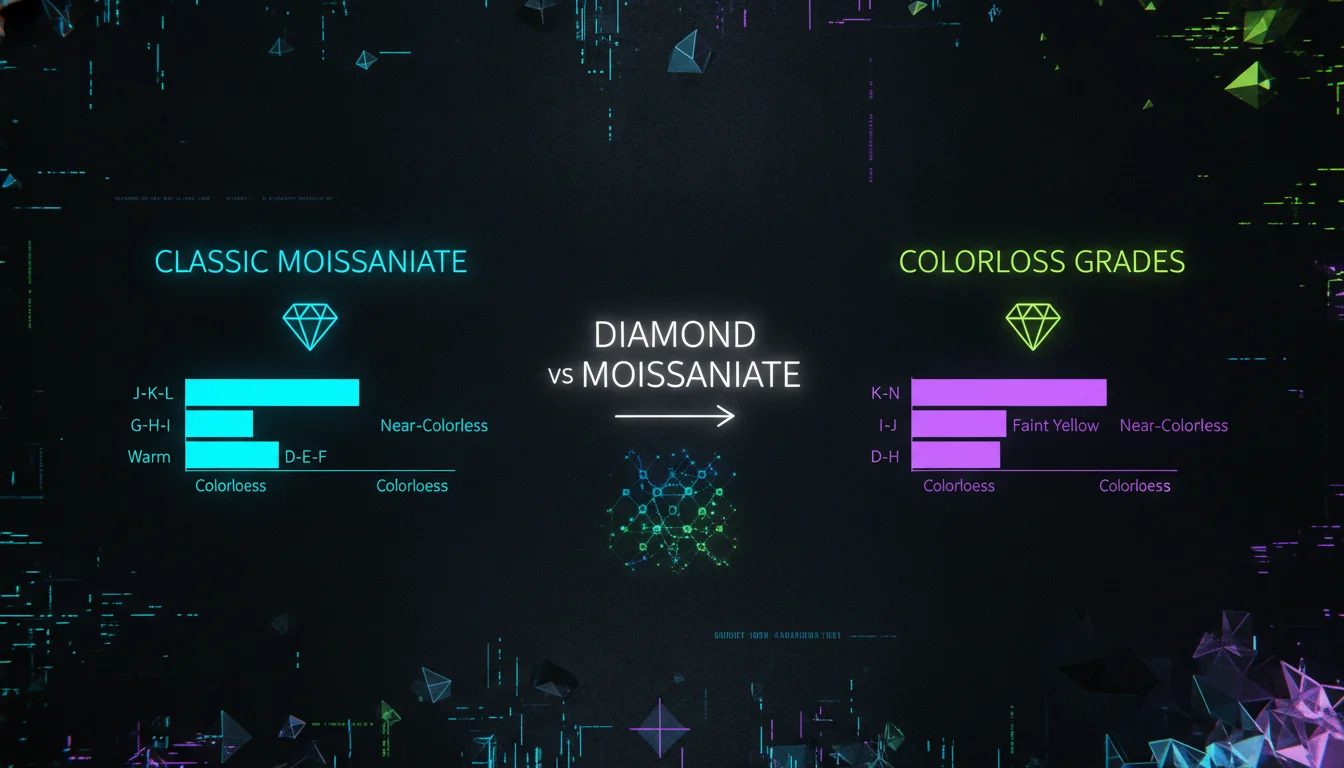
Color is one of the most important and often overlooked factors in the diamond vs moissanite decision. Not all moissanite is created equal, and understanding the evolution of moissanite color grades helps you shop smarter.
Classic Moissanite: The Original (and Its Limitations)
Classic moissanite, the first version produced commercially, carries a greenish-yellow hue. According to Do Amore, many consider classic moissanite’s color comparable to a GIA-certified K-color diamond, which reads as noticeably warm or yellow to most eyes. Do Amore does not sell classic moissanite for this reason, and most reputable jewelers have moved away from it entirely. If you encounter a moissanite at a suspiciously low price, check whether it is classic grade before buying.
Forever Brilliant and Forever One: The Upgrade Path
Charles & Colvard’s Forever Brilliant was the first attempt at a near-colorless moissanite, roughly equivalent to a GIA I-color diamond. Then came Forever One, which achieves true colorless status. Per Do Amore, Forever One Colorless moissanite matches the color of a GIA-certified E-color diamond, placing it firmly in the D-E-F colorless range. That is a remarkable achievement for a lab-created stone, and it makes the diamond vs moissanite color comparison far more favorable to moissanite than it was even a decade ago. For your engagement ring or a statement piece, Forever One colorless is the grade to seek out.
Durability: Hardness and Everyday Wear
Mohs Scale and Scratch Resistance
Durability is one area where the diamond vs moissanite comparison is genuinely close. Diamond scores a perfect 10 on the Mohs hardness scale, while moissanite scores 9.25, as confirmed by both Brilliant Earth and Do Amore. Both gems are extremely resistant to scratching and suitable for daily wear in rings, bracelets, and pendants. Diamond can only be scratched by another diamond. Moissanite can withstand almost all everyday abrasion; only materials like diamond or corundum (sapphire and ruby) can scratch it. For practical purposes, moissanite will remain pristine for a lifetime with normal care.
Toughness, Longevity, and Staying Sparkly
Toughness measures resistance to chipping or breaking, and both stones score well here. Moissanite’s crystal structure gives it excellent toughness, and it does not have the cleavage planes that occasionally cause diamonds to chip when struck at a vulnerable angle. As Do Amore points out, moissanite’s silicon content makes it less likely to attract grease or dirt than diamond, so it stays brighter between cleanings. Unlike cubic zirconia, which can cloud and dull over time, moissanite retains its sparkle indefinitely. It will not fog, scratch, or lose its brilliance, full stop.
Diamond vs Moissanite vs Cubic Zirconia: Know the Difference
The diamond vs moissanite conversation often pulls in a third contender: cubic zirconia (CZ). CZ is a synthetic zirconium oxide that mimics diamond’s look at an even lower price point, but the comparison ends there. CZ scores just 8–8.5 on the Mohs scale, making it significantly softer and prone to scratching with daily wear. More critically, CZ does cloud and dull over time as it absorbs oils and micro-scratches accumulate on its surface. Moissanite, by contrast, maintains its optical properties indefinitely. If you are choosing between moissanite and CZ, moissanite wins on every durability metric. The only reason to choose CZ is price, and given how affordable moissanite already is, that gap rarely justifies the trade-off in longevity.
Price and Value Comparison
Cost Differences
Price is where the diamond vs moissanite debate becomes most dramatic. A one-carat natural diamond of decent quality (G-H color, VS-SI clarity) can range from $2,000 to well over $10,000, while a top-tier one-carat equivalent Forever One™ colorless moissanite typically costs $300–$800. Even lab-grown diamonds are generally three to four times more expensive than comparable moissanite. This price gap widens as carat size increases. For budget-conscious shoppers, moissanite allows for a larger center stone or a more elaborate setting without compromising sparkle. Think of it as accessible luxury: the look of a high-end ring without the financial anxiety.
Long-Term Value
Natural diamonds have historically retained some resale value, though retail markups mean you are unlikely to recoup your full investment. Moissanite, like most lab-created gemstones, has very little resale market. But because the initial outlay is so much lower, many buyers consider moissanite a better immediate value. If you prioritize getting the most brilliance for your dollar and do not view the ring as a financial asset, moissanite is the clear winner. If heirloom value and potential appreciation matter to you, a natural diamond remains the more appropriate choice.
Ethical and Environmental Considerations
The ethical dimension of diamond vs moissanite has become a defining factor for modern couples. Natural diamond mining has been linked to environmental degradation, habitat destruction, and in some regions, human rights concerns. While the Kimberley Process has reduced the flow of conflict diamonds, ethical concerns persist. Moissanite is exclusively lab-created, requiring no mining and using far less land and water. Lab-grown diamonds offer a similar ethical profile, but moissanite’s production process is even more energy-efficient. For anyone who wants total peace of mind about where their gem came from, moissanite is an exemplary choice.
“Moissanite has a smaller carbon footprint and lessened environmental impact than a naturally mined gem. Created in a controlled environment with advanced technology, it is easily traceable and requires no mining.” – Brilliant Earth Gemstone Guide
How to Tell Diamond from Moissanite
Step-by-Step At-Home Tests
While a professional jeweler should make the final call, a few simple checks can point you in the right direction:
- Look for double refraction: Using a 10x loupe, examine the stone from the side. If you see doubled facet junctions, it is likely moissanite. This is the most reliable DIY test.
- Check the sparkle pattern: Hold the stone under a bright light. Moissanite will display intense rainbow flashes, while diamond shows a cooler, more balanced brilliance.
- Use a diamond tester: Thermal testers often register moissanite as “diamond” because both are excellent thermal conductors. More advanced testers that measure electrical conductivity can separate them, as moissanite conducts electricity and diamond generally does not.
- Breathe test: Breathe on the stone as you would on a mirror. Diamond disperses heat almost instantly. Moissanite may stay fogged for a moment longer, though this test is inconclusive because larger moissanites also clear quickly.
Professional Verification
Jewelers use identification tools like the Presidium Multi Tester or Raman spectroscopy to definitively distinguish moissanite from diamond. If you are purchasing a pre-loved piece or an ungraded stone, ask for a certificate from a recognized gemological laboratory. Reputable sellers of both diamonds and moissanite provide authenticity guarantees.
“Moissanite’s unique double refraction can separate it from diamond, if you know what to look for. Diamond is singly refractive, whereas moissanite is doubly refractive.” – Do Amore, Diamonds vs Moissanite Guide
Pros and Cons
Pros of Moissanite
- Significantly lower price point, making larger stones accessible
- Higher fire and brilliance due to superior refractive index and dispersion
- Lab-created with minimal environmental impact and full traceability
- Excellent hardness (9.25 Mohs) for everyday wear
- Does not cloud or dull over time, unlike cubic zirconia
- Available in colorless grades equivalent to GIA D-E-F diamonds
Cons of Moissanite
- Intense rainbow fire can appear “too flashy” to some eyes, especially in larger stones
- Double refraction is detectable under magnification by trained gemologists
- Very little resale or heirloom value
- Lacks the natural rarity and centuries of cultural symbolism that diamonds carry
- Classic-grade moissanite has a greenish-yellow tint; always specify colorless Forever One™
When to Choose Moissanite vs Diamond
Choose Moissanite If…
- You want maximum sparkle and fire on a budget.
- Ethical sourcing and minimal environmental impact are top priorities.
- You prefer a larger center stone without the price jump of a natural diamond.
- You are comfortable with a lab-created gem and love its origin story.
- You want a stone that stays brilliant forever without clouding or dulling.
Choose Diamond If…
- You value tradition, timeless prestige, and the symbolism of a natural wonder.
- You want a stone that holds its value and could become a family heirloom.
- You prefer a more understated sparkle without prominent rainbow flashes.
- You want the highest possible hardness rating for long-term peace of mind.
- You are comfortable with a higher price point for a natural or lab-grown diamond.
The diamond vs moissanite decision ultimately comes down to personal priorities. Moissanite delivers incredible fire, ethical credentials, and affordability. Diamond provides unmatched hardness, classic beauty, and enduring cultural value. Both are stunning choices that can carry a lifetime of meaning.
As of July 2026, moissanite continues to gain ground in the fine jewelry market, with more couples choosing it as a conscious, beautiful alternative to mined diamonds. Whether you are drawn to the stars or to the earth, there is a gem here that is exactly right for you.
Explore our curated jewelry collection at lexazi.com and find the piece that tells your story. Free shipping on orders over $75.
Frequently Asked Questions
Is moissanite better than a real diamond?
Neither is objectively better in the diamond vs moissanite comparison. Moissanite outperforms diamond in fire and brilliance while costing far less, but diamond wins in hardness, tradition, and resale value. Many consider moissanite the better choice for ethical sourcing and price, while others prefer diamond’s natural origin and cultural weight.
What are the negatives of moissanite?
The main drawbacks are its strong rainbow fire, which some find too flashy, the perception of being a diamond substitute, and almost no resale value. In larger sizes, the double refraction effect can create a slightly blurred appearance to those who know what to look for under magnification.
Do wealthy people wear moissanite?
Yes, many affluent individuals choose moissanite for ethical reasons, travel safety, or simply because they appreciate its unique optical beauty. It is not a marker of wealth or its absence. Celebrities and style influencers have normalized moissanite as a conscious luxury alternative.
Can a jeweler tell if a diamond is moissanite?
Absolutely. Trained jewelers and gemologists can distinguish moissanite from diamond using magnification to spot double refraction, dispersion pattern analysis, or electronic testers. It is not possible to pass moissanite off as diamond to a professional.
Does moissanite get cloudy over time?
No. High-quality moissanite such as Forever One™ remains crystal clear indefinitely. Unlike cubic zirconia, moissanite does not absorb oils or become foggy with wear. Regular cleaning keeps it sparkling like new for a lifetime.
Which sparkles more, diamond or moissanite?
Moissanite sparkles more due to its higher refractive index and dispersion index of 0.104 versus diamond’s 0.044. It produces more white brilliance and significantly more rainbow fire. In side-by-side comparisons, moissanite often appears more intensely glittery, while diamond delivers a brighter white sparkle with subtler rainbow accents.