Moissanite is a lab-created silicon carbide gemstone with exceptional brilliance and fire that rivals diamonds at a fraction of the cost. Originally discovered in a meteorite crater, this extraordinary gem offers more rainbow sparkle than any diamond, with a hardness of 9.25 that makes it perfect for everyday wear.
Key Takeaways
- Moissanite is silicon carbide (SiC), not a diamond simulant but a distinct gemstone with superior fire and brilliance
- At 9.25 on the Mohs scale, it’s nearly as hard as diamond (10) and ideal for engagement rings and daily jewelry
- Lab-created moissanite costs 75-80% less than natural diamonds while offering ethical, conflict-free sourcing
- Its higher refractive index (2.65-2.97) creates more rainbow flashes than diamond’s subtle white sparkle
- All jewelry-grade moissanite is lab-grown since natural specimens are extraordinarily rare
- Proper care maintains its brilliance indefinitely, it won’t cloud or lose sparkle over time
What Is Moissanite? The Essential Facts
Definition and Composition
Moissanite is the mineral form of silicon carbide (SiC), a compound of silicon and carbon that creates one of nature’s most brilliant gemstones. Unlike diamond, which is pure carbon arranged in a cubic lattice, this gem has a hexagonal crystal system with strong covalent bonding. According to the Wikipedia entry on moissanite, its crystal structure allows it to withstand pressures up to 52.1 gigapascals and gives it a melting point of 2730°C.
In gemological terms, this stone is not a “simulated diamond” or a “fake diamond.” It is a genuine gemstone with its own distinct chemical identity, hardness, and light performance. Its adamantine luster and double refraction create a dazzling display that many wearers prefer over the more subdued brilliance of a diamond.
Natural vs. Lab-Created Varieties
Natural specimens are so scarce they were initially mistaken for diamond by Nobel Prize-winning chemist Henri Moissan. First found in the Canyon Diablo meteorite in Arizona, tiny crystals of natural material have since been identified only in a handful of localities, including Wyoming’s Green River Formation and kimberlite pipes in Yakutia, Russia. Virtually all stones available for jewelry are lab-created. The American Gem Society notes that lab-grown varieties have a minimal environmental impact and allow for precise control over color and clarity.
Why This Gem Became a Jewelry Favorite
This brilliant stone surged in popularity in the late 1990s when Charles & Colvard, based in Research Triangle Park, North Carolina, perfected the thermal growing process to produce gem-quality crystals. Their breakthrough made it possible to cut large, colorless gems that rivaled diamond in brilliance and fire but cost a fraction of the price. Today, Helzberg Diamonds and many other retailers offer extensive collections, and the gemstone has become a go-to choice for ethically-minded couples.
The Cosmic History Behind This Brilliant Gem
Discovery by Henri Moissan
The story begins in Arizona’s Meteor Crater (also called Canyon Diablo) in 1893. French chemist Henri Moissan was examining rock samples from the crater when he discovered tiny, sparkling crystals that he initially identified as diamonds. It was not until 1904 that he correctly determined they were silicon carbide, a mineral never before found on Earth. The discovery astounded the scientific community because silicon carbide had only been synthesized in a lab two years earlier by Edward G. Acheson. The mineral was later named in Moissan’s honor.
From Meteorite to Laboratory
Natural specimens are believed to have traveled to Earth aboard meteorites, specifically carbonaceous chondrites. Wikipedia reports that 99% of silicon carbide grains found in the Murchison meteorite show anomalous isotopic ratios, proving they originated outside our solar system around carbon-rich asymptotic giant branch stars. Because natural crystals are so scarce, rarer even than diamond, the gemstones you see in jewelry are always lab-grown.
The Rarity of Natural Specimens
For more than a century, scientists debated whether this material could even exist naturally on Earth. It was not until 1958 that terrestrial specimens were confirmed in Wyoming’s Green River Formation, followed by discoveries in Russian kimberlite and as inclusions within diamonds. Despite these finds, natural crystals remain a geological curiosity, not a source for jewelry. When someone asks what is moissanite, the answer is invariably tied to lab creation.
How These Brilliant Gems Are Made in Laboratories
The Thermal Growing Process Step by Step
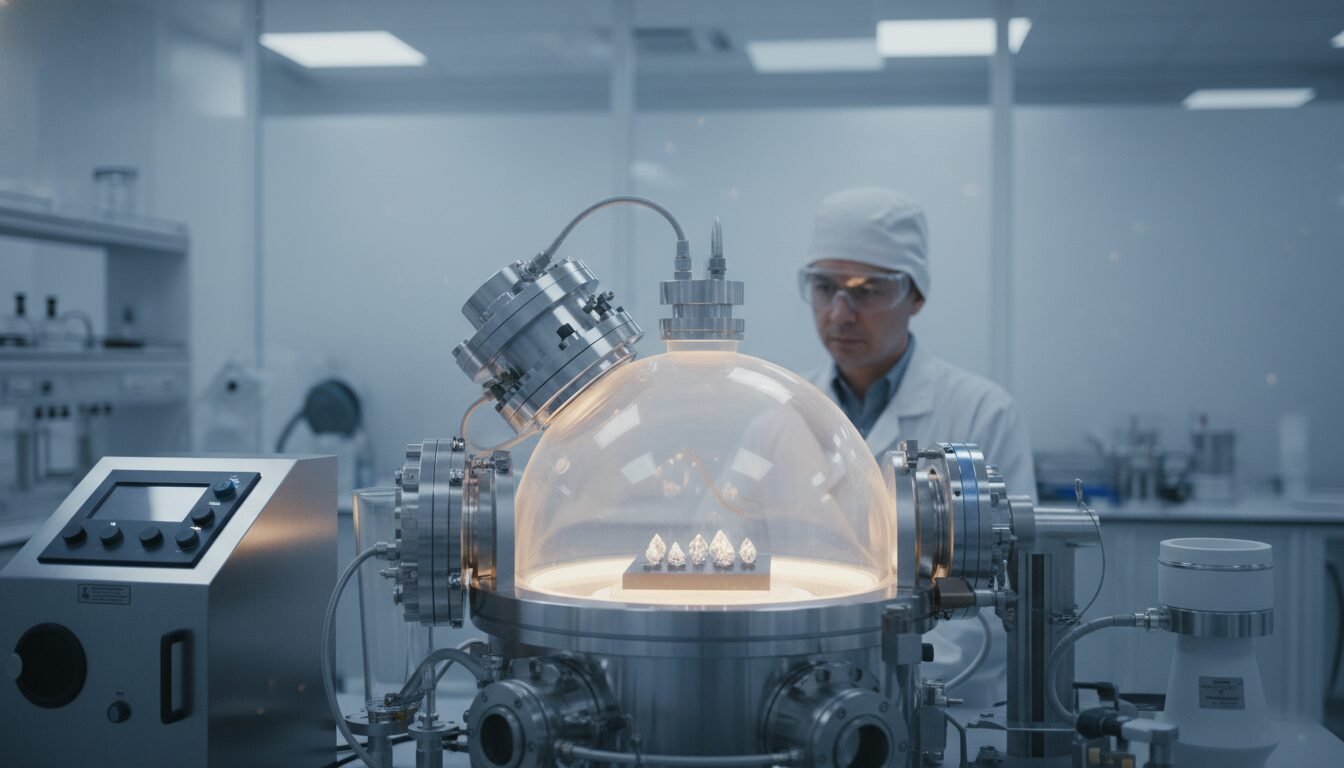
Creating a gem-quality stone is a feat of modern crystallography. Here is a simplified breakdown of the process used by manufacturers like Charles & Colvard:
- Seed crystal preparation. A small single-crystal silicon carbide seed is placed inside a growth chamber.
- Heating silicon carbide powder. The chamber is heated to approximately 2,500°C, causing the powdered SiC to sublimate into vapor.
- Sublimation and crystal growth. The vapor condenses onto the cooler seed crystal, slowly building up layers of pure silicon carbide over several weeks. This is often called the physical vapor transport (PVT) method.
- Cooling and extraction. The chamber is gradually cooled, and a large single-crystal boule is removed, a rough gemstone that weighs hundreds of carats.
- Cutting and polishing. Skilled gem cutters facet the rough material using diamond-tipped tools, revealing its maximum brilliance and fire.
This controlled environment yields stones with consistent clarity grades (often VVS1–VVS2) and customizable colors, from icy colorless to warm near-colorless.
Key Manufacturers: Charles & Colvard and Cree
Two names dominate production. Charles & Colvard pioneered gem-quality stones in the 1990s and remains the leading brand for jewelry. Cree Research, Inc. (now Wolfspeed), founded in 1987 in North Carolina, developed the commercial process for growing large single crystals of silicon carbide, primarily for electronics. Cree’s innovation provided the foundation for gemstone production. Without these companies, understanding what is moissanite might still be a geological footnote.
Brilliant Properties: Hardness, Sparkle, and Durability
Hardness and Scratch Resistance
On the Mohs scale of mineral hardness, this gem scores an impressive 9.25, just below diamond’s perfect 10. This makes it one of the hardest substances on Earth, resistant to scratches and abrasion from everyday activities. For comparison, sapphire and ruby rate 9, and cubic zirconia is only 8–8.5. This durability is a key reason these stones are recommended for engagement rings and other jewelry worn daily.
Brilliance, Fire, and Refractive Index
The optical performance is what truly sets this gem apart. It has a refractive index (nω=2.654, nε=2.967) that is higher than diamond’s (2.417), meaning it bends light more sharply and returns more brilliance. More striking is its dispersion, the ability to split white light into spectral colors, which is 0.104, more than double diamond’s 0.044. This gives these stones their signature rainbow fire, a prismatic display that many wearers find captivating.
“The higher refractive index and dispersion create a bolder, more colorful sparkle compared to diamond’s white and gray brilliance.”
Thermal and Chemical Stability
These gems are exceptionally stable. They decompose only at 2,730°C, are not radioactive, are diamagnetic, and are insoluble in all acids. These properties make them ideal for heirloom jewelry that can withstand decades of wear. It also means they retain their polish and clarity over time, they will not become cloudy or lose their fire with normal use.
Moissanite vs. Diamond: A Side-by-Side Comparison
Composition and Structure
Diamond is pure carbon crystallized in a cubic system; this gem is silicon carbide in a hexagonal structure. This fundamental difference leads to differences in hardness (10 vs. 9.25), density (specific gravity 3.52 vs. 3.22), and optical properties. While nearly as hard, its double refraction can cause a slight doubling of facet edges under magnification, a characteristic gemologists use to distinguish it from diamond.
Sparkle and Light Performance
The visual difference is most apparent under bright light. Diamonds exhibit a scintillating play of white, gray, and blue spectral highlights. These stones throw a noticeably stronger rainbow effect, which some describe as “disco ball” flashing. Both are beautiful, but they appeal to different aesthetics. For those who love bold sparkle, this gem delivers an unmistakable fire.
Price and Value
Cost is a major consideration. Helzberg Diamonds states that lab-created stones can cost four to five times less than a natural diamond of comparable size and quality. In practical terms, that means a 1-carat engagement ring might retail for a few hundred to a couple thousand dollars, while the same size diamond could easily reach $5,000 or more. This price advantage allows couples to choose a larger center stone or a more intricate setting without stretching their budget.
| Property | Moissanite | Natural Diamond |
|---|---|---|
| Composition | Silicon carbide (SiC) | Carbon (C) |
| Hardness (Mohs) | 9.25 | 10 |
| Refractive Index | 2.648–2.691 | 2.417 |
| Dispersion (Fire) | 0.104 | 0.044 |
| Specific Gravity | 3.22 | 3.52 |
| Price (1ct, high quality) | $300–$1,500 | $4,000–$10,000+ |
Pros and Cons
Pros
- Exceptional brilliance and fire that exceeds diamond’s sparkle
- Nearly diamond-hard at 9.25 on the Mohs scale for everyday durability
- Significantly more affordable than natural or lab-grown diamonds
- Completely ethical and conflict-free with minimal environmental impact
- Available in large sizes and various cuts at accessible prices
- Maintains clarity and brilliance indefinitely with proper care
Cons
- More rainbow fire may appear too flashy for some traditional tastes
- Lower resale value compared to natural diamonds
- Double refraction can cause slight doubling of facet edges under magnification
- Less brand recognition and prestige than diamond engagement rings
- May test positive on basic diamond testers, requiring advanced identification
Comparing Lab-Grown Diamonds and Cubic Zirconia
Versus Lab-Grown Diamond
Lab-grown diamonds are chemically, physically, and optically identical to mined diamonds, they are real diamonds, just created in a laboratory. This gem is a distinct stone. The visual difference is primarily the extra fire and its slightly lower hardness. Price-wise, lab-grown diamonds cost more than these stones but significantly less than mined diamonds. Many shoppers who want the exact properties of diamond but a lower environmental footprint choose lab-grown; those who enjoy the unique sparkle and lower price often prefer this alternative.
Versus Cubic Zirconia
Cubic zirconia (CZ) is a synthetic material with a hardness of only 8–8.5, making it prone to scratches and clouding over time. This gem is far more durable and retains its brilliance indefinitely. While CZ is extremely inexpensive and commonly used in fashion jewelry, these stones are genuine gemstones suitable for fine, long-lasting pieces. According to Helzberg, cubic zirconia has no resale value and is best for occasional wear, whereas these gems are heirloom-quality stones.
Which Gemstone Fits Your Lifestyle?
For everyday jewelry, especially engagement rings, durability is paramount. These stones and diamond are the only choices that withstand decades of daily wear without significant damage. If budget is the main factor and you love rainbow sparkle, this gem is an excellent option. For those who prioritize tradition or a more subtle white light, diamond, natural or lab-grown, may be preferable. Understanding what is moissanite in relation to these alternatives helps you make a confident decision.
Is This Brilliant Gem Right for You? A Buyer’s Guide
Engagement Rings and Fine Jewelry
Engagement rings featuring these stones have seen a surge in popularity, particularly among millennials and Gen Z couples. The combination of dazzling brilliance, sustainability, and value aligns with modern values. LEXAZI’s Mediterranean resort wear aesthetic pairs beautifully with these pieces, a sleek pendant or stackable bands can elevate a vacation look without the worry of losing an expensive diamond. Whether for a proposal, anniversary, or self-purchase, these gems fit seamlessly into both casual and formal wardrobes.
Color, Clarity, and Carat Options
These stones are graded on a color scale similar to diamonds, ranging from colorless (D–F) to near-colorless (G–I) to faint tints. Most premium stones today are in the colorless range. Clarity is typically very high, most are eye-clean with VVS1–VVS2 grades. Carat weights are measured the same as diamonds, with large center stones (2 carats and above) becoming increasingly popular given the affordability. Buyers can easily find cushion, oval, round, and emerald cuts, among many others.
Ethical and Sustainable Shopping
One of the strongest arguments for these gems is their ethical footprint. Lab-grown stones require no mining, do not contribute to environmental degradation, and are guaranteed conflict-free. Charles & Colvard emphasizes that their stones are produced with traceable supply chains and minimal waste. For eco-conscious consumers, this is a defining advantage. When someone asks what is moissanite, part of the answer includes responsibility and transparency.
Caring for Your Brilliant Jewelry
Daily Care and Storage
These gems are tough, but they can still be scratched by other diamonds or similar stones. Store your jewelry separately in a fabric-lined box or individual pouches. Avoid wearing it during heavy manual work or exposure to harsh chemicals, though occasional contact with water and mild soap will do no harm.
Cleaning Techniques
To keep these stones sparkling, clean them regularly. A simple method: soak in warm water with a few drops of dish soap, gently scrub with a soft toothbrush, rinse with clean water, and pat dry with a lint-free cloth. Avoid abrasive cleaners. Ultrasonic and steam cleaners are safe for these gems, but check with your jeweler if your ring has delicate settings or accent stones.
When to Seek Professional Maintenance
Like any fine jewelry, settings may loosen over time. Have your ring inspected by a professional jeweler at least once a year. They can check prongs, clean hard-to-reach areas, and repair any damage. With proper care, these pieces will last a lifetime.
Frequently Asked Questions
What is moissanite made of?
This gem is composed of silicon carbide (SiC), a compound of silicon and carbon arranged in a hexagonal crystal structure. This gives it a hardness of 9.25 on the Mohs scale and exceptional optical fire.
Is moissanite a real diamond?
No. This stone is not a diamond. It is a distinct gemstone with its own chemical composition and crystal structure. While it resembles diamond, it is a separate mineral species with superior fire and brilliance.
Does moissanite get cloudy over time?
No. These gems do not become cloudy with normal wear. They are extremely stable and will maintain their transparency indefinitely if kept clean. Buildup of oils and lotions can cause a temporary film, which is easily removed with regular cleaning.
Is moissanite worth anything?
These stones hold value as beautiful, durable gemstones, but their resale value is lower than that of a natural diamond. However, their low purchase price means you are not losing significant investment; the value lies in their long-term beauty and wearability.
Does moissanite pass a diamond tester?
It can. These gems have thermal conductivity similar to diamond, so many basic diamond testers react positively. However, advanced testers that measure electrical conductivity or use UV light can distinguish them from diamond.
How do you pronounce moissanite?
The name is pronounced MOY-san-ite, with the first syllable rhyming with “boy.” The name honors French chemist Henri Moissan.
“Because natural specimens are so rare, all stones used in jewelry today are lab-created, offering unparalleled consistency and ethical peace of mind.” , Adapted from Charles & Colvard
Shop the collection at lexazi.com , free shipping on orders over $75.