Rubber band bracelets are colorful, stretchy accessories woven from small silicone or latex-free elastic bands using a loom, hook, or your fingers. They’re endlessly customizable, waterproof, and surprisingly meditative to make the kind of craft that pulls you in for five minutes and keeps you there for an hour.
Key Takeaways
- Starter rubber band bracelet kits begin around $4.99; premium sets like Rainbow Loom’s Treasure Trove run $24.99 for 11,000 bands.
- A basic fishtail bracelet needs only 40 bands and no loom just your index and middle fingers.
- Top brands include Rainbow Loom, Cra-Z-Art, XKDOUS, and obeoby, with kits ranging from 600 to 17,500+ bands.
- All authentic Rainbow Loom products meet ASTM F963 US Toy Safety Standards and are phthalate-, lead-, and cadmium-free.
- The craft builds fine motor skills, spatial reasoning, and mindfulness making it as educational as it is fun.
- Rubber band bracelets are having a genuine 2026 comeback, fueled by nostalgia, wellness crafting, and new kit releases like Loomigurumi.
What Are Rubber Band Bracelets?
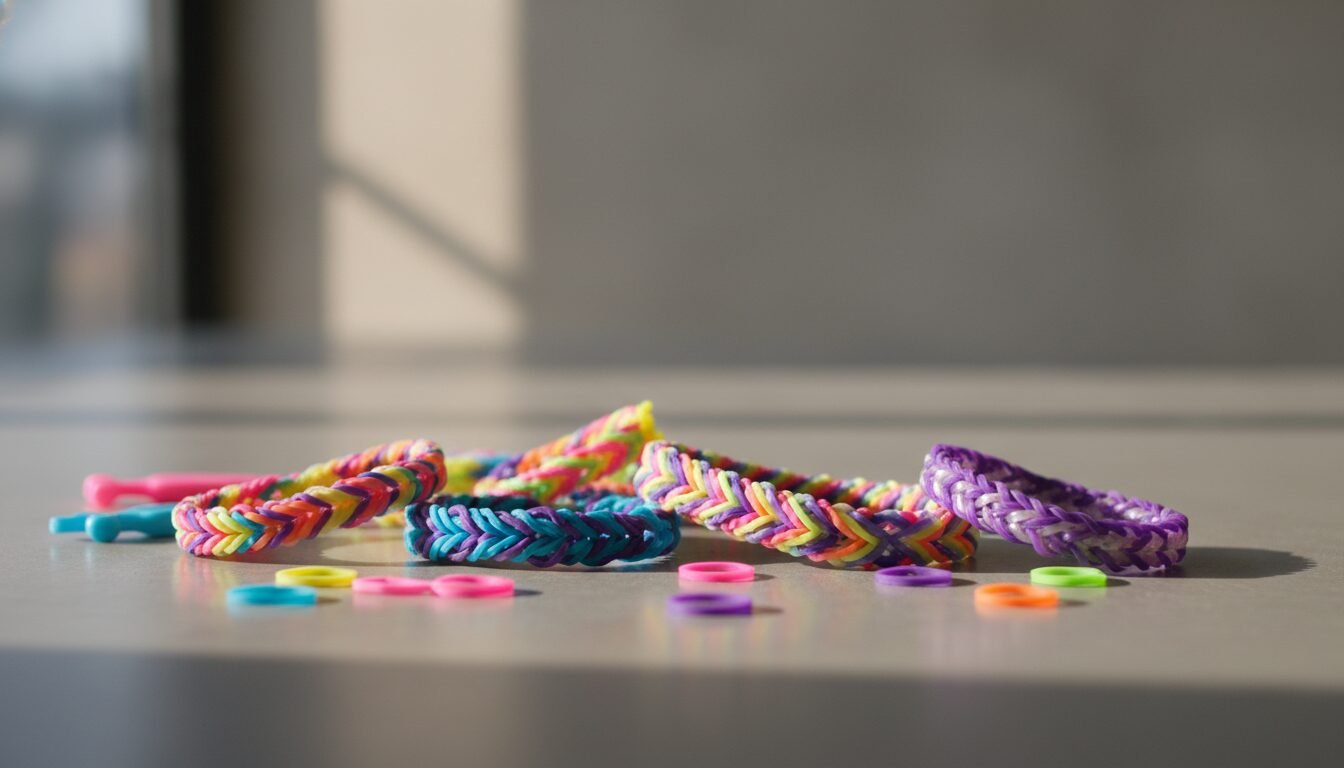
Rubber band bracelets are the kind of craft that sounds simple until you’re three hours deep into a Hexafish pattern with 200 bands spread across your kitchen table. The basics are straightforward: tiny elastic bands, a connecting clip, and a weaving method. The resulting jewelry is lightweight, waterproof, and fully customizable in color, pattern, and size. Whether you follow a YouTube tutorial step by step or freestyle your own design, the process rewards both beginners and seasoned crafters.
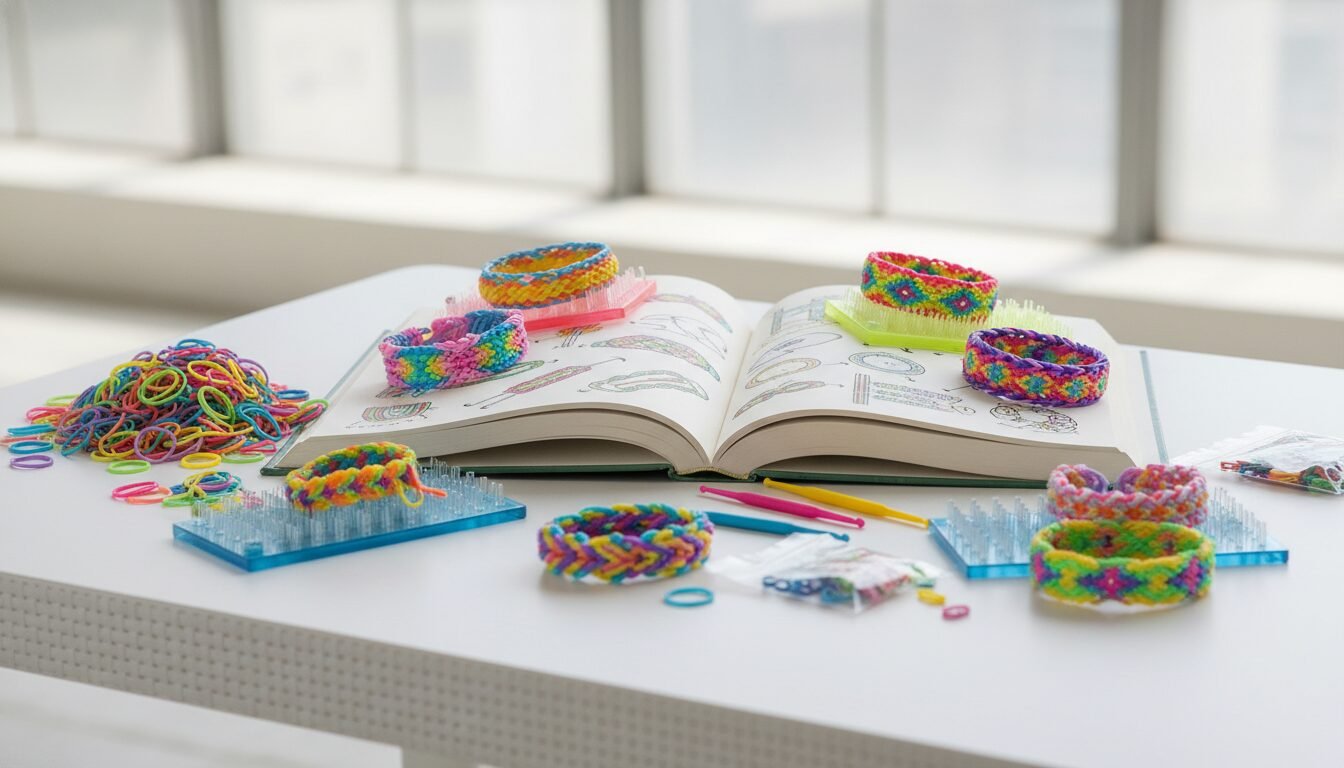
Every rubber band bracelet starts with the same core materials: loom bands (typically 2.5 cm in diameter), S- or C-shaped clips to join the ends, and a weaving tool or just your hands. From there, the possibilities expand fast. A single-chain bracelet uses about 30 bands and takes minutes. An advanced Prism bracelet with 3-bar pins can take an afternoon and hundreds of bands. That range is exactly what makes rubber band bracelets so appealing across age groups.
A Brief History of the Loom Band Craze
The Invention of the Rainbow Loom
Cheong Choon Ng, a Malaysian-born engineer, created the original Rainbow Loom in 2010 after watching his daughters make bracelets with rubber bands at home. The kit was named Toy of the Year in 2014 and has since sold millions of units globally. Today, Rainbow Loom offers dozens of band collections, specialty looms, and 3D figure kits that go well beyond the original bracelet format.
“Rainbow Loom is the original educational rubber band craft that won Toy of the Year award in 2014.” Rainbow Loom official website
From School Yards to Social Media
What began as a playground fad turned into a genuine social media movement. YouTube channels like The Cheese Thief amassed 594,520 playlist views, and single tutorials like the Royal Hearts bracelet collected 4.6 million views. Pinterest boards dedicated to rubber band bracelets now hold over 130 pins per board, showcasing pattern inspiration that ranges from beginner chains to sculptural 3D figures.
Why the Comeback in 2026?
Nostalgia for 2000s and 2010s fashion is real, and hands-on hobbies are having a major cultural moment. According to trend reports from Vogue and Elle, tactile crafts that produce wearable results have surged in popularity as a counterpoint to screen fatigue. New collections like Rainbow Loom’s Loomigurumi kits bunny, frog, parrot blend classic looming with amigurumi techniques, pulling in both kids and adult crafters who want something more sculptural than a flat bracelet.
Materials and Tools for Making Rubber Band Bracelets
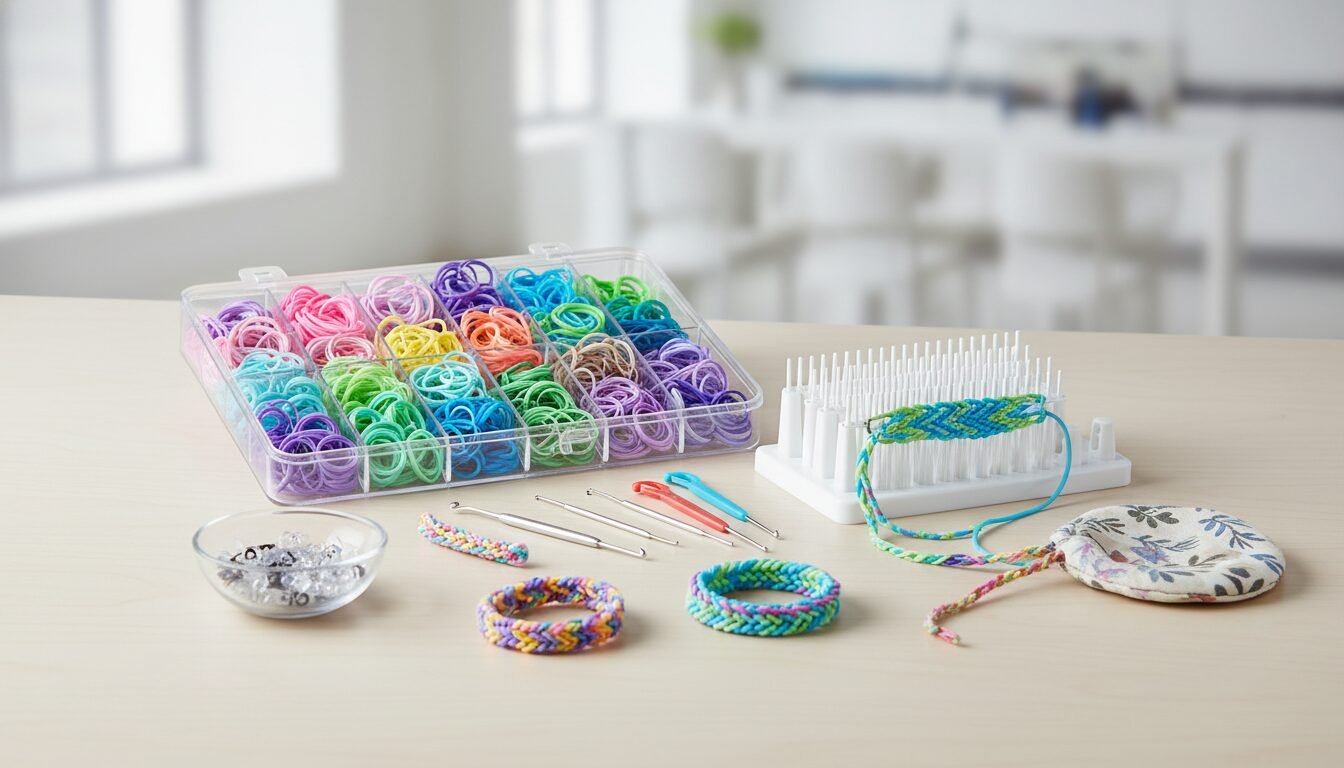
Loom Bands: Types and Quantities
Loom bands are miniature rubber bands, typically 2.5 cm in diameter, sold in kits ranging from 600 bands to over 17,500. The XKDOUS 24 Colors Kit ($7.99) is a solid entry point with 600 bands across two dozen colors. For serious crafters, the obeoby 17,500+ Kit ($24.99) includes a storage container, clips, and a hook enough bands to keep a classroom busy for weeks. Rainbow Loom’s Treasure Trove sits in the middle: 11,000 bands, 150 clips, and a carrying case for $24.99. For large group projects, Cra-Z-Art’s Ultimate Tub offers 8,000 latex-free bands for $11.99.
Looms, Hooks, and Clips
The standard Rainbow Loom board has three rows of pegs, giving you stable anchor points for more complex weaving. Handheld options like the Auto Loom (on sale around $2.99) simplify single-row patterns and travel well. If you prefer to go loom-free, a plastic hook included in most kits or even your fingers are all you need to create rubber band bracelets at home, on a plane, or at a campsite. Almost every rubber band bracelet project uses S- or C-shaped clips to join the ends; most refill packs include at least 100 clips.
Add-ons: Charms, Beads, and More
Kits like the Mighty Rainbow Case include 6 Cute-tique charms and 50 beads, letting crafters personalize rubber band bracelets with texture and dimension. Rainbow Loom sells separate charm packs in themed collections Medieval, Sweets, Glow so you can keep expanding your design options without buying a whole new kit.
Step-by-Step: How to Make Rubber Band Bracelets Without a Loom
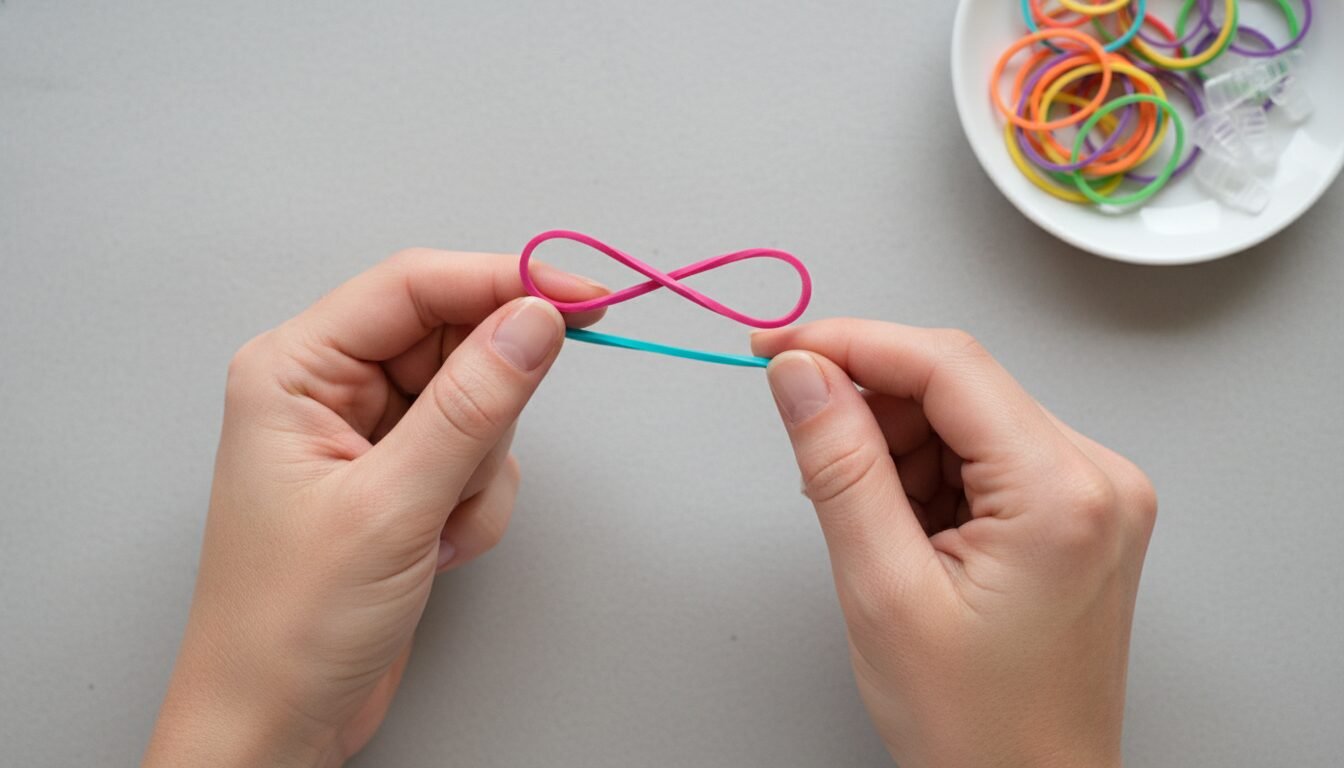
You can create a fishtail bracelet using only your fingers. This method requires no loom and is ideal for beginners. All you need are 40 rubber bands (20 of each color), one C-clip, and your hands.
Step 1: Set Up the First Band
Place a band around your index finger, twist it to form a figure-eight, and loop the other side onto your middle finger. The twist is critical it creates the bracelet’s initial anchor point and keeps the whole thing from unraveling as you build.
Step 2: Add More Bands
Slide a second band (different color) straight onto both fingers above the first band, with no twist. Add a third band of the first color the same way. You now have three bands stacked on your two fingers.
Step 3: Create the Fishtail
Take the bottom band on your index finger and lift it over the top band, dropping it into the center between your fingers. Repeat on the middle finger side. Push the remaining bands down, add a new band on top, and repeat the lifting process. Continue until all bands are used.
Step 4: Finish and Clip
When only two bands remain, perform one last lift so a single loop stays on each finger. Attach the C-clip to both loops, then connect it to the very first twisted band at the other end. Your fishtail rubber band bracelet is complete and ready to wear.
Popular Patterns and Design Ideas
Beginner-Friendly Patterns
- Single Chain: The simplest rubber band bracelet design twist each band into a figure-eight and hook them together in a continuous chain. Uses about 30 bands.
- Fishtail: The classic 2-finger method described above. Requires 40 bands and produces a clean, woven look.
- Triple Fishtail: A wider bracelet made by combining three separate fishtails side by side. A tutorial by The Cheese Thief has collected 1.8 million YouTube views.
Intermediate and Advanced Patterns
- Starburst: A woven star pattern that uses one loom and around 60 bands. Great for learning loom technique.
- Hexafish: A six-strand fishtail that creates a chunky, textured band one of the most requested rubber band bracelet patterns online.
- Prism: An advanced bracelet introduced by Rainbow Loom in 2025 using 3-bar pins and the FAB and FUN kit. One YouTube tutorial collected 57,000 views within six months of release.
Themed and Seasonal Ideas
Rainbow Loom’s Spooky, Sweets, and Persian collections make it easy to create holiday-specific rubber band bracelets for any occasion. Glow-in-the-dark bands are perfect for sleepovers or summer camp. Dual-layer bands let you mix opaque and clear colors for a subtle 3D effect that photographs beautifully.
Loomigurumi: 3D Figures Beyond the Bracelet
One of the most exciting developments in the rubber band bracelet world is Loomigurumi Rainbow Loom’s line of 3D amigurumi-style figures made entirely from loom bands. Current kits include a bunny, frog, and parrot, each requiring several hundred bands and a more advanced looping technique. Stylists and craft educators recommend Loomigurumi as a natural next step for anyone who has mastered flat bracelet patterns and wants a new challenge. The figures also make genuinely charming gifts and keychains.
Choosing the Right Rubber Band Bracelet Kit
With over 8,000 results for “rubber bands for bracelets” on Amazon alone, finding the right kit comes down to three questions: How many bands do you need? What safety certifications matter to you? And how much do you want to spend? The table below compares the most popular options.
| Brand | Product | Band Count | Accessories | Approx. Price (USD) | Age | Safety Features |
|---|---|---|---|---|---|---|
| Rainbow Loom | Treasure Trove | 11,000 | Case, clips, charms | $24.99 | 7+ | Meets ASTM F963; phthalate-, lead-, cadmium-, chromium-, mercury-, arsenic-free |
| Cra-Z-Art | Ultimate Tub | 8,000 | Clips | $11.99 | 8+ | Latex-free |
| XKDOUS | 24 Colors Kit | 600 | Clips, hook | $7.99 | 6+ | Non-toxic, BPA-free |
| obeoby | 17,500+ Kit | 17,500 | Storage container, clips, hook | $24.99 | 6+ | Lab-tested, non-toxic |
| Rainbow Loom | Solid Colors Refill | 110 | None | $3.44 | 7+ | Same as authentic Rainbow Loom standards |
What to Look For
Prioritize kits labeled “phthalate-free” and “latex-free” to avoid skin irritation, especially for younger crafters. Check the age recommendation on the packaging Rainbow Loom products are designed for ages 7 and up due to small clips and the fine motor coordination required. For group activities or classrooms, value packs like the Cra-Z-Loom Ultimate Tub ($14.97) balance quantity and cost without sacrificing safety.
Loom vs. Loom-Free Kits
If you plan to make rubber band bracelets regularly, a sturdy loom is worth the investment. Rainbow Loom’s Original Kit ($11.99) includes everything you need to start. For portability travel, school, or a friend’s house finger-only or hook-only methods are free and require nothing more than a bag of bands in your pocket.
Pros and Cons of Making Rubber Band Bracelets
Pros
- Accessible entry point: Starter kits begin around $4.99, and the finger method costs nothing beyond the bands themselves.
- Genuinely educational: Crafting rubber band bracelets builds fine motor skills, spatial reasoning, pattern recognition, and basic math skills that transfer to real-world problem solving.
- Highly portable: A small bag of bands fits in any pocket or purse, making this a craft you can do anywhere.
- Therapeutic and calming: The repetitive looping motion has a meditative quality that occupational therapists and school counselors actively recommend for anxiety management.
- Endless variety: From a 30-band single chain to a 200-band Hexafish, rubber band bracelets scale with your skill level and ambition.
- Safety-tested options: Brands like Rainbow Loom meet ASTM F963 standards, giving parents confidence in the materials their kids are handling.
Cons
- Small parts risk: Clips and bands are choking hazards for children under 6 always supervise young crafters and store supplies in sealed containers.
- Counterfeit products: Unbranded or deeply discounted bands on marketplace platforms may contain harmful chemicals or break easily mid-project.
- Band loss: Tiny bands scatter easily. A single dropped bag can mean 600 bands across your floor invest in a kit with a storage container.
- Learning curve for advanced patterns: Designs like the Prism or Hexafish require patience and practice. Beginners who jump straight to advanced patterns often get frustrated before they find their rhythm.
Safety and Quality Standards for Looming Supplies
US Toy Safety Certifications
All authentic Rainbow Loom products are tested to meet ASTM F963 US Toy Safety Standards. They are phthalate-free, lead-free, cadmium-free, chromium-free, mercury-free, and arsenic-free. Purchasing from authorized retailers Target, Michaels, Walmart, or the Rainbow Loom webstore directly ensures you receive genuine, safe bands rather than imitations.
“All authentic Rainbow Loom products meet US Toy Safety Standards and are Phthalates-free, Lead-free, Cadmium-free, Chromium-free, Mercury-free, and Arsenic-free!” Rainbow Loom official website
Counterfeit Risks
Imitation bands may contain harmful chemicals or snap mid-project. Stick to known brands and avoid deeply discounted, unbranded packs on marketplace platforms. Counterfeit bands often have an oily smell or leave residue on skin two clear warning signs that the materials haven’t been safety-tested.
Age-Appropriate Use
Most kits specify a minimum age of 7 or 8 years due to small clips and the fine motor coordination required. Always supervise young children, and store bands in sealed containers to prevent accidental ingestion by pets or younger siblings.
The Therapeutic and Educational Benefits of Loom Crafting
Mindfulness and Stress Relief
Repetitive, rhythmic motions like looping bands have a genuinely meditative quality. School counselors and occupational therapists often recommend rubber band bracelets as a calming activity for children and adults alike. The focus required for color selection and pattern repetition helps reduce anxiety and improves concentration a skill that feels especially valuable as of mid-2026, when screen time continues to climb across all age groups.
Educational Value: STEM and Creativity
Following a bracelet tutorial teaches sequencing, spatial reasoning, and practical math counting loops, recognizing repeating patterns, calculating band quantities for a target bracelet length. Rainbow Loom’s Auto Loom and 360 FREEstyle loom encourage engineering thinking by letting users design their own looming setups from scratch. According to fashion industry data and educator feedback, many teachers now integrate loom crafting into geometry and symmetry lessons for students aged 7 to 12.
Fundraising and Social Connection
Since the early 2010s, rubber band bracelets have been a staple of school fundraisers and charity drives. Selling handmade bracelets for $1 to $3 each can raise hundreds of dollars for a cause. Online communities on Pinterest and YouTube connect crafters across age groups and skill levels, turning a solo hobby into something genuinely social.
Where to Buy Rubber Band Bracelets and Supplies
Online Retailers
Amazon stocks over 8,000 results for rubber band bracelet supplies, with bestsellers like the 12,730+ Loom Refill Kit ($15.49) and the 3,000+ Rubber Band Bracelet Kit ($9.99). eBay and Walmart.com offer competitive prices, but always verify authenticity by buying from official brand storefronts when possible.
Physical Stores
Target, Michaels, and Walmart carry Rainbow Loom and Cra-Z-Art products in-store. Walmart’s selection includes the Rainbow Loom Dots Treasure Box (8,000 bands, $14.99) and the Cra-Z-Loom Ultimate kit (ages 8+, $14.97) both solid options for last-minute gift shopping or a spontaneous craft afternoon.
Direct from Brands
Rainbow Loom’s webstore offers exclusive online-only collections (Silk, Limited Edition) and periodic discount codes the RL2 code, for example, takes $2.50 off the Fluff Band Bracelet Kit. Free shipping is available on orders over $35 within the continental US.
Frequently Asked Questions
How many rubber bands does it take to make a bracelet?
A basic fishtail bracelet uses 40 to 50 bands. More complex patterns require 80 to 150 bands the Triple Fishtail needs about 120, while a Starburst uses around 60. Always keep extra bands on hand for color variations or mistakes.
Can you make rubber band bracelets without a loom?
Yes. The fishtail method uses just your index and middle fingers and requires no tools beyond the bands and a C-clip. Other no-loom techniques use a plastic hook or even two pencils. Many of the top-viewed Rainbow Loom tutorials on YouTube demonstrate finger or hook-only methods specifically because they’re so accessible.
What are the safest rubber bands for bracelets?
Look for brands that explicitly state they are phthalate-free, lead-free, and meet ASTM F963 standards. All authentic Rainbow Loom and many Cra-Z-Art bands are made from non-toxic, latex-free silicone the safest option for children and anyone with latex sensitivities.
Why do people wear rubber bands as bracelets?
People wear rubber band bracelets as colorful fashion accessories, friendship tokens, or nostalgic nods to the 2010s craft craze. They’re lightweight, waterproof, and can be made in minutes which makes them easy to give away and fun to collect.
How do I finish a rubber band bracelet securely?
After weaving, pull the final loop through a C-clip or tie a small knot with the last band, then attach the clip to the starting loop. For extra security, double-loop the clip connection. Avoid glue it damages the bands and weakens the join.
Are rubber band bracelets still popular in 2026?
Absolutely. As of summer 2026, social media platforms, new kit releases like Loomigurumi, and the broader wellness-crafting movement have all contributed to a genuine revival. Rainbow Loom continues to release new products including the 360 FREEstyle loom for advanced users signaling that the category has real staying power beyond nostalgia.