Moissanite vs CZ: Which Diamond Alternative Wins in 2026?
Moissanite vs CZ is a comparison between two lab-created diamond alternatives: moissanite, made of silicon carbide, and cubic zirconia, made of zirconium dioxide. Think of it this way: one is built to last a lifetime, the other is made for the moment.
Key Takeaways
- Moissanite ranks 9.25 on the Mohs scale; cubic zirconia ranks 8 to 8.5, making moissanite significantly more scratch-resistant for daily wear.
- Moissanite’s refractive index of 2.65 exceeds even diamond’s 2.42, producing intense rainbow fire that turns heads across a room.
- Cubic zirconia costs a fraction of moissanite’s price and suits fashion jewelry, travel pieces, and occasional wear perfectly.
- For engagement rings and everyday jewelry, moissanite is the clear long-term choice; for trend-driven or temporary pieces, CZ delivers.
- Both stones are lab-created, ethically sourced, and far more affordable than natural diamonds.
Moissanite vs CZ: Quick Answer and Comparison Table

The moissanite vs CZ debate is not about which stone is objectively better in every situation. It is about matching a gemstone to how it will actually be worn. Moissanite is a lab-created silicon carbide gem that closely rivals diamond hardness and exceeds diamond fire. Cubic zirconia is a zirconium dioxide simulant that delivers a convincing diamond look for a fraction of the cost. The table below summarizes the core differences at a glance.
| Criteria | Moissanite | Cubic Zirconia (CZ) |
|---|---|---|
| Composition | Silicon carbide (SiC) | Zirconium dioxide (ZrO₂) |
| Mohs hardness | 9.25 | 8–8.5 |
| Refractive index | 2.65 | Lower than moissanite |
| Sparkle/fire | Intense rainbow fire, doubly refractive | Softer brilliance, singly refractive, higher dispersion than diamond |
| Density/weight | Lighter per carat | Denser, heavier for same size |
| Price | More expensive, but far below diamond | Very inexpensive, often a few dollars per carat |
| Best for | Engagement rings, everyday wear | Fashion, costume, temporary jewelry |
According to Brilliant Earth, moissanite ranks 9.25 on the Mohs scale while cubic zirconia ranks 8 to 8.5. Those numbers matter more than they look on paper, and the sections below explain exactly why.
What Is Moissanite?
Moissanite is a gemstone made of silicon carbide, and its origin story is genuinely extraordinary. Natural moissanite was first discovered in 1893 by French scientist Henri Moissan inside a meteor crater in Arizona, according to CaratBee. He initially mistook the crystals for diamonds. Almost all moissanite sold today is lab-grown, which guarantees consistent quality and ethical sourcing – two things that matter deeply to the modern buyer.
Composition and Origin
Moissanite’s chemical composition is silicon carbide (SiC). Because natural moissanite is so scarce, laboratory growth is the only practical source for jewelry. Lab-created moissanite is not a simulated diamond in the same way CZ is. It is a distinct gem material with its own optical and physical identity, which is exactly what makes the moissanite vs CZ conversation so interesting.
Brilliance and Fire
Moissanite is famous for intense fire: those colorful rainbow flashes a gemstone emits when white light splits into spectral colors. Moissanite’s refractive index reaches 2.65, according to Charles & Colvard, which is higher than diamond’s 2.42. Combined with double refraction, this creates vivid rainbow sparkle visible from across a room. It is genuinely show-stopping.
“Moissanite’s brilliance surpasses that of cubic zirconia and diamonds. Its refractive index reaches 2.65, higher than a diamond’s 2.42. This creates an eye-catching sparkle in any light.” – Charles & Colvard
Durability and Hardness
The Mohs scale ranks mineral hardness from 1 to 10. Moissanite sits at 9.25, making it highly scratch-resistant and perfectly suited for everyday wear. It is second only to diamond among popular gemstones. A moissanite ring will not easily dull or scratch from daily activities like hand washing, typing, or the general chaos of a full life.
Pros and Cons of Moissanite
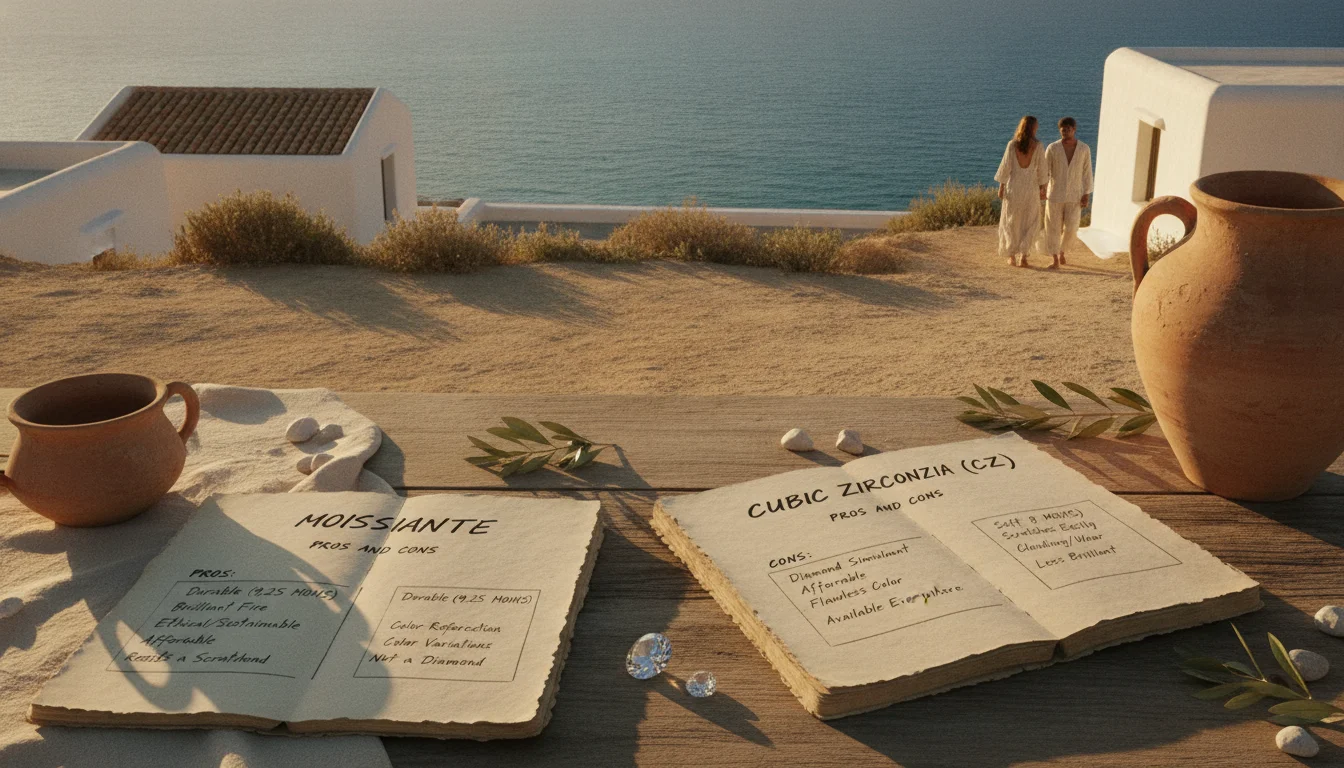
Pros
- Exceptional hardness at 9.25 Mohs resists scratching and surface wear.
- High refractive index of 2.65 creates intense sparkle and rainbow fire.
- Lab-grown and ethically sourced with consistent, guaranteed quality.
- Long-term value as a diamond alternative that lasts decades.
- Accessible luxury pricing, far below natural diamond costs.
Cons
- Higher price than cubic zirconia, though still far below diamond.
- Intense rainbow fire can look different from a diamond under certain lighting conditions.
- Double refraction creates a slight doubling effect that some diamond purists notice on close inspection.
What Is Cubic Zirconia (CZ)?

Cubic zirconia is a synthetic gemstone made of zirconium dioxide, and it is often misunderstood as merely cheap glass. It is not. According to CaratBee, scientists first created CZ in the 1970s as an affordable diamond alternative, and it remains one of the most budget-friendly diamond simulants on the market today. For fashion jewelry and travel pieces, it has a very legitimate place in any jewelry collection.
Composition and Origin
Cubic zirconia’s chemical structure is zirconium dioxide (ZrO₂) grown in a cubic crystal system. Unlike moissanite, which has a natural counterpart found in meteorites, CZ is entirely synthetic. Manufacturers can produce CZ in almost any color, though colorless CZ remains the most popular choice for jewelry that mimics the diamond look.
Brilliance and Fire
Cubic zirconia has a lower refractive index than moissanite, so its brilliance is softer and more subdued. According to Brilliant Earth, CZ produces a brilliance that is almost as lustrous as a diamond’s, with higher dispersion. Because CZ is singly refractive, it does not split light the way moissanite does. Over time, surface scratches and clouding can reduce its sparkle noticeably.
Durability and Hardness
Cubic zirconia ranks 8 to 8.5 on the Mohs scale. This means it is softer than moissanite and more prone to surface wear with regular use. A CZ stone in a ring worn daily will gradually develop scratches and lose its polish, which is why stylists recommend it for occasional or costume jewelry rather than engagement rings meant to last a lifetime.
Pros and Cons of Cubic Zirconia
Pros
- Ultra-affordable, often costing a fraction of moissanite’s price per carat.
- Convincing diamond look at first glance, especially in well-lit settings.
- Available in many colors and sizes for maximum styling flexibility.
- Perfect for costume, travel, or temporary jewelry where loss or damage is a real concern.
Cons
- Softer and scratch-prone, ranking only 8 to 8.5 on the Mohs scale.
- Can cloud or dull over time with regular wear.
- Less fire and brilliance than moissanite due to lower refractive index.
- No long-term value, largely considered a disposable or replaceable jewelry option.
Moissanite vs CZ: Key Differences in Detail
Hardness and Scratch Resistance
Hardness is the first filter to apply in any moissanite vs CZ decision. Moissanite at 9.25 is far more resistant to scratching than CZ at 8 to 8.5. A difference of less than one point on the Mohs scale may look minor on paper, but the scale is not linear. The practical difference in daily durability is substantial. A moissanite engagement ring can withstand decades of hand washing, typing, and occasional bumps. A CZ ring will show visible wear much sooner.
Brilliance, Fire, and Visual Appearance
Moissanite is doubly refractive, meaning it splits incoming light into two rays and creates a lively sparkle with distinct rainbow flashes. Cubic zirconia is singly refractive, keeping light in one ray and producing a more subdued shine. In the moissanite vs CZ comparison, moissanite delivers more fire. That said, some buyers specifically prefer CZ because its white brilliance reads slightly closer to a diamond’s look under certain indoor lighting.
“CZ has lower brilliance but higher fire than diamond. Moissanite has both higher brilliance and fire.” – William Woodward, Gemological Institute of America graduate, via Quora
Price and Long-Term Value
Price is where CZ dominates without question. CZ is among the least expensive diamond simulants available, often costing only a few dollars per carat. Moissanite costs more because of its durability, brilliance, and more complex lab production process. However, moissanite holds its quality over time and does not need frequent replacement. For a ring meant to last a lifetime, the higher upfront cost of moissanite is usually the smarter investment.
Weight and Density
Cubic zirconia is denser than moissanite. A CZ stone of the same millimeter size will feel noticeably heavier than a moissanite. According to Brilliant Earth, this density difference can actually help identify stones: a heavier stone of the same size is more likely CZ. It is a surprisingly useful real-world test.
Moissanite vs CZ vs Diamond: How They Compare
Moissanite, CZ, and diamond each occupy a distinct position in the gemstone world, and understanding all three helps clarify the moissanite vs CZ choice. Diamond is pure carbon, rated a perfect 10 on the Mohs scale, and carries a refractive index of 2.42. Moissanite sits just below diamond in hardness at 9.25 but actually exceeds diamond’s refractive index at 2.65, producing more fire. CZ falls further behind at 8 to 8.5 Mohs and a lower refractive index than both. For buyers who want diamond-level durability without the diamond price tag, moissanite closes that gap far more effectively than CZ does. Lab-grown diamonds are a fourth option worth considering if budget allows, offering identical chemical composition to natural diamonds.
How to Tell Moissanite from CZ: Step-by-Step
If you already own a stone and want to know whether it is moissanite or cubic zirconia, these steps will help you narrow it down quickly.
- Check the sparkle under bright light. Moissanite shows strong rainbow fire with a slight doubling of facet edges. CZ shows more white light and less rainbow dispersion.
- Test the weight. Hold two stones of the same size. The CZ will feel heavier because it is denser.
- Examine the surface over time. Moissanite resists scratches; CZ develops fine scratches and dulling with regular wear.
- Use a diamond tester. Moissanite and diamond conduct heat similarly, while CZ does not. A thermal conductivity tester separates CZ from moissanite reliably.
- Consult a jeweler. Professional gemologists use a refractometer to measure refractive index and a loupe to inspect double refraction, giving a definitive answer.
Moissanite vs CZ: When to Choose Each
The moissanite vs CZ decision depends heavily on how and where you plan to wear the piece. Use these scenarios to match the stone to your actual lifestyle.
For Engagement Rings and Bridal Jewelry
Choose moissanite. Engagement rings are worn daily and need to withstand years of real life. Moissanite’s 9.25 Mohs hardness means it retains its polish and sparkle through everything. CZ in an engagement ring will begin to scratch and cloud within months of daily wear, making it a poor choice for a piece meant to symbolize a lifetime.
For Fashion and Occasional Jewelry
Choose cubic zirconia. If you want a trendy piece for a vacation, a party, or a short-term style moment, CZ delivers the diamond look for very little money. You can buy multiple CZ pieces for the price of one moissanite, which is ideal for rotating fashion accessories or travel jewelry you would not want to risk losing.
For Budget-Conscious Buyers
If your absolute top priority is the lowest possible upfront price, CZ wins. However, if you plan to wear the piece more than occasionally, moissanite offers better value over time because it does not need replacing. In the moissanite vs CZ calculation, ultra-low upfront cost can quietly hide long-term replacement costs.
For Everyday Wear vs Occasional Wear
For rings, earrings, or pendants worn every single day, moissanite is the clear winner. For pieces that live in a jewelry box most of the year and come out for special occasions, CZ is perfectly adequate and far more economical.
Final Verdict: Moissanite vs CZ
Moissanite is the superior choice for fine jewelry worn regularly. Its hardness, refractive index, and long-term quality make it the closest practical alternative to diamond for engagement rings and daily wear pieces. Cubic zirconia has a completely legitimate place as a low-cost fashion option, but it cannot match moissanite’s durability or fire. If you can stretch your budget, choose moissanite. If you need a temporary sparkler or a travel ring you can replace without heartbreak, choose CZ. Both stones have a role to play. The key is knowing which role fits your life right now.
As of July 2026, the moissanite vs CZ category continues to grow as more buyers seek ethical, affordable alternatives to mined diamonds. Explore the full jewelry collection at lexazi.com and find the piece that fits your style. Free shipping on orders over $75.
Frequently Asked Questions
Is CZ better than moissanite?
CZ is better only when price is the absolute priority and the piece will be worn occasionally. Moissanite is the stronger choice for durability, brilliance, and long-term value. For anything worn daily, moissanite wins without question.
Does moissanite or CZ look more real?
Moissanite generally looks more like a diamond in terms of brilliance and fire, though its rainbow sparkle is more intense than a diamond’s. CZ can look convincingly diamond-like at first glance but dulls over time, making it less convincing with regular wear.
Do CZ stones sparkle like moissanite?
No. CZ has a lower refractive index and is singly refractive, so its sparkle is softer and whiter. Moissanite produces vivid rainbow flashes thanks to its higher fire and double refraction, creating a noticeably more dramatic effect.
How can you tell moissanite from CZ?
Look for rainbow fire and a slight doubling of facet edges in moissanite. CZ is denser and heavier for the same size, and it scratches more easily over time. A professional jeweler can confirm the difference using a refractometer or thermal conductivity tester.
Is moissanite a diamond simulant?
Moissanite is a distinct gemstone made of silicon carbide, not a diamond imitation. Cubic zirconia is engineered specifically to mimic diamond’s appearance. The distinction matters: moissanite has its own optical identity, while CZ is designed to disappear into the diamond look.
Which is more affordable, moissanite or CZ?
Cubic zirconia is significantly more affordable, often costing just a few dollars per carat. Moissanite costs more due to its complex lab production and superior durability, but it remains far less expensive than a natural or lab-grown diamond of comparable size.