Key Takeaways
- The most common translation of bracelet in Spanish is la pulsera, used across all Spanish-speaking regions.
- El brazalete is a more formal or rigid alternative, often preferred in Mexico and certain Caribbean islands.
- Regional slang and specific styles introduce terms like esclava (a flat, engraved bracelet) and tobillera (ankle bracelet).
- Pronunciation follows consistent rules: pul-SEH-rah for pulsera, brah-sah-LEH-teh for brazalete.
- Knowing these words enriches travel, fashion shopping, and cross-cultural connection in Spanish-speaking destinations.
Bracelet in Spanish is most commonly la pulsera, a feminine noun used from Mexico City to Madrid. Slip one onto your wrist in a Tulum market or a Barcelona boutique and you’ll hear this word everywhere.
The Direct Translation: How to Say Bracelet in Spanish
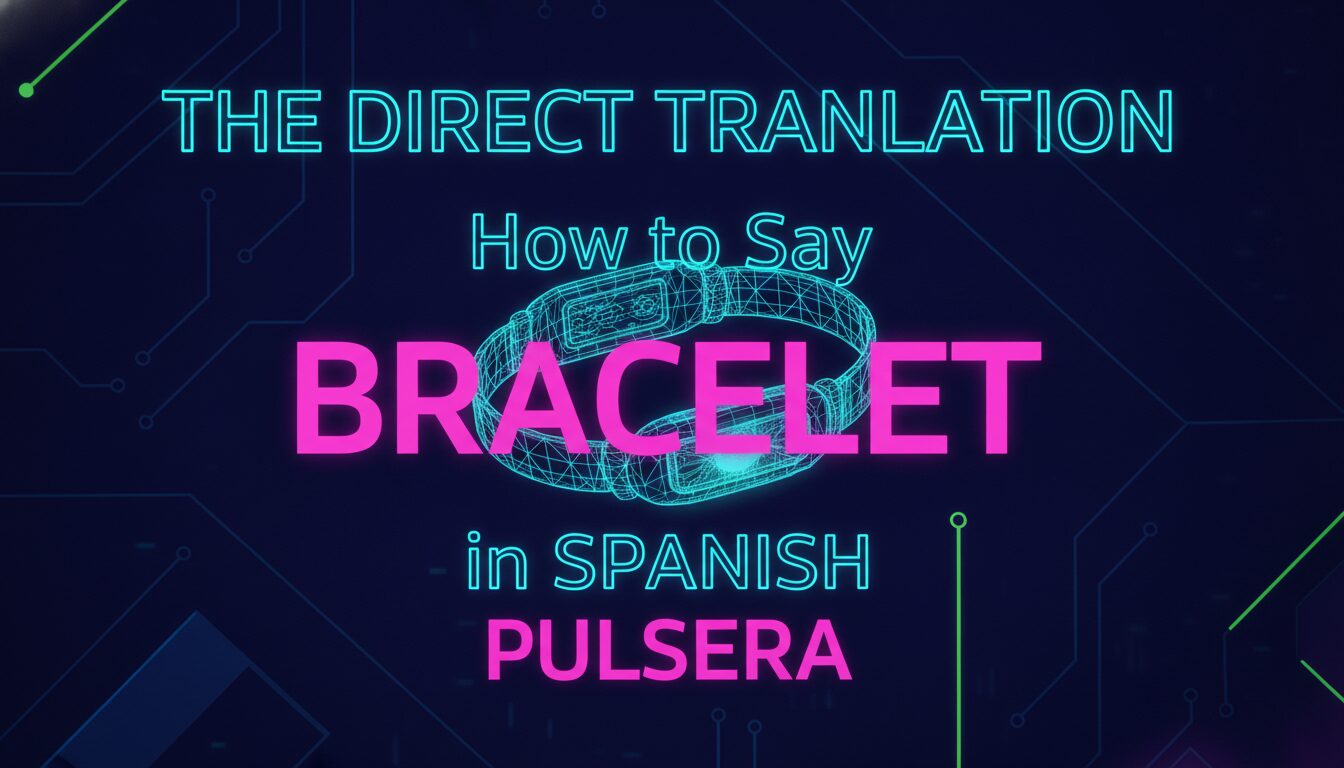
Pulsera: The Most Common Term
When you search for in spanish in any dictionary, la pulsera (pronounced pool-SEH-rah) is almost always the first result. It is the standard, everyday word used from Mexico to Argentina and Spain to Equatorial Guinea. According to SpanishDict’s example database, “pulsera” appears in over 5,972 real-world sentences, confirming its everyday prevalence across the Spanish-speaking world. It works for virtually any wrist ornament: a delicate chain, a beaded strand, a leather wrap, or even a medical alert band. Because it is feminine, you pair it with articles and adjectives like la, una, esta: Lleva una pulsera preciosa en la muñeca (She’s wearing a beautiful bracelet on her wrist).
Brazalete: A Formal Alternative
El brazalete (brah-sah-LEH-teh) is the secondary option you’ll encounter when translating this type of spanish. It tends to describe a more rigid, often metallic band, like a bangle or a cuff. SpanishDict’s corpus shows 2,327 examples for “brazalete,” suggesting it is less common but still important. In jewelry descriptions, you might see brazalete de oro (gold bracelet) or brazalete de diamantes (diamond bracelet) to emphasize a formal or substantial piece. The language app Drops even lists “el brazalete” as the default for Mexican Spanish, though in practice native speakers often use both terms interchangeably.
Other Regional Terms You Might Hear
Beyond the two main words, the world of this kind of spanish includes several geographically specific terms. In the Dominican Republic and Puerto Rico, esclava (literally “slave”) refers to a flat, often engraved metal bracelet that clasps tightly around the wrist. Meanwhile, ajorca appears in some South American countries for a thick bangle, and manilla in Central America can denote a simple wristband. According to WordReference, these regional variants are all recognized translations of bracelet in, each carrying its own cultural weight.
Regional Variations Across the Spanish-Speaking World
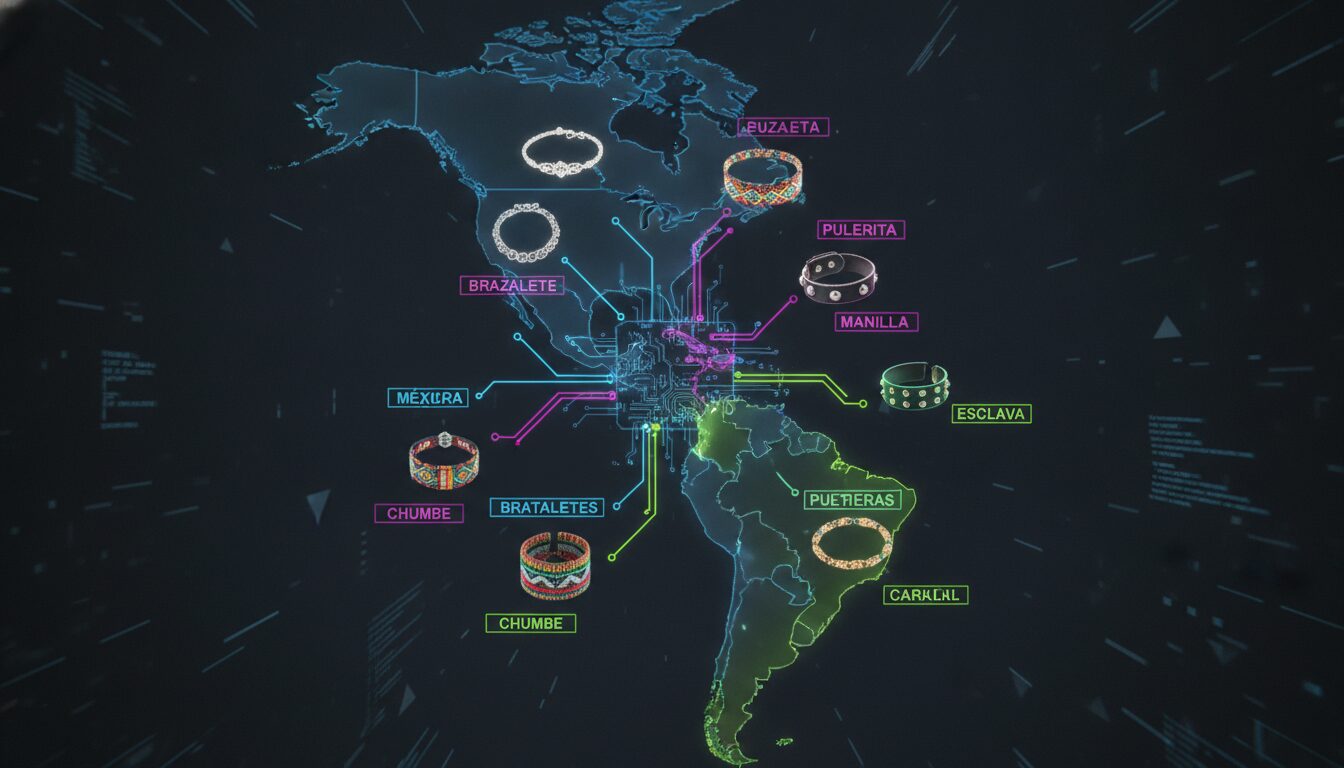
Mexico: La Pulsera vs. El Brazalete
Mexicans widely understand both pulsera and brazalete, but usage can depend on context. In northern states like Chihuahua, a brazalete might suggest a heavier, silver piece, while in resort areas like Cancún, tourist shops label everything as pulseras. Memrise teaches “la pulsera” as the phrase for “the bracelet” in its Mexican Spanish course, while Drops opts for “el brazalete.” This split highlights that you can safely use either term throughout the country. For men’s pieces, brazalete de hombre is particularly common in Mexican jewelry stores, aligning with the more masculine feel of brazalete.
Spain: Castilian Spanish Preferences
In Spain, in spanish most often resolves to la pulsera, used in both casual and formal settings. The Real Academia Española gives pulsera as the primary translation, while brazalete is noted as a larger or ceremonial armband. In fashion contexts, Spanish jewelry brands consistently label their wrist pieces as pulseras, regardless of material. If you’re shopping in Barcelona or Madrid, asking ¿Dónde están las pulseras? will get you exactly where you need to go.
Caribbean Flavors: Dominican Republic, Puerto Rico, and Cuba
The Caribbean adds vibrant color to the this type of spanish lexicon. In Puerto Rico, esclava is a beloved term for a personalized nameplate bracelet, often given as a gift at christenings or birthdays. The same word surfaces in the Dominican Republic, where esclavas de oro (gold slave bracelets) are a staple of traditional jewelry. In Cuba, you might hear tobillera for an ankle bracelet. According to WordReference, tobillera is the direct translation for “ankle bracelet” across most Spanish dialects, though pulsera de tobillo can also appear.
Types of Bracelets and Their Spanish Names
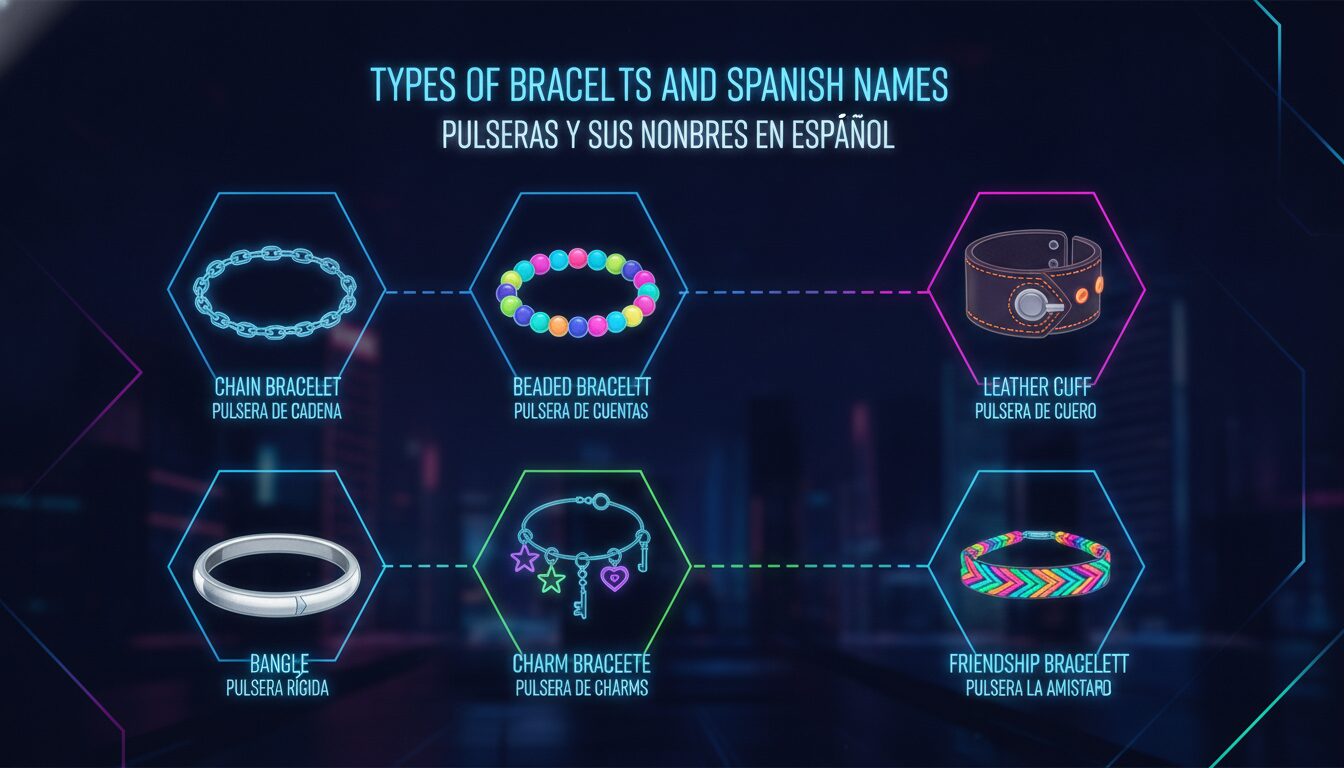
Charm Bracelet: Pulsera de Dijes
A charm bracelet translates neatly to pulsera de dijes in Spanish. Dije means charm or pendant, so a pulsera de dijes is literally a bracelet of charms. WordReference confirms this as the standard compound form. In some regions, you might also hear brazalete de colgantes, but pulsera de dijes is widely recognized. When shopping in a Spanish-speaking country, ask ¿Tienen pulseras de dijes? to see available styles.
Ankle Bracelet: Tobillera
The term for ankle this kind of spanish is tobillera, derived from tobillo (ankle). WordReference includes this translation and notes that it is used across Spain and Latin America. In many Caribbean nations, esclava might also refer to an ankle bracelet, especially if it’s a rigid, hinged design. Use tobillera for clarity, particularly in medical contexts where the word can also mean ankle brace.
Bangle Bracelet: Pulsera Rígida or Brazalete
A bangle is a slip-on, solid bracelet with no clasp. In Spanish, it is often called pulsera rígida (rigid bracelet) or brazalete rígido. The word ajorca is also used in Andalusian Spanish and some Colombian regions to denote a thick bangle. In Mexico, brazalete alone often suffices. For example, Llevaba una pulsera rígida de plata clearly describes a silver bangle.
| English Term | Spanish Translation | Region/Usage Note |
|---|---|---|
| Bracelet (general) | la pulsera | Universal; feminine noun |
| Bracelet (formal/rigid) | el brazalete | More common in Mexico; masculine |
| Charm bracelet | pulsera de dijes | Widely understood |
| Ankle bracelet | la tobillera | Standard; also means ankle brace |
| Bangle | la pulsera rígida / el brazalete rígido / la ajorca | Ajorca in Andalusia, Colombia |
| Nameplate bracelet | la esclava | Caribbean; often flat and engraved |
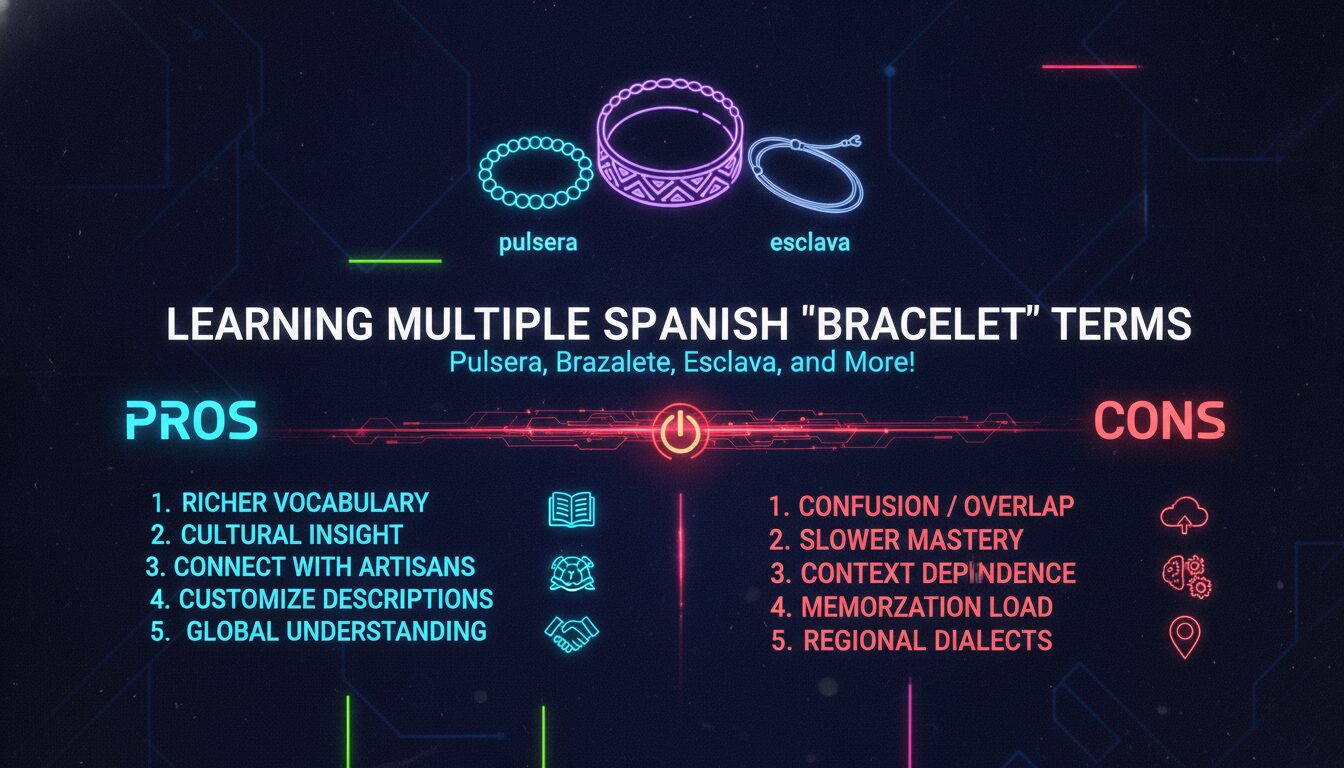
Pros and Cons of Learning Multiple Spanish Bracelet Terms
Pros
- You can shop confidently in markets from Tulum to Marbella, using the right word for each region.
- Knowing terms like esclava and ajorca opens doors to authentic, artisanal pieces that tourists often miss.
- Using local vocabulary builds genuine rapport with vendors and artisans, sometimes leading to better prices.
- Medical and identification bracelet vocabulary (pulsera médica) can be genuinely life-saving when traveling.
Cons
- Regional variation can be confusing: a word that works in Puerto Rico may draw a blank stare in rural Spain.
- Some terms like esclava carry historical weight that requires cultural sensitivity in conversation.
- Slang terms like pulsi or manilla are informal and may not be appropriate in all settings.
Pronunciation Guide: How to Say Bracelet in Spanish Like a Native
Phonetic Breakdown: pul-SEH-rah
Mastering the pronunciation of bracelet in starts with the vowel-rich sound of pulsera. Break it into three syllables: pul (like “pool,” but with a shorter, relaxed “u”), se (like “seh,” with an open “e” as in “red”), and ra (a crisp, lightly rolled “r” followed by “ah”). The stress naturally falls on the second-to-last syllable, SEH, as with most Spanish words ending in a vowel. Noun Town confirms that “la pulsera” is spoken with stress falling naturally on the penultimate syllable, which aligns with standard Spanish phonetics. For brazalete, the emphasis lands on the third syllable: brah-sah-LEH-teh.
Stress and Accents
Neither pulsera nor brazalete carries a written accent mark because their stress patterns follow default rules. In Spanish, words ending in a vowel, “n,” or “s” are stressed on the penultimate syllable. Pulsera matches this rule perfectly. Brazalete ends in a vowel, so the stress naturally goes to the penultimate “le,” making it brah-sah-LEH-teh. Getting the stress right is crucial for being understood clearly.
Audio Resources and Practice Tips
To perfect your bracelet in Spanish pronunciation, use online tools. Forvo.com offers native speaker audio clips for both pulsera and brazalete from multiple regions. SpanishDict includes video pronunciations and a slow-play option. A practical step-by-step method:
- Listen to the audio recording three times without repeating, focusing on the rhythm.
- Repeat the word slowly, syllable by syllable, exaggerating the vowels.
- Practice the word in a full sentence, like Quiero comprar una pulsera (I want to buy a bracelet).
- Record yourself and compare to the native audio; adjust your mouth shape accordingly.
- Use the word in conversation with native speakers or language exchange apps like Tandem.
“Mastering the local terminology for accessories like bracelets not only enriches your travel experience but also shows respect for the culture. A simple pulsera can spark a conversation that leads to discovering artisanal markets and unique Mediterranean-inspired designs.” – LEXAZI Style Guide
“In Spanish-speaking countries, jewelry vocabulary is deeply tied to regional identity. Knowing whether to say pulsera or brazalete signals cultural awareness that locals genuinely appreciate.” – WordReference Community, language forum discussions on bracelet terminology
Cultural Context: The Role of Bracelets in Spanish-Speaking Countries
Mediterranean and Latin American Jewelry Traditions
Bracelets hold deep cultural significance across the Spanish-speaking world. In Spain, pulseras de plata (silver bracelets) are often associated with flamenco dancers who stack multiple bangles for percussive effect. In Mexico, the Taxco silver tradition has produced iconic brazaletes worn by both men and women, often featuring pre-Columbian motifs. Meanwhile, in Colombia, filigree gold bracelets from Mompox reflect a colonial-era craft legacy. Understanding bracelet in Spanish is the first step toward appreciating these regional art forms. For resort wear enthusiasts, these pieces pair beautifully with linen and silk ensembles.
From Spanish Flamenco to Mexican Silver
The Spanish flamenco tradition elevates rhythm through accessories: dancers adorn their wrists with pulseras de lunares (polka-dotted bracelets) or layered ajorcas. These are not just decorative. They are instruments. In Mexico, the state of Guerrero’s Taxco de Alarcón is world-renowned for silverwork. A Taxco brazalete is often a cuff-like piece with intricate etching, and knowing the word helps you negotiate directly with artisans. Travelers searching for bracelet in Spanish Mexico frequently discover this silver capital, where workshops reveal the entire crafting process from raw ore to finished cuff.
Fashion and Resort Wear: Accessorizing in Style
For a Mediterranean-inspired wardrobe, the bracelet in Spanish vocabulary dovetails perfectly with resort dressing. A crocheted pulsera from Ibiza, a coral brazalete from Cartagena, or a leather esclava from Santo Domingo pairs effortlessly with airy cotton caftans and linen trousers. When browsing local markets, using the correct term, ¿Cuánto cuesta esta pulsera tejida? (How much is this woven bracelet?), can lead to friendlier interactions and sometimes better prices. Merchants appreciate the linguistic effort, and you walk away with a story behind each piece.
Travel Tips: Shopping for Bracelets Using Spanish Vocabulary
Essential Phrases for Jewelry Shopping
Equip yourself with a few key sentences that incorporate bracelet in Spanish. Here’s a quick cheat sheet:
- Estoy buscando una pulsera. – I’m looking for a bracelet.
- ¿Tienen pulseras de plata? – Do you have silver bracelets?
- ¿Puedo ver ese brazalete, por favor? – Can I see that bracelet, please?
- ¿Qué talla es esta pulsera? – What size is this bracelet?
- ¿Es ajustable? – Is it adjustable?
- Me lo llevo. – I’ll take it.
These phrases work in markets and boutiques from Tulum to Marbella, giving you the confidence to explore local craftsmanship on your own terms.
Asking About Materials: Gold, Silver, and More
Material vocabulary is essential when combining bracelet in Spanish with fashion purchases. Oro (gold), plata (silver), cuero (leather), tela (fabric), and abalorios (beads) are the basics. For luxury seekers, diamantes (diamonds) and piedras preciosas (gemstones) appear in high-end brazaletes. A common query is ¿Es de oro auténtico? (Is it real gold?), followed by asking for a hallmark: ¿Tiene sello? (Does it have a stamp?). In many Latin American countries, artisanal silver is marked “925” or “Sterling,” recognizable internationally.
Negotiating Prices and Understanding Sizes
When you find the perfect pulsera, you might want to negotiate, especially in open-air markets. Use polite phrases like ¿Me puede hacer un descuento? (Can you give me a discount?) or ¿Cuál es el mejor precio? (What’s your best price?). Sizing matters too: bracelets are measured in centimeters, and you can ask ¿Puede medir mi muñeca? (Can you measure my wrist?). If the bracelet is too tight, say Está muy apretada; too loose, Está muy suelta. For adjustable styles, ajustable is the word to remember.
Medical and Identification Bracelets in Spanish
Pulsera de Identificación Médica
A medical alert bracelet translates to pulsera de identificación médica or simply pulsera médica. In hospital settings, bracelet in Spanish often refers to the identification band every patient receives: pulsera de identificación or brazalete hospitalario. SpanishDict’s corpus includes the example Considere comprar una pulsera con su información médica en ella (Consider buying a bracelet with your medical information on it), confirming that such terms are in active everyday use. If you have allergies or chronic conditions, wearing a pulsera médica while traveling in Spanish-speaking countries can be genuinely important. Make sure the text appears in both English and Spanish.
Traveling with Medical Bracelets
For globetrotters, knowing bracelet in Spanish extends to emergency preparedness. When checking into a foreign hospital, you may be asked ¿Lleva alguna pulsera médica? (Do you wear any medical bracelet?). Respond with Sí, llevo una pulsera médica and point to it. Some resorts and cruise lines provide waterproof pulseras de identificación for guests, often called pulseras de todo incluido (all-inclusive bracelets). These are typically plastic and different from jewelry, but the base word remains the same.
Bracelet in Spanish Slang and Everyday Expressions
Esclava: The Nameplate Bracelet
The word esclava is a fascinating entry in the bracelet in Spanish dictionary. Literally meaning “slave” (feminine), it refers to a rigid, often nameplate-style bracelet that became popular in the mid-20th century. It is not considered offensive in context. Rather, it’s a term of endearment for a gift that symbolizes eternal love or friendship. In Puerto Rico and the Dominican Republic, a gold esclava is a classic christening or birthday present. When shopping, you might hear Quiero una esclava con mi nombre (I want a nameplate bracelet with my name).
Colloquial Terms and Nicknames
Beyond esclava, other colloquialisms pop up regionally. In Central America, pulserita (little bracelet) is an affectionate diminutive for a thin, dainty bracelet, often made of thread or beads. Among younger speakers in Spain, pulsi has emerged as casual slang for pulsera, especially in the context of festival wristbands. In some South American countries, manilla is used for any wristlet, even a watch strap. Recognizing these informal terms helps you connect with locals on a more personal level.
Other Useful Terms and Phrases Related to Bracelets
Adjectives to Describe Bracelets
When describing a bracelet in Spanish, a few adjectives go a long way. Delgada (thin), gruesa (thick), elegante (elegant), artesanal (handmade), and brillante (shiny) are all commonly used. For example, Una pulsera artesanal de cuero (a handmade leather bracelet) is perfect for a boho-chic resort look. Ajustable (adjustable) is another key term, especially when buying gifts for friends back home.
Verbs Associated with Wearing and Gifting Bracelets
Expand your bracelet in Spanish fluency with verbs. Llevar (to wear) is the most frequent, as in Llevo una pulsera de plata (I wear a silver bracelet). Ponerse (to put on) and quitarse (to take off) are practical for daily routines: Me pongo la pulsera todas las mañanas (I put on my bracelet every morning). For gifting, use regalar: Le regalé un brazalete a mi madre (I gifted my mother a bracelet). These constructions appear in phrasebooks like Memrise’s and demonstrate natural, everyday usage.
Bracelet-Related Idioms and Sayings
While not numerous, a few idioms incorporate bracelet vocabulary. No todo lo que brilla es oro (Not everything that glitters is gold) is often referenced when admiring a cheap pulsera that looks expensive. In some Caribbean cultures, estar como una esclava can mean “to be tightly secured,” drawn from the snug fit of an esclava bracelet. These expressions add color to your language skills and deeper cultural insight.
Final Tips and Resources for Mastering Bracelet in Spanish
Online Dictionaries and Language Apps
To solidify your grasp of bracelet in Spanish, bookmark trusted resources. SpanishDict offers translations, audio, and regional breakdowns. WordReference lists compound forms like charm bracelet and ankle bracelet, along with a forum for nuance questions. Noun Town provides a game-based approach, while Drops and Memrise reinforce vocabulary through images and spaced repetition. Using a mix of these tools will help you select the right term for any context.
Practice with Native Speakers
Language exchange platforms like Tandem or HelloTalk let you chat with native Spanish speakers who can correct your usage in real time. Simply ask, “¿Cómo se dice ‘bracelet’ en tu país?” and you’ll often get nuanced answers that no textbook provides. Following Spanish-speaking fashion influencers on Instagram also exposes you to how real people talk about pulseras and brazaletes in daily life, from resort markets in Ibiza to jewelry stalls in Oaxaca.
One Word, Many Worlds
Learning bracelet in Spanish opens a window into the diverse cultures of more than 20 countries. Whether you choose pulsera, brazalete, or esclava, each term carries a story. As you plan your Mediterranean resort wardrobe or your next Latin American adventure, let these words guide you to authentic accessories and meaningful interactions. The right pulsera is more than an ornament. It’s a souvenir of language and place.
Ready to find your next statement piece? Shop the collection at lexazi.com – free shipping on orders over $75.
Frequently Asked Questions
How do Mexicans say bracelet?
Mexicans commonly say pulsera or brazalete. Both are understood throughout the country, with pulsera being more frequent in everyday speech and brazalete used for heavier, more formal pieces. Memrise teaches la pulsera in its Mexican Spanish course, while Drops defaults to el brazalete.
What is bracelet slang in Spanish?
In slang, esclava is used for a flat, often name-engraved bracelet, especially in the Caribbean. Affectionate diminutives like pulserita or the casual pulsi also appear among younger speakers in Spain and Latin America.
How do you say bangle bracelet in Spanish?
A bangle bracelet is typically pulsera rígida or brazalete rígido. In Andalusia and parts of Colombia, ajorca is the traditional term for a thick bangle, as noted by WordReference.
How do you pronounce pulsera?
Pulsera is pronounced “pool-SEH-rah,” with the stress on the second syllable. The “u” is short, the “e” is open, and the “r” is lightly rolled. Noun Town confirms that stress falls naturally on the penultimate syllable, following standard Spanish phonetic rules.
What is an esclava bracelet?
An esclava is a rigid, typically flat metal bracelet that clasps tightly around the wrist. The term is common in Puerto Rico and the Dominican Republic and is often associated with personalized nameplate jewelry given as a christening or birthday gift.
How do you say ankle bracelet in Spanish?
Ankle bracelet is tobillera in most Spanish-speaking regions, derived from tobillo (ankle). In the Caribbean, esclava may also refer to an ankle bracelet if it is a rigid design, but tobillera is the clearest and most universally understood choice.