Story the diamond necklace is Guy de Maupassant’s 1884 short story about Mathilde Loisel, a clerk’s wife who loses a borrowed necklace and replaces it at ruinous cost, only to learn the original was fake. It is one of literature’s most celebrated twist endings.
Key Takeaways
- First published on 17 February 1884 in the French newspaper Le Gaulois under the title La Parure.
- The replacement necklace cost 36,000 francs; the original was worth no more than 500 francs.
- The Loisels spent ten years repaying the debt, during which Mathilde lost her youth and beauty.
- The twist ending reframes every earlier scene: the sacrifice was entirely unnecessary.
- The story is classified as naturalism, set in 1880s Paris, and has inspired films, radio dramas, and literary responses for over a century.
- Core themes include materialism, pride, class envy, and the gap between appearance and reality.
What Is the Story the Diamond Necklace?

diamond necklace, also known as The Necklace and originally titled La Parure in French, is a short story by Guy de Maupassant. According to Wikipedia, it was first published on 17 February 1884 in the French newspaper Le Gaulois. It is one of the most widely read examples of the twist ending in literary fiction, and its central irony, a fake necklace that costs a real couple ten years of their lives, has kept it on syllabuses and reading lists for well over a century.
Publication History and Original Title
The original French title La Parure translates roughly to “the adornment” or “the necklace.” The story has circulated in English under both The Necklace and The Diamond Necklace. Wikipedia notes an English translation appeared in 1896, while the EBSCO Research Starter dates a separate English translation to 1903. That small discrepancy simply reflects the story’s long publication history across multiple collections and translators.
The Author Behind the Story
Guy de Maupassant was a 19th-century French writer associated with the naturalist movement. He trained under Gustave Flaubert and contributed to the 1880 collection Les Soirées de Médan under Émile Zola’s leadership. His short stories and novels consistently depict ordinary people caught in difficult social circumstances, and his work frequently explores obsession and mental strain. this type of necklace shows his characteristic economy: in a few pages, he moves from domestic dissatisfaction to financial ruin and ironic revelation.
Genre and Literary Movement
Naturalism is a literary movement that presents human life as shaped by environment, heredity, and social forces. According to the EBSCO Research Starter, the plot type of The Necklace is naturalism, the time of plot is the 1880s, and the locale is Paris. this kind of diamond necklace fits this classification because Mathilde’s fate is not entirely the result of personal flaw. Her social position and the rigid expectations of class play a decisive role in every choice she makes.
| Story element | Detail | Source / notes |
|---|---|---|
| Original French title | La Parure | Wikipedia; EBSCO |
| First publication | 17 February 1884 in Le Gaulois | Wikipedia |
| English translation date | 1896 (Wikipedia) vs 1903 (EBSCO) | Sources disagree |
| Dress cost | 400 francs | Full text excerpts |
| Replacement necklace cost | 36,000 francs | Wikipedia |
| Actual necklace value | No more than 500 francs | Wikipedia |
| Time to repay debt | Ten years | Wikipedia |
Full Plot Summary of Story the Diamond Necklace
The plot of the the diamond necklace unfolds in five clear movements: the invitation, the borrowed jewelry, the loss, the repayment, and the twist. Each movement deepens the gap between what Mathilde wants to appear to be and what she actually is.
The Invitation and the Dress
Mathilde Loisel is a beautiful but discontented woman married to a clerk at the Ministry of Education. She dreams of elegant rooms, fine meals, and social prestige, but has no dowry or connections. One evening her husband brings home an invitation to a ball hosted by the Minister of Education. Instead of being pleased, Mathilde complains that she has nothing to wear. Her husband sacrifices the 400 francs he had saved for a hunting rifle to buy her a dress.
The Borrowed Necklace and the Ball
Still dissatisfied, Mathilde refuses her husband’s suggestion to wear fresh flowers. She then accepts his idea to borrow jewelry from her wealthy friend Madame Forestier. Madame Forestier offers many pieces, and Mathilde selects a diamond necklace. At the ball, Mathilde dances with influential men and revels in the attention. This is the peak of her social ambition, and it makes the fall that follows much sharper.
The Loss and the Replacement
After returning home, Mathilde discovers the necklace is missing. She and her husband search but cannot find it. Afraid to admit the loss, they decide to replace it. They visit many jewelers until they find a nearly identical model priced at 36,000 francs. Monsieur Loisel uses an inheritance to cover half the cost and borrows the rest at high interest. Mathilde returns the replacement to Madame Forestier, who does not notice the substitution.
The Ten Years of Hardship
To repay the debt, the Loisels dismiss their maid, move into a shabby apartment, and take on grueling work. It takes ten years for them to repay the debt and accumulated interest. By the end, Mathilde has lost her youthful beauty and aged prematurely from poverty and toil. Her body and speech show the physical cost of the secret she kept.
The Twist Ending
Debt-free at last, Mathilde encounters Madame Forestier on the street. Madame Forestier barely recognizes her. Mathilde confesses that she lost the original necklace and replaced it, describing the hardship. A horrified Madame Forestier reveals that the necklace she lent was not made of real diamonds and was worth no more than 500 francs. That single sentence transforms every earlier event in necklace.
Main Characters: Mathilde, Monsieur Loisel, and Madame Forestier
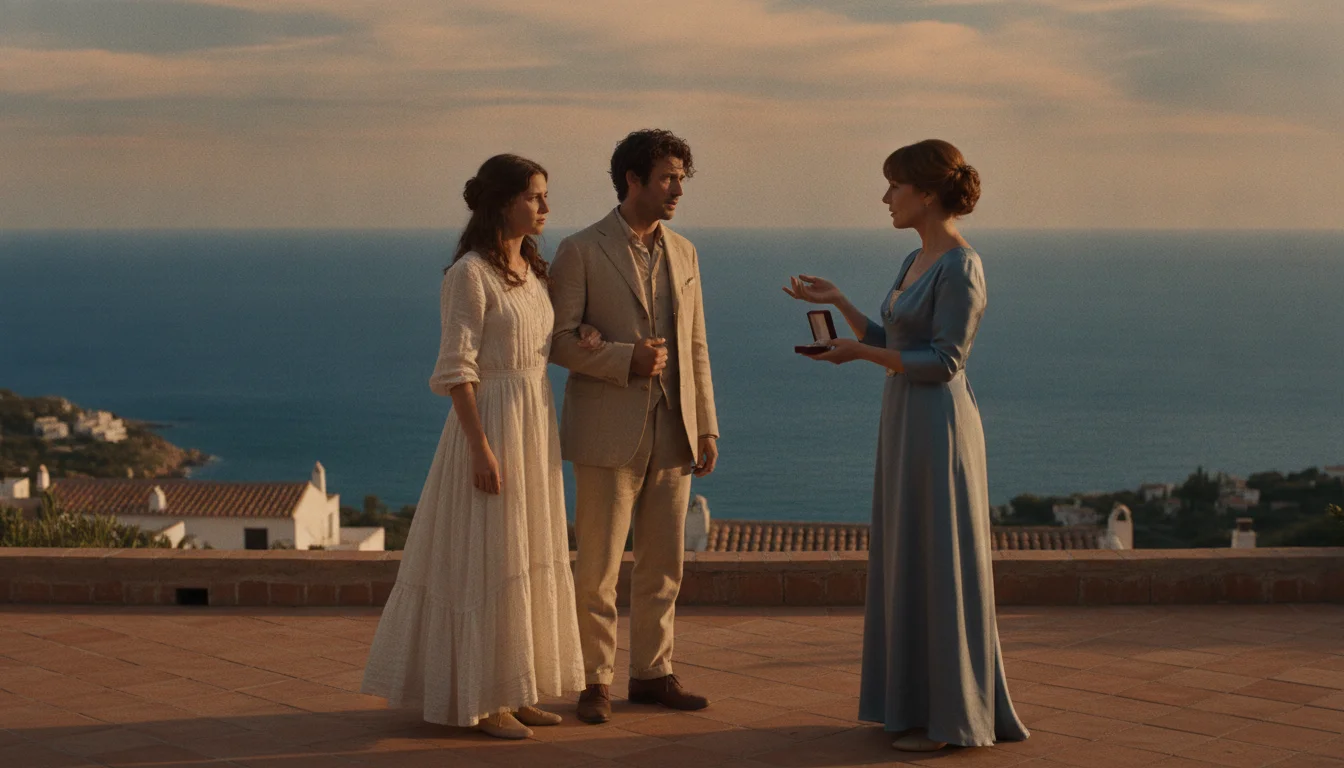
story the depends on three central characters whose choices and blind spots drive the plot. Each represents a different relationship to money, class, and honesty.
Mathilde Loisel
Mathilde is the protagonist. She is pretty and charming but born into a modest family, and she feels that her beauty entitles her to wealth and status. Throughout the story, she mistakes appearance for worth. At the beginning, she weeps for days after visiting her rich friend. By the end, poverty has erased her beauty, but she has gained a harder, more honest understanding of her situation. Her pride is both her defining trait and her tragic flaw.
“She suffered endlessly, feeling herself born for every delicacy and luxury. She suffered from the poorness of her house, from its mean walls, worn chairs, and ugly curtains.” – Guy de Maupassant, The Necklace
Monsieur Loisel
Monsieur Loisel is a clerk in the Ministry of Education. He is content with simple meals and works hard to please his wife. He gives up his 400 francs of savings, uses his inheritance, and takes on debt to replace the lost necklace. During the ten years of repayment, he works alongside Mathilde without complaint. His quiet sacrifice contrasts with Mathilde’s earlier dissatisfaction, and he never blames her openly.
Madame Forestier
Madame Forestier is Mathilde’s wealthy friend from school. She is generous, offering Mathilde many pieces of jewelry and lending the necklace without hesitation. She is also the bearer of the twist ending. Her revelation that the original necklace was fake transforms the entire meaning of the Loisels’ sacrifice and suggests that the object Mathilde envied was never worth what she believed.
Themes and Symbols: Materialism, Appearance, and Irony
Several interrelated themes run through diamond necklace. They are not abstract. Maupassant embeds them in the cost of a dress, the shine of a necklace, and the number of years a couple must work to pay for a mistake.
Materialism and Social Ambition
Mathilde’s unhappiness comes from measuring her life against an imagined world of luxury. As the original text makes clear, she felt she “was born for every delicacy and luxury” and suffered from her modest home’s worn chairs and plain curtains. Her desire is not for money in a simple sense but for recognition. She wants to be envied and sought after. this type of necklace shows how this craving for status makes her unable to appreciate her husband’s love or her own circumstances. Her social ambition, not the necklace itself, is the engine of her ruin.
Appearance vs. Reality
The central irony of this kind of diamond necklace is that the necklace appears valuable but is not. Mathilde appears elegant at the ball but is not wealthy. The replacement necklace is real, but the original was fake. This reversal exposes the gap between surface and substance. Appearance versus reality is a literary contrast between how things seem and how they actually are, and Maupassant builds it into every layer of the plot.
The Necklace as a Symbol
The necklace functions as a symbol of the luxury Mathilde believes she deserves. It is also a symbol of borrowed status and the danger of living beyond one’s means. Because the necklace is fake, it additionally symbolizes the emptiness of superficial values. When Mathilde loses it, she loses the illusion she chased and is forced into a starker reality. The object becomes the pivot on which the entire plot turns.
Pros and Cons of Story the Diamond Necklace as a Literary Text
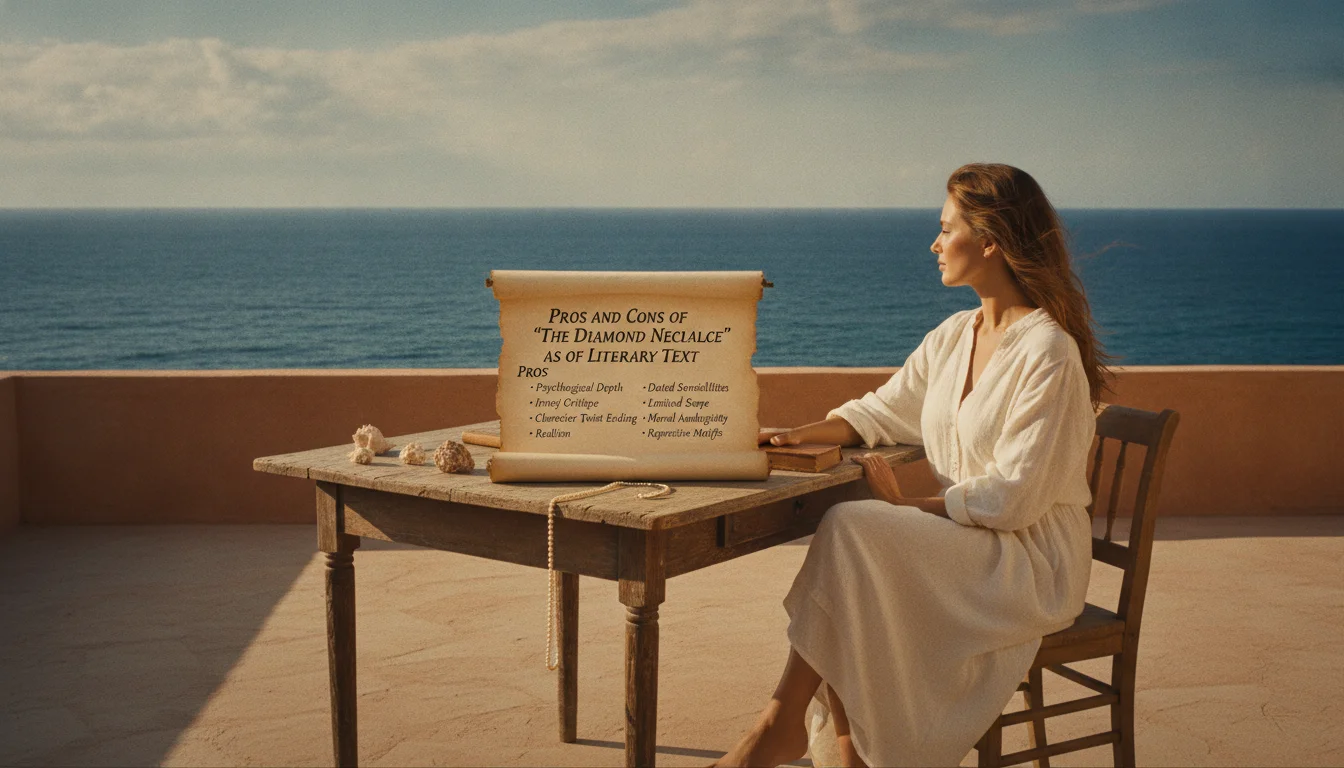
the the diamond necklace is widely taught and widely praised, but like any text it has strengths and limitations worth considering before you assign or read it.
Pros
- Masterful economy: Maupassant tells a complete, emotionally devastating story in a few pages, making it ideal for close reading exercises.
- Unforgettable twist: The fake-necklace revelation is one of literature’s most studied examples of irony and surprise, giving readers an immediate hook for discussion.
- Rich thematic depth: Materialism, class anxiety, pride, and the cost of dishonesty are all present and accessible without requiring specialist knowledge.
- Naturalist precision: The specific monetary figures (400 francs, 36,000 francs, 500 francs) ground the story in social reality and make abstract themes concrete.
- Wide adaptability: Over a century of film, radio, and literary responses confirms the story’s cultural staying power.
Cons
- Limited female agency: Some modern readers find Mathilde’s characterization one-dimensional, reducing her to a cautionary figure defined entirely by vanity.
- Ambiguous ending: Maupassant ends on Madame Forestier’s revelation without showing Mathilde’s reaction, which some readers find unsatisfying.
- Period class assumptions: The story’s social logic depends on 19th-century French class structures that require contextual explanation for contemporary audiences.
- Short length limits complexity: The brevity that makes the story teachable also means character development is compressed and secondary figures remain underdeveloped.
The Twist Ending: How It Works and Why It Matters
The twist ending is the most famous feature of necklace. It is worth analyzing separately because it changes the reader’s understanding of every scene that came before.
Definition of a Twist Ending
A twist ending is a narrative device in which the final revelation reverses or reframes the story’s earlier events. The technique works by withholding a key piece of information until the final lines, then making the reader re-interpret earlier details. Maupassant was known for this technique. The twist in story the is the information that the borrowed necklace was fake, which transforms a story about debt into a story about pride and needless sacrifice.
The Irony of the Fake Necklace
The Loisels replace a fake necklace worth no more than 500 francs with a real one costing 36,000 francs. They spend ten years repaying this sum. The irony is that their sacrifice was unnecessary. If Mathilde had told Madame Forestier the truth immediately, she would have learned the necklace was inexpensive costume jewelry. diamond necklace punishes pride and secrecy more than poverty.
What the Ending Reveals
The ending reveals that Mathilde’s suffering was caused not by fate but by her refusal to admit a simple mistake. Her fear of looking poor made her poorer. It also reconfigures Madame Forestier’s character: her generosity was genuine, but the symbol of wealth she lent was an illusion. this type of necklace leaves readers to consider how much of their own striving is spent on appearances.
“A horrified Mme Forestier reveals that the necklace she had lent to Mathilde was not made of real diamonds, and was worth no more than five hundred francs.” – Wikipedia summary of The Necklace
Adaptations and Cultural Influence of Story the Diamond Necklace
this kind of diamond necklace has been adapted and referenced across film, radio, television, and literature for more than a century. Its twist ending makes it especially attractive to screenwriters and other authors.
Film and Television Adaptations
According to Wikipedia, notable adaptations include The Necklace (1909), an American silent film directed by D. W. Griffith; The Diamond Necklace (1921), a British silent film directed by Denison Clift; The Pearl Necklace (1926), a Chinese film directed by Li Zeyuan; and The Necklace (1949), the first episode of the NBC-TV series Your Show Time. The 1949 episode’s producer Stanley Rubin won the first-ever Emmy Award for it. A 1975 episode of the CBS Radio Mystery Theater also adapted the story under the title The Diamond Necklace.
Literary Works Inspired by the Story
Several authors have responded to or borrowed from the the diamond necklace. Henry James’s 1899 short story Paste reverses the twist ending. Somerset Maugham’s Mr. Know-All (1925) and A String of Beads (1943) both revolve around the price of a necklace. The story also influenced The Diamond Pendant in E.C. Comics’ Impact #1 (1955), and later Indian films such as Doctor Innocentanu (2012) and Vennila Veedu (2014) use a similar main plot. A Sinhala translation by K. G. Karunathilake of Sri Lanka also exists, demonstrating the story’s international reach.
The Story in the Classroom
Because of its brevity, clear structure, and surprise ending, necklace is widely taught in English and literature courses. Study guides often use it to introduce irony, character development, and theme. The GradeSaver study guide offers a full list of characters and themes for students. Teachers frequently ask students to consider whether Mathilde’s pride or society’s class system is more responsible for her fate.
How to Analyze Story the Diamond Necklace: A Step-by-Step Guide
A close reading of story the can follow five ordered steps. Each step builds on the previous one to move from plot to theme.
- Establish the conflict: Identify Mathilde’s dissatisfaction and the ball invitation as the inciting incident.
- Track Mathilde’s transformation: Note her physical, emotional, and social changes over ten years.
- Examine money and class: List every monetary amount and what it buys or costs.
- Evaluate the ending’s irony: Ask how the fake necklace reframes the sacrifice.
- Connect themes to modern life: Apply the lesson to contemporary status symbols and debt.
Step 1: Establish the Conflict
Begin by identifying the initial problem: Mathilde wants a life of luxury but has no money or social rank. List the objects she desires and the ways she despises her home. Note that the external conflict arises when she must attend a ball without suitable clothes or jewels. This step shows that the plot starts with internal dissatisfaction before any external loss occurs.
Step 2: Track Mathilde’s Transformation
After Mathilde borrows the necklace, she is momentarily happy at the ball. After losing it, she becomes determined but also secretive. Over the ten years, her physical beauty fades and she hardens. Use a chart or notes to compare her speech and actions at the beginning, middle, and end of diamond necklace. The transformation is not only physical. It is a change in what she values.
Step 3: Examine Money and Class
List every monetary amount mentioned: 400 francs for the dress, 36,000 francs for the replacement, and 500 francs as the actual value. Calculate how the Loisels raise the money and what they give up. This step shows how financial pressure and class anxiety drive the plot. The gap between the replacement cost and the real value is the numerical heart of the irony.
Step 4: Evaluate the Ending’s Irony
Ask what the final revelation changes. If the necklace was fake, was the Loisels’ sacrifice meaningless? Why did Mathilde never suspect? Consider how Maupassant builds the twist through details about Madame Forestier’s casual lending and the ease of her agreement. The twist works because the reader shares Mathilde’s assumption that the necklace is valuable.
Step 5: Connect Themes to Modern Life
Consider how this type of necklace applies today. People still compare themselves to others, borrow beyond their means, and hide mistakes out of shame. Discuss what the story says about honesty, social media, or status symbols. The lesson remains relevant because the desire to appear wealthy is not limited to 1880s Paris.
Why Story the Diamond Necklace Still Resonates
this kind of diamond necklace has outlasted thousands of other 19th-century short stories because its twist feels both surprising and inevitable. The ending forces readers to re-read the story with new eyes.
The Enduring Lesson
Story the diamond necklace endures because it exposes a universal human flaw: the willingness to suffer rather than admit a mistake. Mathilde’s pride costs her ten years of labor, and the twist makes those years tragically unnecessary. The lesson is not simply that honesty is best. It is that status is often an illusion.
A Story for Modern Readers
In an age of social media and consumer debt, story the diamond necklace feels newly relevant. As of mid-2026, the pressure to appear richer or more successful than one is can lead to real financial and emotional consequences. The financial figures in the story are dated, but the psychology is not. By reading Mathilde’s story, modern readers can see how borrowed appearances rarely survive contact with reality.
Frequently Asked Questions
What is story the diamond necklace about?
Story the diamond necklace is about Mathilde Loisel, a woman who borrows a diamond necklace, loses it, and replaces it at great cost, only to learn the original was fake. The story explores materialism, pride, and the gap between appearance and reality.
Who wrote story the diamond necklace?
Story the diamond necklace was written by French author Guy de Maupassant. It was first published in French as La Parure on 17 February 1884 in the newspaper Le Gaulois, according to Wikipedia.
What is the twist ending of story the diamond necklace?
In the twist ending, Madame Forestier reveals that the borrowed necklace was made of fake diamonds and was worth no more than 500 francs. The Loisels had spent ten years repaying a 36,000-franc replacement, making their entire sacrifice unnecessary.
How much did the replacement necklace cost?
The replacement necklace cost 36,000 francs. Monsieur Loisel used an inheritance to cover half the cost and borrowed the rest at high interest, according to the story’s text and confirmed by Wikipedia.
How long did it take the Loisels to repay the debt?
It took ten years for the Loisels to repay the debt and accumulated interest. During that time they dismissed their maid, moved into a smaller apartment, and took on grueling work.
Why is story the diamond necklace considered naturalist?
Story the diamond necklace is considered naturalist because it shows how social environment, class, and economic necessity shape Mathilde’s fate. The EBSCO Research Starter classifies its plot type as naturalism, set in 1880s Paris.