Moissanite rings vs diamond is a comparison of two distinct gemstones: silicon carbide moissanite and carbon diamond, each with different optical properties, price points, and symbolic weight. Moissanite dazzles with intense rainbow fire and a lower price tag, while diamond carries centuries of tradition and the highest hardness rating on Earth.
Key Takeaways
- Moissanite is composed of silicon carbide, while diamond is pure carbon.
- Moissanite has a higher refractive index (2.65–2.69) than diamond (2.42), producing more fire and rainbow sparkle.
- Both stones are durable, but diamond is a 10 on the Mohs scale, while moissanite is 9.25, still harder than sapphire and ruby.
- Moissanite is almost exclusively lab-grown and costs significantly less than a comparable diamond.
- Moissanite is doubly refractive, which can create a subtle double image; diamond is singly refractive.
- Diamond carries traditional symbolism and higher perceived value; moissanite offers ethical and budget-friendly appeal.
Moissanite Rings vs Diamond: Side-by-Side Comparison
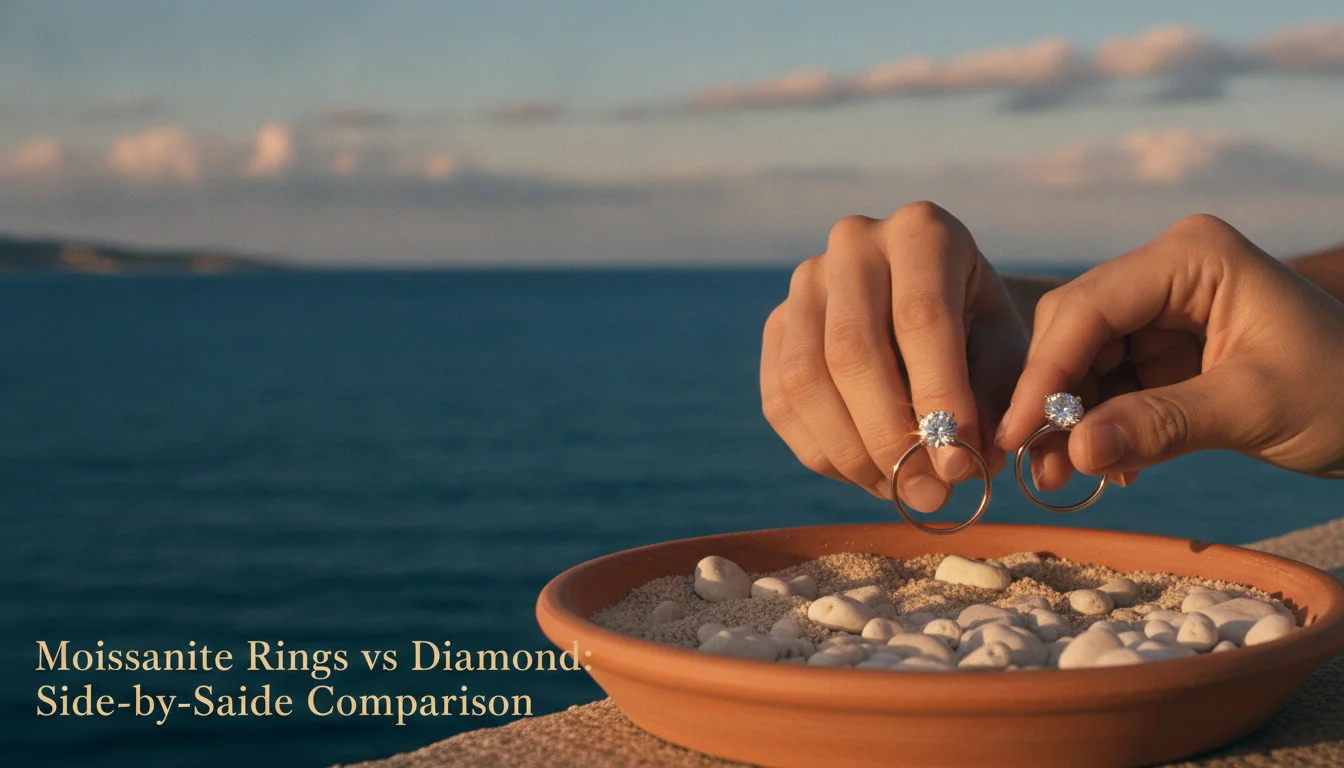
The measurable differences between vs diamond come down to chemistry, optics, and price. The table below compares both gemstones across the criteria that matter most to engagement ring shoppers.
| Characteristic | Moissanite | Diamond |
|---|---|---|
| Composition | Silicon carbide (SiC) | Carbon (C) |
| Mohs Hardness | 9.25 | 10 (hardest natural mineral) |
| Refractive Index | 2.65–2.69 | 2.42 |
| Fire (Dispersion) | More than twice diamond’s fire | Lower fire, balanced white and rainbow sparkle |
| Color Range | Colorless (D-E-F), plus teal, grey, green, yellow, black | Colorless (D-Z), plus pink, blue, yellow from trace elements |
| Origin | Almost exclusively lab-created (natural is extremely rare) | Natural mined or lab-grown |
| Price (relative) | Significantly less expensive for same size | More expensive, especially high grades |
| Best For | Value, ethics, maximum sparkle | Tradition, hardness, investment |
What Is Moissanite?
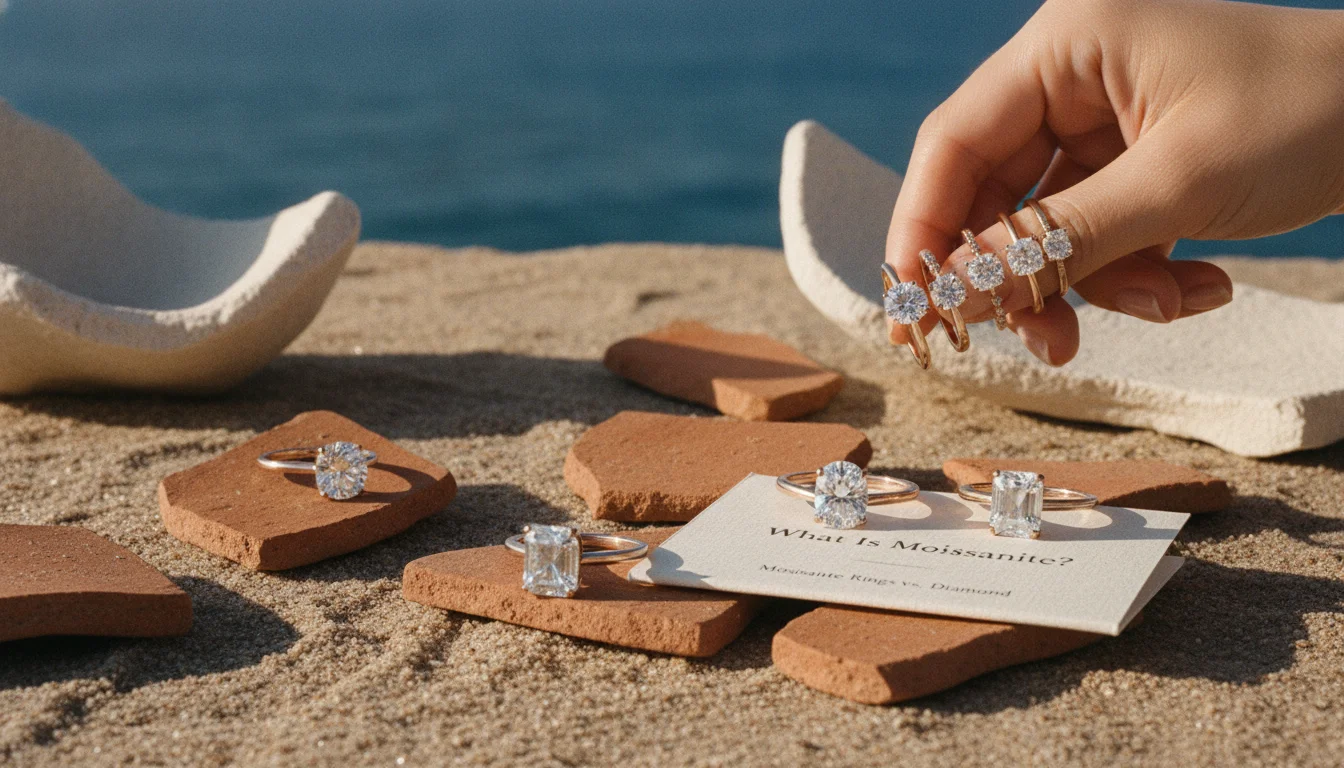
Moissanite is a mineral composed of silicon carbide. It was first discovered in 1893 by French chemist Henri Moissan inside a meteorite crater in Canyon Diablo, Arizona. Moissan initially believed he had found diamonds, but by 1904 he identified the crystals as silicon carbide. Natural moissanite is extraordinarily rare. Geologists did not find it outside meteorites until 1958, when it was discovered in the Earth’s upper mantle near Wyoming. Today, virtually all moissanite used in jewelry is grown in laboratories using advanced technology, making it traceable and mining-free. According to Brilliant Earth, moissanite has a smaller carbon footprint and less environmental impact than naturally mined gems.
Moissanite is not a diamond. It is classified as a diamond simulant: a stone that looks similar to diamond but has different chemical and physical properties. Unlike cubic zirconia, moissanite is extremely hard (9.25 Mohs) and does not cloud or fade over time. Its most notable optical property is double refraction, which splits light into two rays and produces extra sparkle. That rainbow flash is part of what makes this type of diamond such a lively debate among ring shoppers.
What Is a Diamond?
A diamond is a naturally occurring crystalline mineral composed primarily of carbon. It is renowned for its exceptional hardness, brilliance, and symbolic meaning. Diamond is the hardest naturally occurring substance on Earth, rated a perfect 10 on the Mohs scale. Diamonds form deep within the Earth under extreme heat and pressure, but they can also be grown in laboratories with identical chemical, physical, and optical properties. According to Blue Nile, diamonds have been the standard for engagement rings since at least 1477, when Archduke Maximilian of Austria gave the first recorded diamond engagement ring. Diamonds are valued for their rarity, durability, and the way they reflect light in a balanced mix of white brilliance and subtle rainbow fire.
“Moissanite is slightly more brilliant than diamonds, though it features more than twice the amount of fire. If a moissanite is larger than 1 carat, the difference in fire can be very noticeable.” – Brilliant Earth Gemologist Team
Pros and Cons of Moissanite Rings vs Diamond
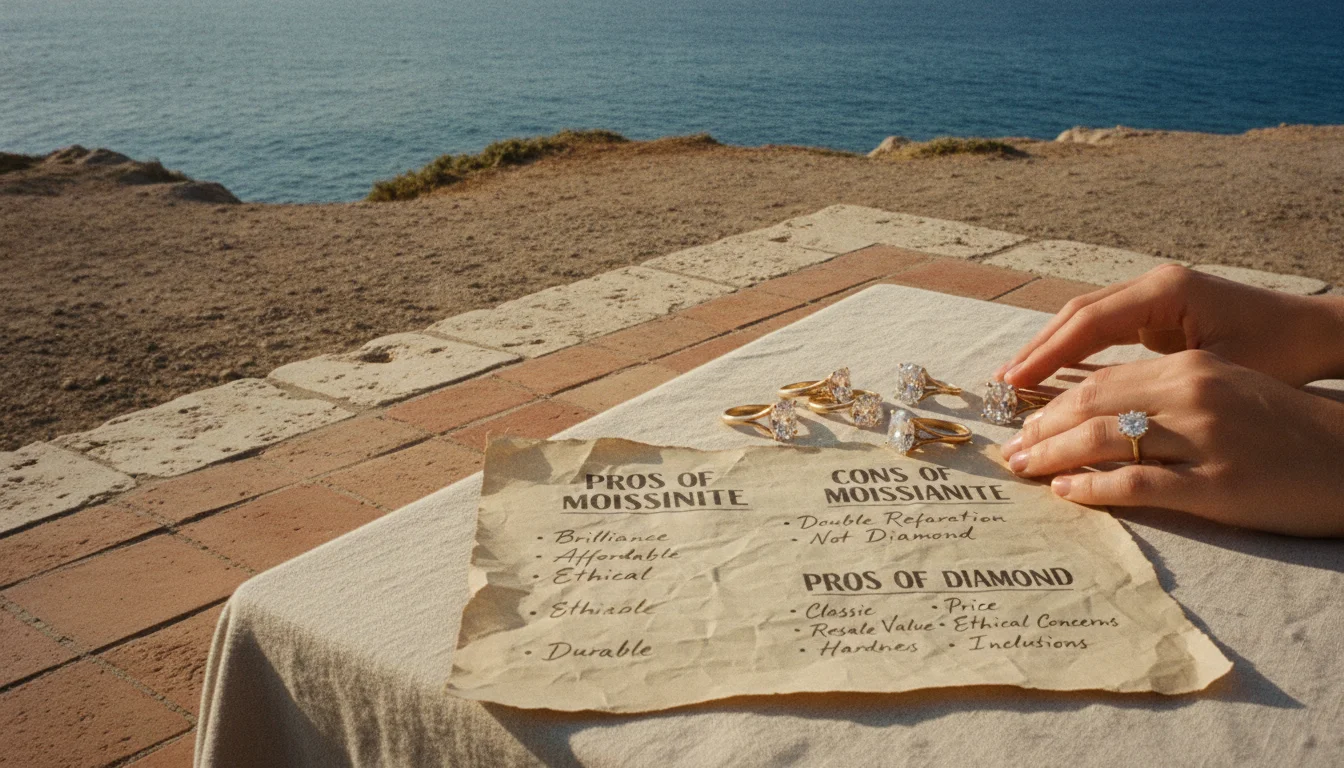
Weighing this kind of vs diamond means understanding what each stone gives you and what it asks you to accept. Here is a clear breakdown of both sides.
Pros of Moissanite Rings
- Superior fire and brilliance: Moissanite has a refractive index of 2.65–2.69, compared to diamond’s 2.42. According to Brilliant Earth, moissanite features more than twice the fire of diamond.
- High durability: At 9.25 on the Mohs scale, moissanite is harder than sapphires and rubies and perfectly suited for everyday wear.
- Accessible price: Moissanite costs significantly less than a diamond of comparable size and quality, allowing you to choose a larger center stone within budget.
- Ethical and eco-conscious: Because it is lab-grown, moissanite requires no mining and carries a smaller environmental footprint.
- Low maintenance: According to Do Amore, moissanite is less likely to attract grease or dirt than diamond, so it keeps sparkling longer between cleanings.
- Color variety: Premium moissanite is available in the colorless D-E-F range, and it can also be grown in teal, grey, green, yellow, and black for a truly unique look.
Cons of Moissanite Rings
- Not as hard as diamond: Diamond’s 10 on the Mohs scale makes it the most scratch-resistant gemstone. Moissanite’s 9.25 is excellent but slightly softer.
- Double refraction: Moissanite’s doubly refractive nature can create a slightly hazy or blurred appearance when viewed through the side, especially in larger stones. Diamond is singly refractive and always crisp.
- Intense rainbow sparkle: While some love the “disco ball effect” in sunlight, others find it too flashy and prefer diamond’s balanced white and rainbow light.
- Perceived as a simulant: Because moissanite is not a diamond, it may carry less traditional or status appeal for those who value a natural diamond’s symbolism.
Pros of Diamond Rings
- Hardest natural material: Diamond’s 10 on the Mohs scale makes it the most durable option for a ring worn every day for a lifetime.
- Classic brilliance: Diamond has a refractive index of 2.42, producing a beautiful balance of white light and subtle fire. Its single refraction keeps the stone crisp and clear.
- Traditional symbolism: Diamonds have represented love and commitment since 1477 and remain the cultural standard for engagement rings worldwide.
- Heirloom and resale potential: High-quality natural diamonds can retain value over time and are often passed down through generations.
- Variety: Diamonds come in every shape, size, and color, from colorless D-grade to fancy pink, blue, and yellow from trace elements like nitrogen and boron.
Cons of Diamond Rings
- Higher price: Diamonds cost significantly more than moissanite of equivalent size and quality. The difference can be substantial for a one-carat center stone.
- Environmental and ethical concerns: Mined diamonds can have a larger environmental footprint and have historically been linked to conflict, though lab-grown options address this.
- Lower fire: Diamond has less dispersion than moissanite, so it does not produce the same intensity of rainbow sparkle.
- Rarity depends on grade: As Blue Nile notes, diamonds are not the rarest gemstone overall. Rarity depends on specific combinations of color, clarity, carat, and cut.
“Because moissanite contains some silicon, it is also less likely to attract grease or dirt than a diamond. That means a moissanite will sparkle more in between cleanings.” – Do Amore
Moissanite Rings vs Diamond vs Cubic Zirconia
the rings vs diamond is only part of the conversation. Cubic zirconia (CZ) is another diamond simulant worth understanding, especially since it is often confused with moissanite. CZ is made from zirconium dioxide and is significantly softer than both moissanite and diamond. Unlike moissanite, CZ can cloud, scratch, and lose its brilliance over time. Moissanite’s 9.25 Mohs hardness and permanent sparkle put it in a completely different category from CZ. As Queensmith notes, most people can tell a diamond simulant apart from a real diamond because simulants emit a different sparkle and their facets look less crisp. Moissanite sits closest to diamond in terms of durability and optical quality, while CZ is the most affordable but least durable of the three.
| Characteristic | Moissanite | Diamond | Cubic Zirconia |
|---|---|---|---|
| Composition | Silicon carbide | Carbon | Zirconium dioxide |
| Mohs Hardness | 9.25 | 10 | 8–8.5 |
| Durability | Excellent, does not cloud | Best in class | Clouds and scratches over time |
| Price | Accessible luxury | Investment piece | Very low cost |
| Sparkle longevity | Permanent | Permanent | Fades over time |
Care and Cleaning: Moissanite Rings vs Diamond
Both moissanite rings and diamond rings are low-maintenance, but a few simple habits keep them looking their best. Clean either stone with warm water, mild dish soap, and a soft toothbrush. Rinse thoroughly and pat dry with a lint-free cloth. Avoid harsh chemicals, ultrasonic cleaners with damaged settings, and storing rings loose together where stones can scratch metal. Because moissanite is less likely to attract grease than diamond, according to Do Amore, you may find it stays brilliant longer between cleaning sessions. For diamond rings, a professional cleaning once or twice a year helps maintain that crisp, white sparkle. Both stones are safe for everyday wear and will not cloud or fade with proper care.
How to Choose Between Moissanite Rings vs Diamond
The moissanite rings vs diamond decision comes down to a few personal priorities. Use this step-by-step process to narrow down your choice.
- Set your budget. Determine the maximum you are willing to spend on the center stone. Moissanite typically allows a larger stone for the price of a smaller diamond of similar quality.
- Decide what sparkle you love. Do you prefer maximum rainbow fire (moissanite) or a balanced white light (diamond)? Compare both in sunlight if possible.
- Assess your priorities. If ethical sourcing and minimal environmental impact are top concerns, lab-grown moissanite or lab-grown diamond are both strong choices, but moissanite is often more affordable.
- Consider long-term wear. Both stones are durable enough for daily rings, but diamond’s 10 on the Mohs scale gives a slight edge for scratch resistance over decades.
- Reflect on tradition and meaning. If the diamond engagement ring tradition matters deeply to you or your partner, diamond may be the better emotional fit. If you value innovation and a stone born from the stars, moissanite shines.
Choose Moissanite If…
- You want the biggest, brightest stone for your budget.
- Ethical sourcing and lab-grown origins matter to you.
- You love rainbow fire and a stone with a cosmic origin story.
- You are open to a modern, accessible-luxury alternative to diamond.
Choose Diamond If…
- You value tradition and the classic engagement ring symbol.
- You want the hardest possible stone for maximum longevity.
- You prefer a crisp, white sparkle with subtle fire.
- You are considering resale or heirloom potential.
The Verdict on Moissanite Rings vs Diamond
In the moissanite rings vs diamond debate, there is no single winner. For most shoppers, moissanite rings offer the better overall value: more fire, high durability, ethical lab-grown origin, and a significantly lower price. However, diamond rings remain the choice for tradition, ultimate hardness, and long-term investment. If you are buying an engagement ring on a practical budget and want maximum sparkle, moissanite is your answer. If the diamond’s legacy and superior scratch resistance matter most, diamond is worth every penny. Both are beautiful, durable, and worthy of a lifetime of wear. The right choice depends entirely on what you value most.
As of July 2026, both moissanite and lab-grown diamond options are more accessible than ever, giving you more ways to find a ring that feels completely, perfectly yours.
Ready to find your ring? Shop the collection at lexazi.com – free shipping on orders over $75.
Frequently Asked Questions
Is moissanite a lab grown diamond?
No. Moissanite is a distinct gemstone made of silicon carbide, while diamond is carbon. Lab-grown diamonds are real diamonds with identical chemical properties to mined stones. Moissanite is a diamond simulant, not a diamond.
Moissanite vs diamond price: which is cheaper?
Moissanite is significantly less expensive than diamond of similar size and quality, as confirmed by Helzberg and Blue Nile. You can often get a larger moissanite for the same budget as a smaller diamond, making it an accessible-luxury choice for couples who want a statement center stone.
Can you tell moissanite from diamond?
Yes, especially side by side. Moissanite shows more rainbow fire and may have a slight double image due to double refraction, while diamond has crisper facets and balanced white light. As Queensmith notes, most trained and untrained eyes can tell the two apart when compared directly.
Is moissanite durable for everyday wear?
Yes. Moissanite ranks 9.25 on the Mohs hardness scale, which is harder than sapphire and ruby. It is perfectly suitable for daily rings and will not cloud or fade over time, unlike cubic zirconia.
Does moissanite lose its sparkle?
No. Because of its hardness and high refractive index, moissanite stays brilliant for life. Unlike cubic zirconia, which can dull and cloud over time, moissanite maintains its fire and brilliance permanently.
Men moissanite rings vs diamond: are there differences?
The same physical properties apply to men’s rings. Both are durable enough for daily wear, but moissanite offers more fire and a lower price, while diamond offers the hardest material available and classic status. The choice comes down to personal preference and budget, just as it does for any ring buyer.