Lab grown diamonds vs moissanite is a comparison between two distinct lab-created stones: a real diamond made of pure carbon (Mohs 10) and a silicon carbide gemstone (Mohs 9.25) with more rainbow fire and a lower price.
Key Takeaways
- Lab-grown diamonds are real diamonds, chemically identical to mined ones; moissanite is a separate gemstone entirely.
- Moissanite exhibits more colorful fire (dispersion 0.104) vs. diamond’s white brilliance (dispersion 0.044).
- The price gap is significant: moissanite can cost 70–90% less than a comparable lab-grown diamond.
- Both are durable for daily wear, but diamond (Mohs 10) is harder than moissanite (Mohs 9.25).
- Choose moissanite for budget and bold sparkle; choose lab-grown diamond for classic elegance and ultimate hardness.
- As of October 2025, GIA grades lab-grown diamonds on new descriptive tiers rather than the full 4Cs scale.
So many shoppers arrive at the vs moissanite question with the same mix of excitement and confusion. Both stones are created in laboratories. Both are beautiful. Both sidestep the ethical weight of traditional mining. Yet they are fundamentally different materials with distinct optical personalities, hardness ratings, and price points. Understanding those differences is how you walk away with exactly the stone you wanted, whether that’s the timeless identity of a diamond or the vibrant, budget-friendly flash of moissanite.
What Are Lab Grown Diamonds?
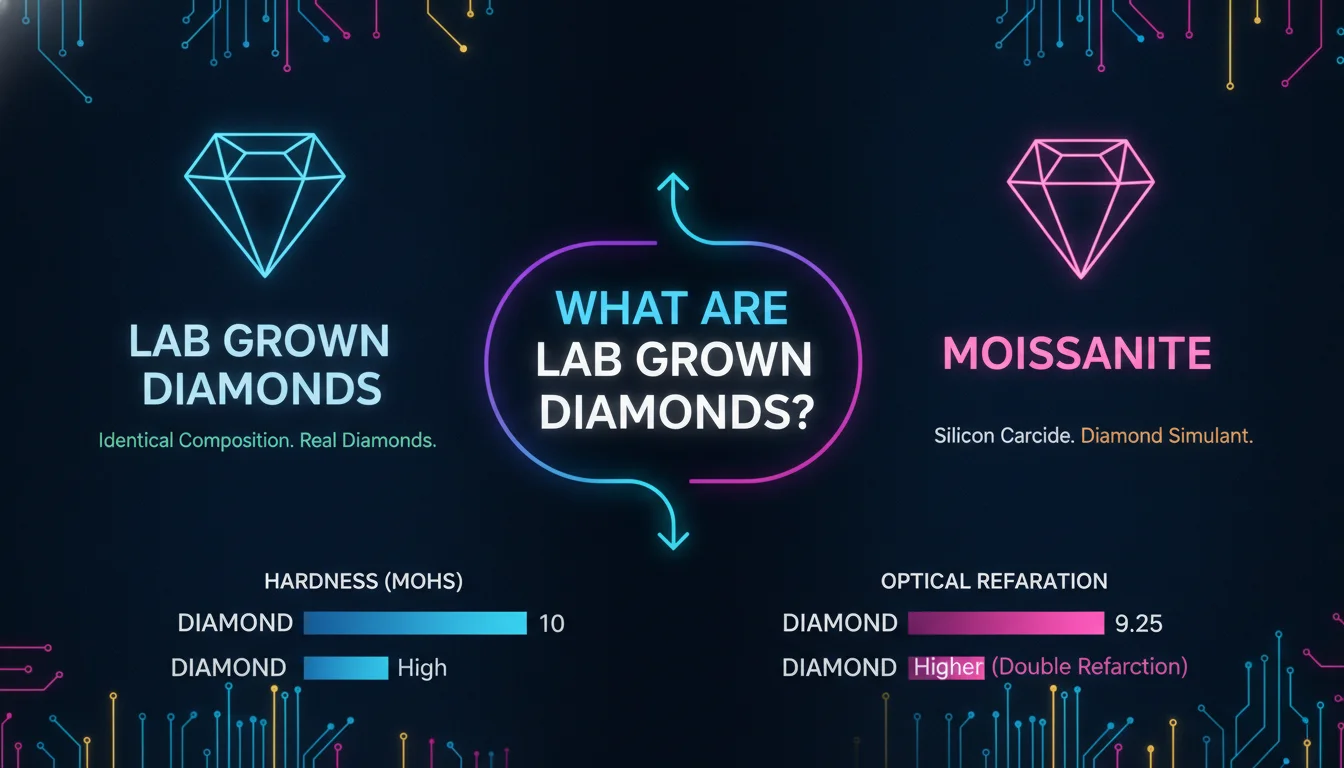
Lab grown diamonds are real diamonds, crystallized from pure carbon in a controlled laboratory environment. They share the same chemical, physical, and optical properties as natural mined diamonds. The only difference is their origin. A lab grown diamond is a diamond, not a simulant, not an imitation, but genuine diamond graded by world-renowned gemological institutes.
How Lab Grown Diamonds Are Made
There are two main production methods: Chemical Vapor Deposition (CVD) and High Pressure High Temperature (HPHT). Both replicate the conditions deep within the Earth, causing carbon atoms to bond into the characteristic diamond crystal lattice. The resulting rough crystals are then cut and polished exactly like mined diamonds.
Why Choose a Lab Grown Diamond?
Lab grown diamonds offer the same timeless appeal as mined diamonds: brilliance, fire, and scintillation, often at a meaningfully lower price for a stone of comparable quality. They are conflict-free, require no mining, and are increasingly popular with eco-conscious buyers. According to the Gemological Institute of America (GIA), lab grown diamonds are evaluated using the same 4Cs framework (cut, color, clarity, carat) as mined diamonds, offering full transparency and confidence. Notably, as of October 1, 2025, GIA shifted to grading lab-grown diamonds on Premium and Standard descriptive tiers rather than the full 4Cs numerical scale, per Stienhardt’s gemologist review.
What Is Moissanite?
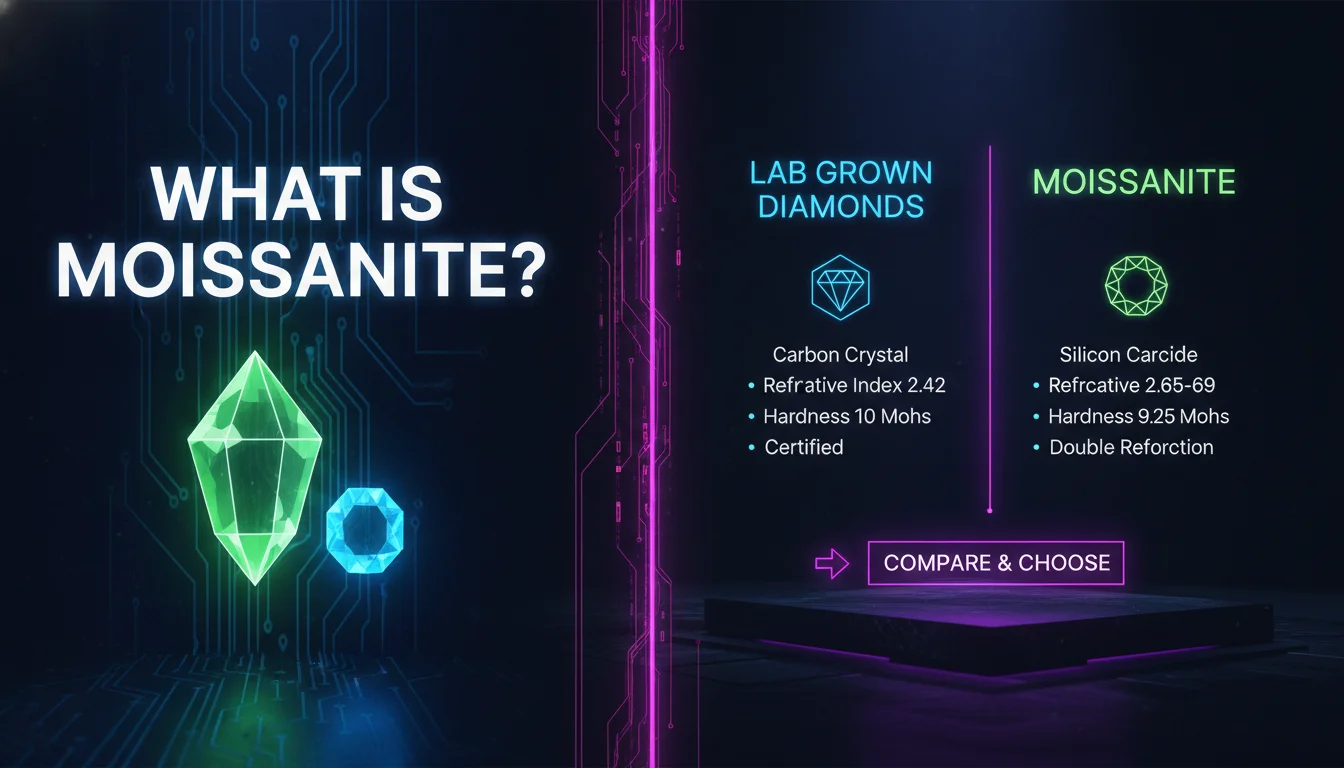
Moissanite is a lab-created gemstone composed of silicon carbide (SiC). First identified in 1893 by French chemist Henri Moissan inside a meteorite crater in Arizona, natural moissanite is so rare that all jewelry-grade moissanite today is lab grown. It is a diamond simulant, meaning it imitates diamond’s appearance but is a completely different material with its own optical signature.
The Origin and Rise of Moissanite
For decades, moissanite has been a popular diamond alternative. Charles & Colvard pioneered the gem, refining its color and clarity to produce near-colorless stones. Their Forever One line is exceptionally white and full of rainbow fire, setting the benchmark for premium moissanite quality.
Why Some Buyers Prefer Moissanite
Moissanite appeals to those who want a dazzling gemstone at a fraction of a diamond’s price. It is harder than sapphire or ruby, making it tough enough for daily wear. Its double refraction gives each facet a lively, vivid effect. For many buyers, that extra sparkle is a feature, not a flaw.
Lab Grown Diamonds vs Moissanite: Key Differences
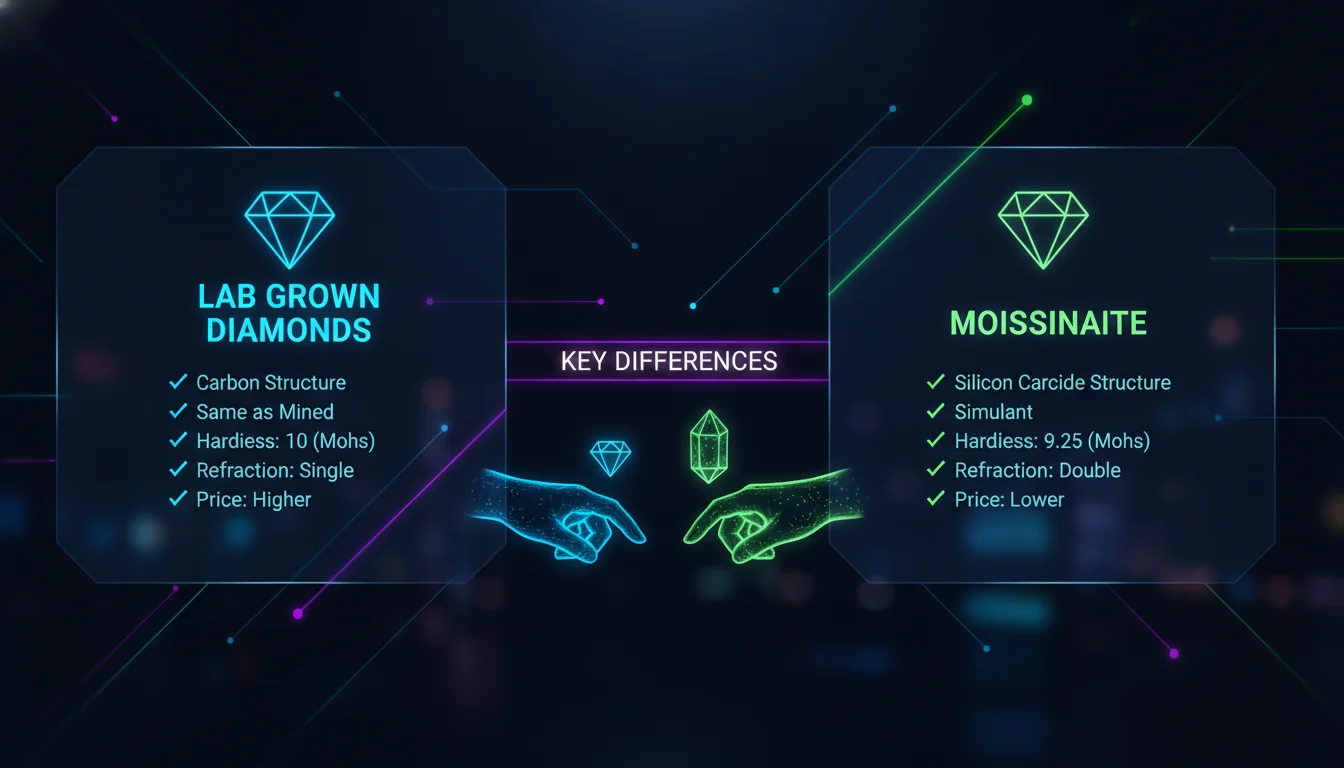
When the two stones sit side by side, the differences become clear. The table below summarizes the most important criteria to help you evaluate this type of moissanite at a glance.
| Criteria | Lab Grown Diamond | Moissanite |
|---|---|---|
| Chemical Composition | Carbon (C) | Silicon carbide (SiC) |
| Hardness (Mohs) | 10 | 9.25 |
| Sparkle Type | Brilliance (white light) + fire (colored light) | Intense rainbow fire (dispersion 0.104) |
| Color Grades | D (colorless) to Z (light yellow) | Near-colorless; premium options appear colorless |
| Approx. Price (1ct equiv.) | $1,500–$5,000 | $500–$800 |
| Grading Report | GIA, IGI, or GCAL diamond report | No standardized diamond report |
| Refraction | Single refractive | Double refractive |
Hardness and Durability
Diamond is the hardest substance known, scoring a perfect 10 on the Mohs scale. Lab grown diamonds share this perfect score, making them virtually scratch-proof. Moissanite, at 9.25, is still exceptionally hard, harder than sapphire and far harder than cubic zirconia. Both stones are suitable for engagement rings worn daily, but a diamond will resist scratching better over decades of wear.
Sparkle and Fire
This is the most striking visual difference in the this kind of vs moissanite debate. Moissanite has a dispersion rate of 0.104, more than double that of diamond’s 0.044, according to Do Amore. As a result, moissanite throws vivid rainbow flashes, especially under direct light. Lab grown diamonds display a balanced mix of white light brilliance and subtle fire, which many consider the classic diamond look.
“Moissanite exhibits significantly more ‘rainbow fire’ than a diamond, which some find breathtakingly vibrant, while others feel it appears less natural,” say certified gemologists at Brilliant Earth.
“A Lab Grown Diamond has the balanced, mostly white brilliance people picture when they picture a diamond,” notes the gemologist team at Stienhardt, who add that moissanite’s higher dispersion can read as a ‘disco-ball look’ to traditionalists.
Color and Clarity
Lab grown diamonds are graded on the D-to-Z color scale, with D being completely colorless. You can select exactly the color grade you prefer. Moissanite is not graded on that scale. While modern moissanite, especially premium brands, is near-colorless or colorless, larger stones may still show a faint grayish or warm tint in certain lighting. Both stones can be eye-clean, with few or no visible inclusions.
Price and Value
Price is often the deciding factor in the lab grown diamonds vs moissanite conversation. Moissanite typically costs 70–90% less than a comparable lab grown diamond. A one-carat equivalent moissanite might retail for $500–$800, whereas a 1-carat lab grown diamond of decent quality starts around $1,500 and can exceed $5,000 for higher grades. That gap makes moissanite incredibly attractive for anyone who wants a large center stone on a smaller budget.
Ethical and Environmental Impact
Both stones are lab-created, completely avoiding the environmental and social concerns tied to traditional diamond mining. No mining, no conflict, and a significantly lower carbon footprint. For the ethically minded buyer, both are excellent choices, and neither requires a compromise on beauty.
How to Tell the Difference Between Moissanite and a Lab Grown Diamond
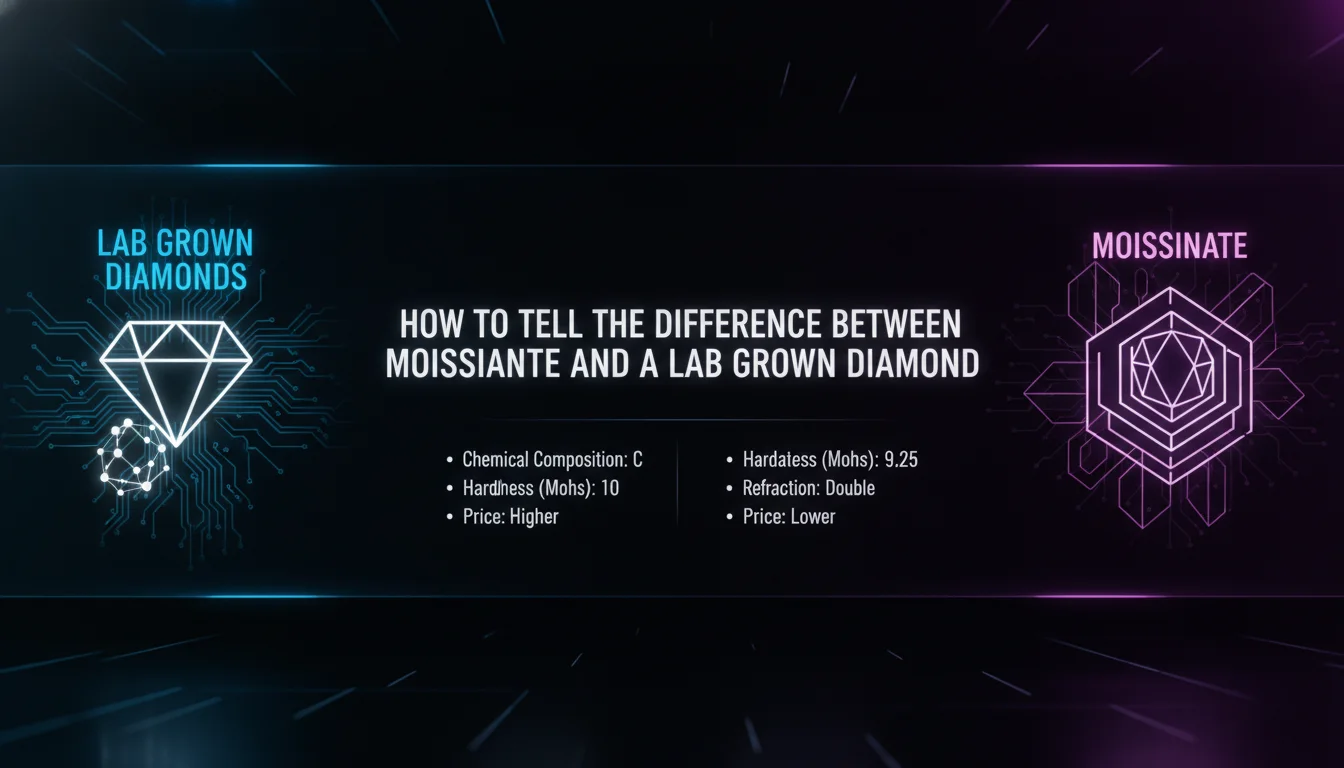
Distinguishing lab grown diamonds vs moissanite reliably requires gemological tools, not just a sharp eye. According to Brilliant Earth’s certified gemologists, identifying the difference between the two stones typically involves specialized equipment that detects double versus single refraction, hardness differences, and fluorescence patterns. Side by side in natural light, moissanite’s extra rainbow fire is often the most obvious tell, but in isolation, most people cannot distinguish the two without a direct comparison. A trained jeweler using a loupe or refractometer can spot moissanite’s double refraction, where facet edges appear slightly doubled, within seconds.
Lab Grown Diamonds vs Moissanite vs Cubic Zirconia
The lab grown diamonds vs moissanite comparison sometimes expands to include cubic zirconia (CZ), the third common simulant. CZ is zirconium dioxide, softer than both (Mohs 8–8.5), and tends to cloud or scratch over time with daily wear. Moissanite sits well above CZ in durability and optical quality. Lab grown diamonds, of course, are not simulants at all: they are real diamonds. If you’re weighing all three, CZ is best suited to fashion jewelry rather than a ring you’ll wear every day, while moissanite and lab grown diamonds are both strong long-term choices.
When to Choose Moissanite Over Lab Grown Diamonds
Moissanite shines in specific situations. Choose moissanite if:
- Budget is your top priority. You can get a visibly larger stone for the same money.
- You love extra sparkle. If you want a ring that throws rainbows in every light, moissanite delivers.
- You’re open to a modern gemstone. Moissanite has its own identity and doesn’t pretend to be a diamond.
- You want a durable, everyday stone that resists chipping and scratching beautifully.
When to Choose Lab Grown Diamonds Over Moissanite
A lab grown diamond is the better fit for many traditional buyers. Choose lab grown diamond if:
- You want the real thing. There is no substitute for the precise optics and cultural weight of a diamond.
- You value lasting hardness. A diamond’s Mohs 10 rating means it will look pristine for a lifetime.
- You prefer a classic look. The subtler fire and pure white brilliance of a diamond are timeless.
- Resale and heirloom potential matter. While no diamond is a strong investment, lab grown diamonds hold their identity better than moissanite, which carries minimal resale value.
Pros and Cons
Lab Grown Diamond Pros
- Chemically and optically identical to a mined diamond
- Graded by GIA, IGI, and GCAL for full transparency
- Maximum hardness (Mohs 10) for lifelong scratch resistance
- Classic white brilliance that reads as timeless and traditional
- Conflict-free and lower environmental impact than mined stones
Lab Grown Diamond Cons
- Significantly higher price than moissanite for a comparable size
- Little to no resale value on the secondary market
- Some buyers still prefer the romance of a mined origin
Moissanite Pros
- Costs 70–90% less than a comparable lab grown diamond
- Exceptional hardness (Mohs 9.25), suitable for daily wear
- Vivid rainbow fire that stands out in any light
- Fully lab-created with no mining required
- Allows a larger center stone on a smaller budget
Moissanite Cons
- Not a diamond; carries different cultural and sentimental weight
- Double refraction can make facets appear slightly doubled under magnification
- Larger stones may show a faint warm or grayish tint in some lighting
- No standardized diamond grading report
Lab Grown Diamonds vs Moissanite: Final Verdict
There is no universal winner in the lab grown diamonds vs moissanite comparison. The decision hinges on personal priorities. If you seek a genuine diamond with all the heritage, grading, and classic sparkle while still enjoying the ethical and price advantages of a lab origin, lab grown diamond is the clear choice. If you prefer a stone that is remarkably affordable, vividly colorful, and hard enough for everyday wear, moissanite offers outstanding value. Both are beautiful, durable, and completely lab-made. The right one is the one that feels right on your hand.
Explore more about choosing the perfect stone in our guides on how to style fine jewelry and ethical gemstone buying.
Shop the collection at lexazi.com – free shipping on orders over $75.
Frequently Asked Questions
Is moissanite a fake diamond?
No. Moissanite is not a fake diamond; it is a distinct gemstone composed of silicon carbide. It may resemble a diamond to the untrained eye, but its different chemical and optical properties make it a diamond simulant, not a counterfeit. It is a real gemstone in its own right.
Why don’t some jewelers like moissanite?
Some jewelers are less familiar with moissanite or prefer to sell diamonds due to tradition, profit margins, or grading standardization. Additionally, moissanite’s double refraction can make it look overly flashy to traditionalists who associate diamond with a more restrained, white-light sparkle.
What are the disadvantages of lab grown diamonds?
Lab grown diamonds carry little to no resale value, just like moissanite. Prices for lab grown diamonds have also dropped significantly in recent years as production has scaled, which can affect perceived long-term value. Some buyers still prefer mined diamonds for sentimental or traditional reasons.
How much does a 1-carat lab grown diamond cost vs. a 1-carat moissanite?
A 1-carat lab grown diamond typically ranges from $1,500 to $5,000, depending on cut, color, clarity, and grading lab. A 1-carat equivalent moissanite (same diameter) costs roughly $500 to $800, about 70–90% less. That price difference is the single biggest reason many buyers choose moissanite.
Can you tell the difference between moissanite and a lab grown diamond with the naked eye?
Often, yes. Moissanite’s extra rainbow fire and double refraction, which can make facets look slightly doubled, are telltale signs to a trained eye. However, many people cannot distinguish the two without a direct side-by-side comparison or gemological tools.
Is moissanite durable enough for daily wear?
Absolutely. With a Mohs hardness of 9.25, moissanite is harder than sapphire and ruby and resists scratching well. It is a very durable choice for engagement rings worn every day, and Brilliant Earth’s gemologists confirm both stones are considered good options for daily-wear jewelry.