Moissanite vs Cubic Zirconia: The Real Difference
Moissanite vs cubic zirconia is a comparison between two lab-created diamond alternatives that differ significantly in hardness, sparkle, and long-term durability. Think of moissanite as the stone that catches fire across a candlelit dinner table, throwing rainbow flashes that turn heads, while cubic zirconia offers a quieter, softer glow at a fraction of the price.
Key Takeaways
- Moissanite ranks 9.25 on the Mohs scale, making it far more scratch-resistant than cubic zirconia’s 8 to 8.5 rating.
- Moissanite has a refractive index of 2.65, higher than diamond’s 2.42, producing intense rainbow fire that cubic zirconia cannot match.
- Cubic zirconia costs a fraction of moissanite’s price and suits costume jewelry, travel pieces, and one-time-event rings beautifully.
- Moissanite is the stronger long-term choice for engagement rings and daily-wear fine jewelry.
- Both stones are lab-created, with ethical sourcing and consistent quality built into their production.
- Caring for each stone differently extends its life: gentle soap and water work for both, but CZ needs more frequent replacement under daily wear.
Side-by-Side Comparison: Moissanite vs Cubic Zirconia
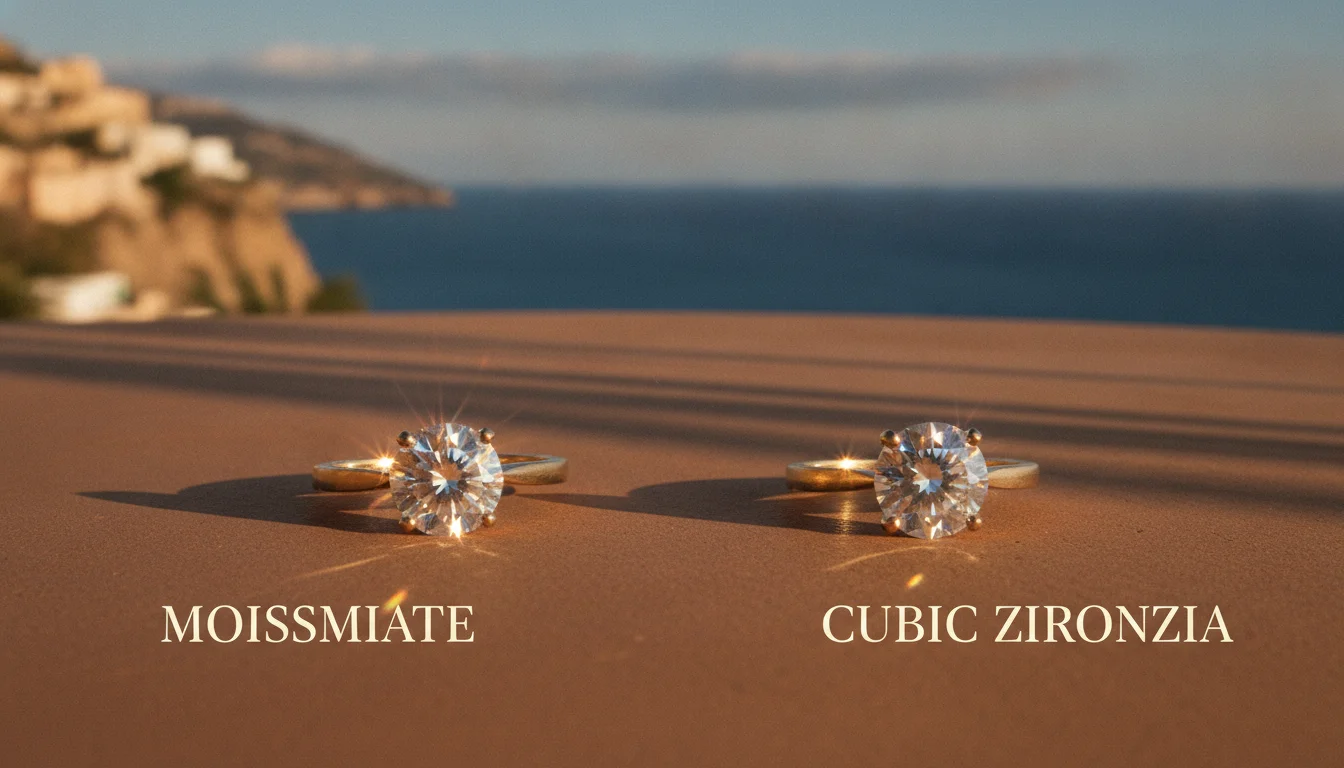
| Feature | Moissanite | Cubic Zirconia |
|---|---|---|
| Composition | Silicon carbide | Zirconium dioxide |
| Mohs hardness | 9.25 | 8 to 8.5 |
| Refractive index | 2.65 | Lower than moissanite |
| Sparkle profile | Intense brilliance and rainbow fire | Softer, glass-like sparkle; high dispersion |
| Durability | Very scratch-resistant for daily wear | More prone to surface wear and clouding |
| Price | Higher than CZ, far below diamond | Fraction of moissanite’s price |
| Best for | Engagement rings, daily fine jewelry | Costume jewelry, fashion pieces, temporary wear |
What Is Moissanite?
Moissanite is a gemstone composed of silicon carbide, and it is the stone that started as a cosmic accident. French scientist Henri Moissan first identified it in 1893 inside a meteor crater in Arizona, initially mistaking those tiny crystals for diamonds. Natural moissanite is so rare it is essentially unavailable for commercial use, so virtually every moissanite you will find in jewelry today is grown in a controlled laboratory. The best-known producer is Charles & Colvard, which manufactures Forever One™ moissanite. According to Charles & Colvard, moissanite has a refractive index of 2.65, higher than a diamond’s 2.42, creating an eye-catching sparkle in any light.
Composition and History
Moissanite is silicon carbide, a compound that forms in meteorites or in specialized laboratory environments. Its lab-grown production ensures uniform quality and ethically traceable sourcing. Unlike cubic zirconia, moissanite is not a diamond simulant in the strictest sense. It is a distinct gemstone with its own optical and physical properties, which is part of why the moissanite vs cubic zirconia conversation matters so much for serious jewelry buyers.
Durability and Hardness
On the Mohs scale of mineral hardness, moissanite ranks 9.25, placing it second only to diamond’s 10 among popular jewelry stones. According to Brilliant Earth, that hardness makes moissanite highly resistant to scratching and suitable for long-term wear. Daily exposure to soap, hand sanitizer, and routine knocks will not quickly create the fine scratches that make softer stones look dull over time.
Sparkle and Visual Profile
Moissanite exhibits both high brilliance and strong fire. Brilliance is the total white light reflected from a gemstone. Fire is the rainbow-colored light created by dispersion. With a refractive index of 2.65, moissanite bends light more sharply than cubic zirconia, producing visible rainbow flashes. Some buyers describe this effect as more colorful than diamond itself, especially under jewelry store lighting or direct sunlight. One optical test documented on Quora showed moissanite producing roughly 2.4 times more spectral color than diamond under the same white light conditions.
Pros of Moissanite
- Hardness rating of 9.25 on the Mohs scale supports daily ring wear.
- Higher refractive index creates intense brilliance and rainbow fire.
- Lab-created origin offers consistent quality and ethical sourcing.
- Keeps its polished surface for years without heavy scratching.
Cons of Moissanite
- Generally more expensive than cubic zirconia.
- Strong rainbow fire may look too colorful for buyers who prefer a quieter diamond-like appearance.
- Replacement cost is higher if a stone is lost from a setting.
What Is Cubic Zirconia?

Cubic zirconia is a synthetic gemstone made from zirconium dioxide crystals arranged in a cubic crystal structure. Scientists first created this lab-made diamond alternative in the 1970s, and it quickly became one of the most common diamond simulants in costume jewelry. According to Caratbee, CZ revolutionized affordable jewelry when it arrived, giving couples and fashion lovers a diamond-like look without the premium price. Unlike moissanite, cubic zirconia is entirely synthetic. Natural occurrences exist but are not used in jewelry.
Composition and Origin
Cubic zirconia is zirconium dioxide, not to be confused with zircon, which is a separate gemstone composed of zirconium silicate. The material is engineered in a cubic crystal structure to imitate diamond’s optical properties. Because it is manufactured, producers can create CZ in nearly any color, though colorless versions remain the most popular for engagement-ring-style jewelry and bridal-adjacent fashion pieces.
Durability and Hardness
Cubic zirconia ranks 8 to 8.5 on the Mohs scale, lower than moissanite’s 9.25 and noticeably lower than diamond’s 10. According to Brilliant Earth, this lower hardness makes cubic zirconia less durable than moissanite and more prone to surface wear over time. With daily wear, CZ can develop fine scratches, lose its crisp polish, and eventually take on a cloudy or milky appearance that no amount of cleaning will fully reverse.
Sparkle and Visual Profile
Cubic zirconia has a lower refractive index than moissanite, so its brilliance is not as strong. That said, CZ still produces a white sparkle that can closely resemble a diamond from a distance, especially in small stones or dim lighting. Some observers describe CZ as having a softer, more glass-like sparkle. It can also show high dispersion, meaning it separates light into spectral colors, but the fire often appears less controlled than moissanite’s intense rainbow flashes.
Pros of Cubic Zirconia
- Extremely affordable, often costing a fraction of moissanite’s price.
- Visually similar to diamond in small sizes and low lighting.
- Available in many colors, shapes, and sizes.
- Cheap and easy to replace if scratched or lost.
Cons of Cubic Zirconia
- Mohs hardness of 8 to 8.5 makes it more susceptible to scratches.
- Surface wear can lead to cloudiness over time.
- Not ideal for long-term daily wear in engagement rings.
Moissanite vs Cubic Zirconia: Composition, Hardness, and Durability
The most important technical difference in the moissanite vs cubic zirconia debate is material hardness. Mohs hardness ranks minerals from 1 (talc) to 10 (diamond) based on scratch resistance. Moissanite sits at 9.25, while cubic zirconia sits at 8 to 8.5. That gap may sound small on paper, but in real jewelry use it translates into meaningful differences in how long a stone keeps its polish and its beauty.
Why Hardness Matters for Daily Rings
A ring stone faces doorknobs, phones, desks, and cleaning products every single day. A harder stone like moissanite at 9.25 resists the fine scratches that accumulate on softer stones over months and years. Cubic zirconia at 8 to 8.5 can still look beautiful for occasional wear, but an everyday engagement ring set with CZ will usually show signs of wear much sooner. This is why many jewelers describe moissanite as the more practical long-term choice, while CZ remains ideal for affordable fashion and travel jewelry categories.
Compositional Differences
Moissanite is silicon carbide, a compound first found in meteorites. Cubic zirconia is zirconium dioxide, a fully synthetic crystal. These different chemistries produce different optical behaviors. Moissanite is doubly refractive, meaning a viewer may see doubled facet edges under 10x magnification. Cubic zirconia is singly refractive, so its facet edges stay sharp and single under magnification. This distinction is one of the most reliable ways for jewelers and gemologists to separate the two stones without specialized equipment.
Moissanite vs Cubic Zirconia: Brilliance, Fire, and Sparkle
The visible difference between moissanite and cubic zirconia is easiest to see under a bright pinpoint light or direct sun. Moissanite, with its 2.65 refractive index, produces strong rainbow-colored fire that can catch attention from across a room. Cubic zirconia has a lower refractive index, so its sparkle appears whiter and softer. A JTV street challenge found that most people could not identify the real diamond among diamond, moissanite, and cubic zirconia, proving how close all three can look at a casual glance.
“Moissanite has much more brilliance and fire, often showing colorful rainbow flashes under light. Many people feel moissanite looks closer to a diamond than CZ does.” – Lepdo, Former Diamond & Jewelry Manufacturer, via Quora
Fire vs Brilliance Explained
Brilliance is the total white light reflected by a gemstone. Fire is the rainbow-colored light created when a gemstone disperses white light into spectral colors. Moissanite is known for high brilliance and strong fire. Cubic zirconia also shows fire, and some sources note that CZ has a higher dispersion than diamond, but its lower refractive index can make the overall sparkle less intense and less crisp than moissanite. This is why the two stones look different even though both are white gemstones sitting in similar settings.
Double Refraction and Visual Clues
Moissanite is doubly refractive, which means that under a 10x jeweler’s loupe its facet edges can appear doubled. Cubic zirconia is singly refractive, so it lacks this doubling effect. For casual shoppers, the simplest tip is to look for the stone with the most fire under a bright light. If you are buying online, look for stated refractive index and hardness numbers rather than relying only on photos or marketing language.
Moissanite vs Cubic Zirconia: Price and Long-Term Value
Price is where the moissanite vs cubic zirconia comparison splits most sharply. Cubic zirconia is among the most budget-friendly diamond simulants, often costing a fraction of moissanite’s price. Moissanite is generally more expensive because its production, hardness, and optical quality require more investment. Even so, moissanite remains far less expensive than natural or lab-grown diamond, making it an accessible luxury for buyers who want lasting quality without a diamond price tag.
Upfront Cost vs Replacement Cost
Cubic zirconia wins the initial price test, and there is no argument there. A CZ piece can be replaced for very little money, which is ideal for trend-driven fashion or travel jewelry. But if a CZ ring is worn every day, the stone may need replacement after it scratches or clouds. Moissanite’s higher hardness means it typically keeps its polished surface for years without replacement, making it the stronger long-term value for fine jewelry that you plan to wear for decades.
Why Moissanite Costs More
According to Brilliant Earth, moissanite is generally more expensive due to its durability, brilliance, and production costs. The laboratory process for silicon carbide is more complex than for zirconium dioxide. Brands such as Charles & Colvard also market proprietary grades like Forever One™, which carry additional quality control, cutting standards, and branding. These factors push moissanite’s price above CZ while keeping it well below diamond.
Pros and Cons
Pros of Choosing Moissanite
- Exceptional hardness at 9.25 Mohs means it holds up to daily life without losing its finish.
- A refractive index of 2.65 delivers brilliance and fire that outperforms cubic zirconia.
- Lab-created with ethical sourcing, consistent grading, and long-term quality assurance.
- Strong long-term value: buy once, wear for years without frequent replacement.
Cons of Choosing Moissanite
- Higher upfront cost compared to cubic zirconia.
- Intense rainbow fire is not for everyone; buyers who want a subdued diamond look may find it too colorful.
- Replacing a lost stone costs more than replacing a CZ.
Cleaning and Care: How to Keep Each Stone Looking Its Best
Caring for moissanite vs cubic zirconia requires slightly different approaches because of their different hardness levels. Both stones benefit from regular, gentle cleaning, but CZ needs more attention to stay looking sharp under daily wear.
Cleaning Moissanite
Moissanite is low-maintenance by nature. Warm water, a drop of mild dish soap, and a soft toothbrush are all you need to restore its fire. Stylists recommend cleaning moissanite every two to four weeks for rings worn daily. Ultrasonic cleaners are generally safe for moissanite, but always confirm with your jeweler based on the specific setting and metal.
Cleaning Cubic Zirconia
Cubic zirconia benefits from the same gentle soap-and-water routine, but because its surface scratches more easily, avoid abrasive cloths or harsh chemical cleaners. CZ can also cloud over time from oils, lotions, and everyday residue. A soft lint-free cloth after each wear slows that process. If the stone has already developed a milky appearance from surface scratches, cleaning will not restore its original clarity. At that point, replacement is the practical solution.
Certification and Grading: What to Look For
When shopping for moissanite, look for stones that come with a certificate of authenticity from the manufacturer or a recognized gemological lab. Charles & Colvard’s Forever One™ moissanite, for example, comes with its own grading documentation. According to Brilliant Earth, moissanite quality and grading standards vary by brand, so buying from a reputable source matters. Cubic zirconia is rarely certified because its low cost makes formal grading economically impractical. For CZ, focus on the metal quality of the setting rather than the stone’s paperwork.
“Moissanite’s brilliance surpasses that of cubic zirconia and diamonds. Its refractive index reaches 2.65, higher than a diamond’s 2.42. This creates an eye-catching sparkle in any light.” – Charles & Colvard, Forever One™ Moissanite Education
When to Choose Moissanite vs Cubic Zirconia
Your decision in the moissanite vs cubic zirconia choice should reflect how long you plan to wear the piece, how much sparkle you want, and how often you are willing to replace the stone. Neither stone is universally better. Each fits different needs, budgets, and lifestyles.
Choose Moissanite If…
- You are shopping for an engagement ring or daily-wear ring.
- You want a stone that resists scratches and keeps its finish for years.
- You prefer intense brilliance and noticeable rainbow fire.
- You value lab-created stones with ethical sourcing and quality certification.
Choose Cubic Zirconia If…
- You need a very low-cost diamond look for a one-time event or travel.
- You are buying fashion jewelry, costume pieces, or a temporary ring.
- You do not mind replacing the stone after heavy wear.
- You prefer a softer, whiter sparkle with less fire.
How to Tell Moissanite from Cubic Zirconia: Step-by-Step
If you are evaluating a stone in person, use the following steps to identify which gemstone you are handling. No single step is definitive, but together they provide a reliable signal for distinguishing moissanite vs cubic zirconia.
- Step 1: Check the sparkle under a bright white light. Moissanite emits strong rainbow flashes because of its 2.65 refractive index. Cubic zirconia appears whiter and softer, though it can also flash color.
- Step 2: Look for doubled facet edges with a 10x loupe. Moissanite is doubly refractive, so facet junctions may look doubled. Cubic zirconia is singly refractive, so its edges remain single and sharp.
- Step 3: Assess the surface condition after wear. A stone at 8 to 8.5 Mohs will show fine scratches and a cloudy surface sooner than a stone at 9.25. If an older piece still looks crisp and clear, it is more likely moissanite.
- Step 4: Consider the setting and price. Cubic zirconia is often set in inexpensive metal or protective bezels, while moissanite is typically paired with gold, platinum, or high-quality silver. The overall price often reveals the stone’s quality tier.
Final Verdict: Which Is Better?
In the moissanite vs cubic zirconia comparison, moissanite is the better stone for engagement rings and everyday fine jewelry. Its 9.25 Mohs hardness, 2.65 refractive index, and long-term sparkle make it a genuinely lasting investment. Cubic zirconia is not a poor stone. It simply serves a different purpose. If you want maximum savings and a diamond-like look for occasional wear, CZ is hard to beat. If you want a durable, fiery, and lasting centerpiece for a ring you will wear every day, choose moissanite.
Frequently Asked Questions
What is the downside of moissanite?
Moissanite’s main downside is that its rainbow fire can appear too colorful to some eyes, and it costs more than cubic zirconia. It is not a diamond, so buyers who want an exact diamond-white sparkle may notice the difference, particularly in larger stone sizes under bright lighting.
What is the realest fake diamond?
Many jewelry professionals point to moissanite as the most convincing diamond alternative because its hardness is 9.25 and its refractive index is 2.65, higher than diamond’s 2.42. Cubic zirconia is visually close but less durable, so moissanite is generally considered the more realistic long-term alternative for fine jewelry.
How much is 1 carat of moissanite worth?
There is no single public price for a one-carat moissanite because the cost depends on brand, cut, and setting. According to Brilliant Earth, moissanite is generally more expensive than cubic zirconia but remains an affordable diamond alternative, making it accessible for buyers who want quality without a diamond price tag.
Do rich people wear cubic zirconia?
Wealthy buyers sometimes wear cubic zirconia in travel jewelry or costume pieces to avoid the risk of losing expensive stones. Fine jewelry collections more often favor moissanite, lab-grown diamond, or natural diamond. CZ’s lower durability makes it less common in permanent high-end pieces worn daily.
Which is better for an engagement ring: moissanite or cubic zirconia?
Moissanite is better for an engagement ring because its 9.25 Mohs hardness withstands daily wear far better than cubic zirconia’s 8 to 8.5 rating. A CZ engagement ring works for a very tight budget, but expect more visible wear and likely stone replacement within a few years of daily use.
Can you tell moissanite from cubic zirconia by eye?
In many cases, yes, but only under careful lighting. Moissanite shows stronger rainbow fire, while cubic zirconia has a softer, more glass-like sparkle. Under magnification, moissanite’s doubled facet edges are a reliable separator that most jewelers use to distinguish the two stones quickly.