A jade bangle bracelet is a one-piece, rigid circular ornament carved from natural jadeite or nephrite, worn for beauty, protection, and cultural meaning. Slip one onto your wrist and you’re carrying centuries of tradition alongside your sundress.
Key Takeaways
- A genuine bangle bracelet comes in two true forms: jadeite (rarer, more vibrant) and nephrite (more common, with a waxy luster).
- Authentic jade bangles are rooted in Chinese tradition and believed to offer protection, harmony, and good luck.
- Always request a GIA or seller certificate confirming Type A, untreated jadeite before purchasing.
- Sizing is everything: measure carefully to find your perfect “Cinderella” slip-on fit.
- Prices span from fashion-forward bangles starting around $68 to investment-grade heirlooms priced above $36,000.
- Only Type A (untreated) jade holds long-term collector and heirloom value.
What Is a Jade Bangle Bracelet?
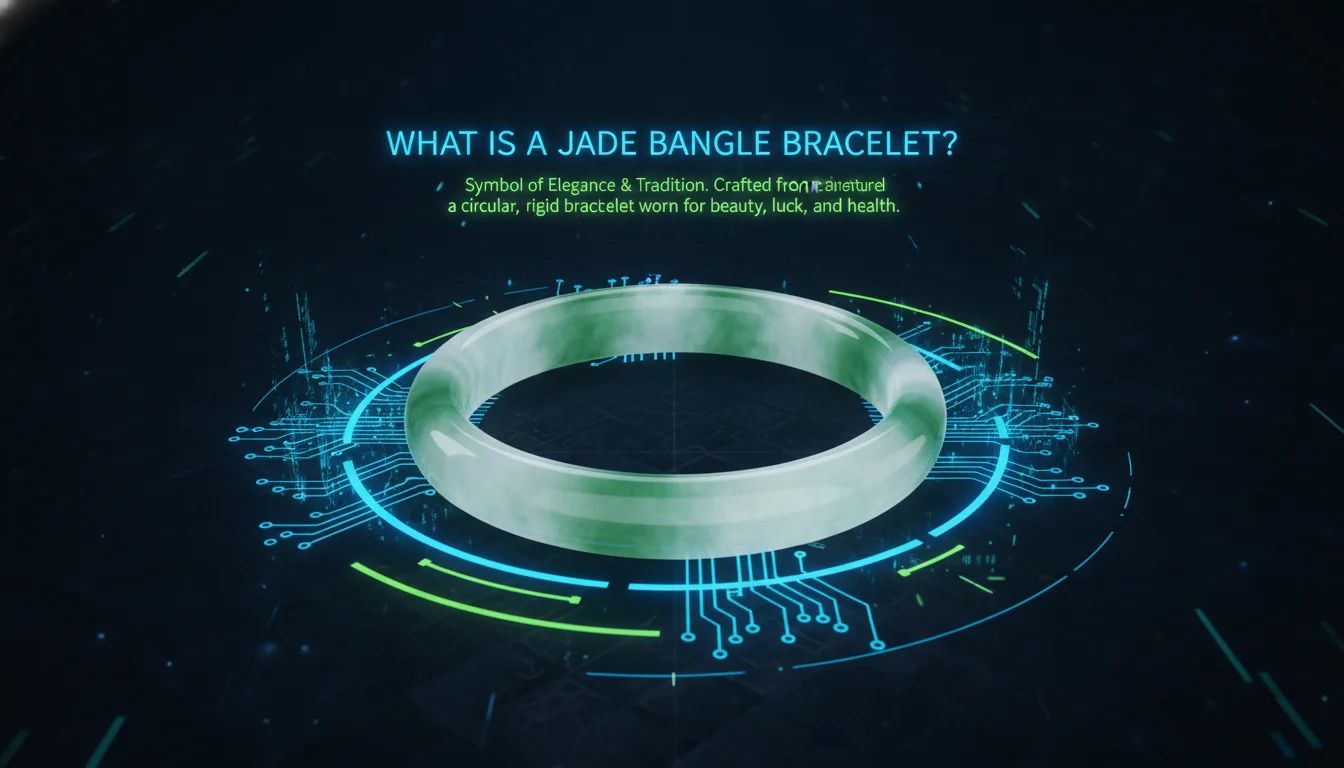
A this type of bracelet is a seamless, rigid circle that slides over the hand and rests on the wrist. Unlike a chain or beaded bracelet, it holds its shape permanently, which is exactly the point. That unbroken circle carries weight beyond aesthetics. In Chinese philosophy, the circle represents heaven, infinity, and unity. Wearing one is thought to channel life energy continuously around the body, creating a quiet, constant sense of protection. Once it’s on, it becomes part of you.
Jadeite and Nephrite: The Two True Jades
Only two minerals qualify as authentic jade: jadeite and nephrite. Jadeite is the rarer of the two, prized for its glass-like luster and a spectrum of colors that ranges from vivid emerald green to icy white, soft lavender, and rare blue-green. Nephrite is softer, typically more opaque, and found in muted greens, greys, and black. Both are genuinely beautiful, but jadeite commands higher prices because of its scarcity and visual depth. According to Mason-Kay and Baikalla, every this kind of bracelet in their collections is crafted from natural, untreated jadeite, unless explicitly noted as nephrite.
The Significance of the Bangle Shape
The seamless form of a jade bangle is not just a design choice. Mason-Kay calls their one-piece bangles “Cinderella pieces” because they must fit just right: snug enough to stay on the wrist, loose enough to slide over the hand with a little lotion or water. Once on, they rarely come off. That permanence is part of the meaning. A bangle that lives on your wrist accumulates your history, your travels, your stories.
The Meaning and Cultural Significance of Jade Bangles
Jade bangles carry meaning that goes far deeper than their surface beauty. Across East Asian cultures, jade has been considered a guardian stone for centuries, and the bangle form amplifies that protective energy through its unbroken shape.
“Authentic, natural jadeite jade bangles provide the wearer with a sense of harmony and balance while offering protection and good luck.” – Mason-Kay
Protection and Good Luck
For centuries, jade has been considered a guardian stone. Mason-Kay notes that natural jadeite bangles provide the wearer with a sense of protection and good luck. Magnolia Jewelers in New York City described one of their standout green-and-white jade bangles as protective jewelry that shields your energy. Many wearers believe that if a jade bangle breaks, it has absorbed a misfortune on their behalf, a belief that turns even a cracked bangle into something meaningful rather than something lost.
Balance and Harmony
Beyond protection, jade is linked to emotional and physical balance. Mason-Kay describes bangle bracelets as promoting harmony and balance in the wearer’s life. Choosing a color that resonates with you deepens this effect: green for growth, lavender for calm, white for clarity. Think of it as intentional dressing, the jewelry equivalent of choosing a linen kaftan over a stiff blazer because you want to feel at ease.
How to Identify a Real Jade Bangle Bracelet
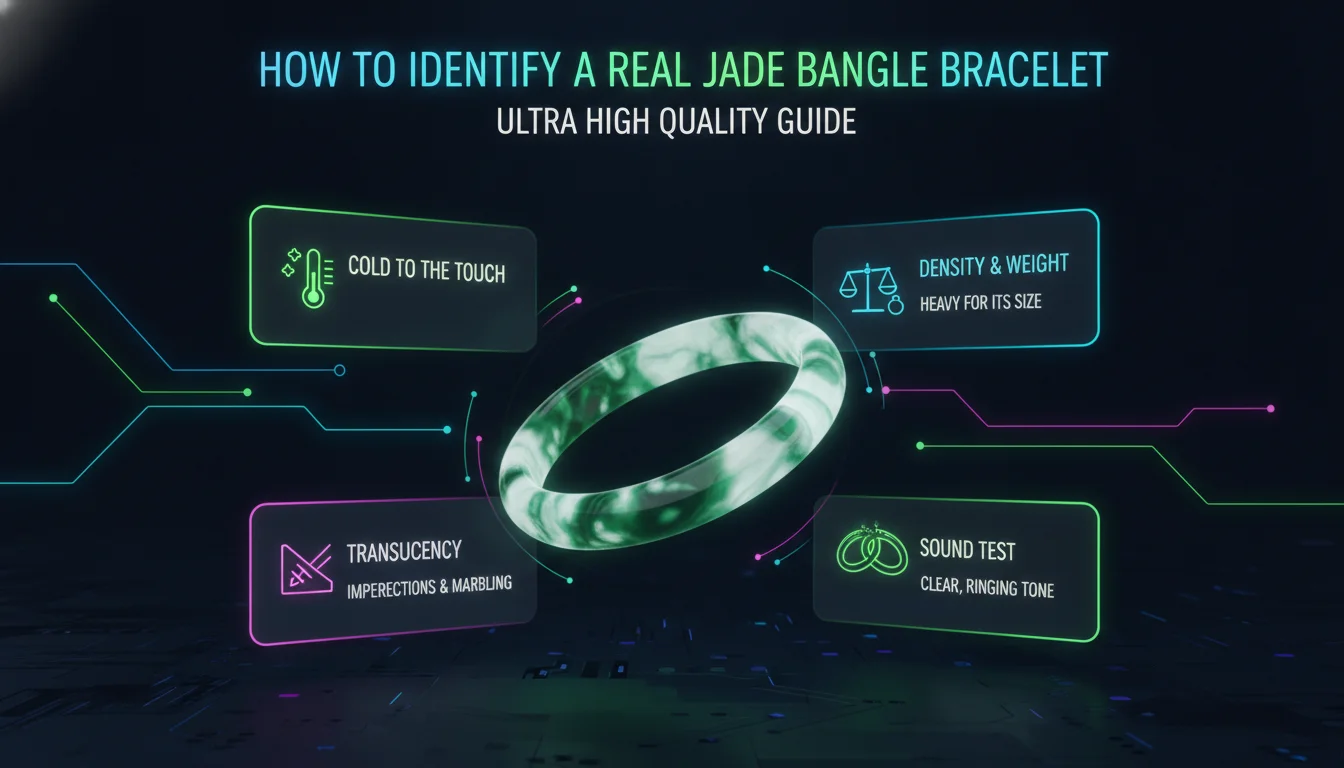
With high-quality jadeite priced in the thousands, counterfeits and treated stones are common. Knowing how to spot the real thing protects both your investment and your connection to the piece.
The Ping Test
Tap the bangle gently with a coin or another piece of jade. Real jadeite emits a clear, bell-like ring because of its dense crystalline structure, a characteristic highlighted by gemology channel Jewels of the Trade. Nephrite also pings, though often with a softer, lower pitch. Plastic fakes produce a dull thud. Glass can ring, but the harmonic is different once you’ve trained your ear. A commenter on the Jewels of the Trade video noted that Guatemalan jadeite produces a noticeably high-toned ping, even compared to Burmese pieces. This test is most reliable when combined with other checks.
Certification and Laboratory Reports
The most reliable way to confirm authenticity is a professional lab report. Both Baikalla and Mason-Kay supply certificates of authenticity with every this type of bracelet they sell. Many high-end Baikalla pieces come with a GIA (Gemological Institute of America) certificate, which verifies the piece as natural jadeite (Type A) and confirms it has not been dyed, bleached, or polymer-impregnated. Those treatments define Type B or C jade, which looks attractive initially but degrades over time and holds no collector value. Always insist on a certificate before committing to a purchase.
Visual Inspection for Natural Inclusions
Under magnification, real jade reveals its inner world: tiny fibrous interlocking crystals, subtle color zoning, and occasional natural veins or dark spots. These variations are hallmarks of authenticity, not flaws. A perfectly uniform, deeply green bangle at a suspiciously low price is almost always synthetic or heavily treated. Baikalla’s collection showcases these natural variations beautifully, and learning to appreciate them is part of becoming a confident jade buyer.
Jade Bangle Materials and Price Tiers
The material, treatment status, and seller reputation all shape what you’ll pay. Here’s a clear breakdown of what the market actually looks like.
Natural Jadeite (Type A) Bangles
This is the gold standard: 100% natural jadeite with no chemical enhancement. Colors range from icy whites and soft lavenders to deep emerald greens. A genuine Burmese apple-green this kind of bracelet at Baikalla starts at $4,860, while their icy green “Traditional Round” with GIA certification reaches $36,990. At Mason-Kay, green jadeite half-round bangles range from $620 to $8,100, with their rare blue water jadeite flat bangle priced at $21,380. These are pieces you buy once and pass down.
Natural Nephrite Bangles
Nephrite offers a more accessible entry point into genuine jade. It is softer than jadeite but still a true jade with its own devoted following, especially for antique and traditional pieces. Mason-Kay lists a green nephrite half-round bangle at $1,070. Its smooth, waxy luster reads as quietly luxurious, and the darker greens and blacks suit a more understated aesthetic.
Fashion and Gemstone Bangles
Retailers like Seree offer bangles labeled as “jade” or “jade-green” at price points between $68 and $125. A closer look at descriptions reveals terms like “jade-green aventurine,” meaning the bangle is actually aventurine quartz rather than jade. These fashion bangles are popular for their on-trend colors and accessibility, but they rarely come with gemological certification and hold no investment value. They’re a fun way to wear the aesthetic without the commitment. For a true jade bangle, shop with specialists who guarantee natural, untreated stone.
At a Glance: Jade Bangle Bracelet Price and Material Comparison
| Bangle Type | Material | Price Range (USD) | Certification | Best For |
|---|---|---|---|---|
| Natural Jadeite (Type A) | Untreated jadeite | $620 – $36,990 | GIA or seller certificate | Collectors, heirloom investment |
| Natural Nephrite | Untreated nephrite | ~$1,070 (Mason-Kay example) | Seller certificate | Entry-level genuine jade lovers |
| Fashion / Gemstone | Jadeite, nephrite, or other stones (e.g., aventurine) | $68 – $125 (Seree) | Typically none | Trend-focused, casual wear |
Pros and Cons of Owning a Jade Bangle Bracelet
Pros
- Timeless beauty: The colors, translucency, and natural variation of jadeite are unlike any synthetic stone.
- Cultural depth: Wearing a jade bangle connects you to centuries of meaning, tradition, and craftsmanship.
- Investment potential: Type A jadeite holds and often grows in value, especially rare colors like imperial green or icy blue-green.
- Durability: Jadeite rates 6.5–7 on the Mohs scale, making it suitable for daily wear with basic care.
- Versatility: A jade bangle pairs effortlessly with everything from a linen sundress to an evening look.
Cons
- Sizing commitment: One-piece bangles require precise measurement and can be difficult to remove once on.
- Fragility under impact: Despite its hardness, jadeite can chip or crack if struck sharply against a hard surface.
- High entry cost for quality: Genuine Type A jadeite starts in the hundreds and quickly climbs into the thousands.
- Counterfeit risk: The market is full of treated or imitation pieces, requiring careful vetting of sellers and certificates.
Popular Styles and Shapes of Jade Bangles
The classic round bangle is just the beginning. Modern jade bangle bracelets come in several silhouettes designed to suit different wrists, aesthetics, and occasions.
Cylindrical, Half Round, and Flat Bangles
Mason-Kay categorizes bangles by their cross-section: cylindrical (round both inside and out), half round (flat inside, curved outside), and flat (rectangular profile). Baikalla’s “traditional round” bangles offer a smooth, symmetrical look, while their half-round profile sits more comfortably against the wrist for all-day wear. Cylindrical bangles tend to be the most classic and are often carved with intricate motifs.
Carved and Hinged Bangles
For those who prefer easier wear, Mason-Kay carries bangles finished with a 14K yellow gold hinge and clasp, allowing the bangle to open and fasten around the wrist without squeezing over the hand. These are especially popular for wearers with larger hands or anyone who prefers to remove their bangle at night. Carved bangles, whether one-piece or hinged, feature auspicious symbols like dragons, phoenixes, or floral patterns that add layered meaning to an already meaningful piece.
Color Varieties and Their Appeal
Jade bangle bracelets span a wide palette. The most coveted shade is imperial green, a vibrant, evenly saturated hue historically associated with Chinese royalty. Other desirable colors include lavender, believed to soothe the spirit; icy white, which looks luminous against warm skin; and blue-green, with Guatemalan jadeite being a notable source, as discussed by Jewels of the Trade. Mason-Kay also offers rare green with red patches, valued for its “hong fei” auspiciousness. Even within the fashion segment, Seree experiments with unexpected tones like pool blue and blush pink, though these are typically aventurine or other gemstones rather than jade.
The Investment Value of Jade Bangle Bracelets
A premium jade bangle bracelet is not just an adornment. For many collectors, it’s a portable asset with enduring demand, particularly in Asian markets where top pieces command serious prices at auction.
What Makes a Jade Bangle Valuable
Several factors drive the price of a jade bangle bracelet: color (intense, even green being most prized), translucency (icy, gemmy material fetches more), texture (fine, tight crystal structure), and carving artistry. At Baikalla, a Burmese jade bangle with vibrant apple green starts around $4,860, while their icy green “Traditional Round” with GIA certification reaches $36,990. Mason-Kay’s rare blue water jadeite flat bangle is listed at $21,380, illustrating how unusual colors command their own premium.
Type A Jade vs. Treated Jade: Holding Value Over Time
Only Type A (untreated) jade is considered investment-worthy. Treated jades, whether Type B (bleach-impregnated) or Type C (dyed), may look appealing initially but degrade over time and carry no collector value. Reputable sellers like Mason-Kay and Baikalla sell exclusively Type A jadeite, providing certificates that protect your purchase as a genuine heirloom.
Why One-Piece Bangles Are Especially Prized
The “Cinderella” nature of a one-piece jade bangle adds to its collectibility. Because it must fit the wearer perfectly and is difficult to remove, it becomes a deeply personal object that accumulates sentimental and historical value over time. Mason-Kay emphasizes this in their educational content: a well-fitted jade bangle is a lifelong companion, not just an accessory.
How to Choose the Right Size for Your Jade Bangle Bracelet
Size is the most critical factor in buying a jade bangle bracelet, particularly a one-piece style. An ill-fitting bangle is uncomfortable at best and risky at worst.
The “Cinderella” Fit Explained
Mason-Kay coined the term “Cinderella jade bangles” because the fit must be just right: snug enough to stay on the wrist, loose enough to slide over the hand with a little lotion or water. Once on, it should move freely but not slip off without effort. Too small and it may be impossible to wear; too large and it could fly off during activity and shatter.
Step-by-Step Guide to Measuring Your Bangle Size
- Tuck your thumb into your palm as if you’re about to slide on a bangle.
- Wrap a soft measuring tape around the widest part of your hand, across the knuckles and the lowest joint of the thumb. Keep it snug but not tight.
- Record the circumference in millimeters. For example, you might measure 180mm.
- Calculate the inner diameter by dividing the circumference by 3.14. So, 180mm divided by 3.14 equals approximately 57.3mm. That is your hand diameter.
- Choose a bangle with an inner diameter 1–2mm larger than your hand diameter for a comfortable slide. In this example, look for a bangle in the 58–59mm range.
Both Baikalla and Mason-Kay stock bangles in precise millimeter increments, so finding your Cinderella fit is entirely achievable. Some retailers also offer printable sizing guides or expert sizing assistance by appointment.
“Size is the most important factor in finding the perfect jade bangle for you.” – Mason-Kay
Where to Buy an Authentic Jade Bangle Bracelet
Finding a trustworthy source is everything. The market is full of imitations, but a few reputable dealers consistently deliver the real thing.
Trusted Online Retailers
Mason-Kay Inc. (Centennial, Colorado) is a family-run business specializing in natural jadeite and nephrite. Every jade bangle bracelet from Mason-Kay comes with a certificate of authenticity and is graded as Type A, untreated. Their collection spans rare colors and a wide range of sizes, and they offer detailed educational resources on bangle sizing and jade care.
Baikalla Jewelry (Portland, Oregon) carries one of the largest U.S. collections of Type A jadeite bangles, with thousands in stock and ready to ship. Their pieces often come with GIA certifications and a lifetime authenticity warranty. Baikalla’s inventory ranges from accessible entry-level pieces to investment-grade heirlooms priced above $30,000.
For fashion-forward, budget-friendly options, Seree offers bangles in playful colors at accessible price points. Read descriptions carefully, though: many are aventurine or other gemstones rather than natural jadeite. They serve those seeking a trendy look without the investment commitment.
What to Look for in a Seller
When shopping for a jade bangle bracelet, prioritize sellers who provide a written guarantee of Type A, untreated jade; offer third-party lab reports from GIA or equivalent; maintain a transparent return policy; share detailed product photos and videos under different lighting; and have verified reviews from independent platforms. A “Type A” imperial green bangle listed for $200 is a red flag, not a bargain.
Caring for Your Jade Bangle Bracelet
A natural jade bangle bracelet can last a lifetime and beyond with simple, consistent care.
Cleaning and Storing Jade
Jadeite rates 6.5–7 on the Mohs hardness scale, making it relatively durable but still vulnerable to harder materials like diamond or corundum. Clean your jade bangle with lukewarm water, mild soap, and a soft cloth. Avoid ultrasonic cleaners and harsh chemicals, which can damage the stone or loosen settings in hinged pieces. Store your bangle separately in a padded jewelry box or soft pouch to prevent scratches from other jewelry.
Avoiding Damage and Breakage
Jadeite can chip or crack if struck sharply, despite its toughness. Remove your bangle during sports, gardening, or heavy lifting. If your bangle does break, many cultures hold that it absorbed a misfortune on your behalf, turning a loss into a kind of gift. Some jewelers can repair breaks using gold or silver reinforcement, similar to the Japanese kintsugi tradition, transforming a mishap into a beautiful new chapter in the piece’s story.
Frequently Asked Questions
What does it mean to wear a jade bangle?
Wearing a jade bangle symbolizes protection, good luck, and a connection to ancient tradition. Many believe the bangle shields your energy and brings harmony to daily life. The unbroken circle shape amplifies this meaning, representing continuity and wholeness.
How can you tell if a bangle is real jade?
Perform a ping test by tapping the bangle with a piece of metal: real jadeite should ring clearly, like a small bell. Always ask for a GIA or seller certificate confirming Type A, untreated jade. Under magnification, look for natural inclusions, subtle color zoning, and fibrous crystal structure rather than uniform perfection.
How much should a real jade bangle cost?
Authentic jadeite bangles start around $620 for simple green pieces at Mason-Kay and can exceed $36,000 for rare, vivid colors at Baikalla. Nephrite bangles offer a more accessible entry point, with Mason-Kay listing a green nephrite option at $1,070. Fashion bangles using aventurine or other stones start around $68 but are not genuine jade.
Which wrist do you wear a jade bangle on?
Traditionally, jade bangles are worn on the left wrist, considered the receiving side of the body, to absorb protective energy. Personal comfort and style can guide the choice, though. There is no strict rule, and many wearers simply go with whichever wrist feels right.
What size jade bangle do I need?
Measure the circumference of your hand at the knuckles with your thumb tucked in, then divide by 3.14 to find your hand diameter in millimeters. Choose a bangle with an inner diameter 1–2mm larger than that measurement for a comfortable Cinderella fit. Both Mason-Kay and Baikalla stock bangles in precise millimeter increments to help you find the right size.
Can a cracked jade bangle be repaired?
Yes. Skilled jewelers can mend cracks using gold or silver reinforcement, similar to the kintsugi tradition. Some collectors find that a repaired bangle carries even more personal history than an intact one. The cultural belief that a breaking bangle absorbs misfortune on your behalf makes the repair feel like completing a story rather than fixing a mistake.
The Timeless Allure of a Jade Bangle Bracelet
A jade bangle bracelet is far more than an accessory. It’s a wearable story of earth, energy, and elegance. Whether you invest in a vivid Type A jadeite heirloom from Baikalla or a quietly beautiful nephrite piece from Mason-Kay, the right bangle becomes a loyal companion on your wrist. By understanding materials, verifying authenticity, and nailing the perfect fit, you can choose a jade bangle bracelet with confidence, knowing it brings beauty, protection, and a tangible link to centuries of tradition.
Ready to find yours? Shop the collection at lexazi.com and discover pieces that feel like they were made just for you. Free shipping on orders over $75.