Earrings in Spanish are most often translated as aretes in Latin America and pendientes in Spain, but the exact word shifts by country. Puerto Ricans say pantallas, while Uruguayans and Bolivians say caravanas.
Key Takeaways
- in spanish has no single universal word: aretes dominates Latin America, while pendientes is standard in Spain.
- The Royal Spanish Academy recognizes arete, aro, pendiente, and zarcillo as correct terms for earring.
- Country-specific words include pantallas (Puerto Rico), caravanas (Bolivia and Uruguay), topos (Colombia), and chapas (Nicaragua).
- Jewelry type matters: argollas are hoops, dormilonas are studs, and arracadas are dangling earrings.
- When unsure, use aretes in Latin America and pendientes in Spain for maximum clarity.
Why Earrings in Spanish Has More Than One Answer
Spanish, like English, has regional synonyms for everyday objects. Just as British English says aubergine while American English says eggplant, the phrase this type of spanish can resolve to aretes, pendientes, pantallas, or caravanas depending on the country. There is no single universal word that works equally well in Madrid, Mexico City, San Juan, and Montevideo.
Learning the regional differences is not just a vocabulary exercise. If you walk into a jewelry store in Buenos Aires and ask for aretes, you will likely be understood. But if you use pantallas in Mexico, you may get a confused look because pantalla means screen there. The safest approach is to learn the dominant terms for the countries you will visit or interact with.
The Core Translation: Aretes and Pendientes
Aretes is the plural of arete, a masculine noun that SpanishDict identifies as the standard Latin American translation for this kind of spanish. Example: Esos aretes de perla se te ven lindos means Those pearl earrings look nice on you. In Mexico, los aretes is the everyday phrase, as confirmed by both Memrise and Drops.
Pendientes is the plural of pendiente, the preferred term in Spain. It also carries the meaning of pendant or dangling earring in some countries. SpanishDict’s example Sus pendientes de diamante son hermosos translates to Her diamond earrings are beautiful. Collins lists el pendiente as the first Spanish translation for earring, with el arete specified for Mexico.
WordHippo lists el pendiente, el arete, el aro, and el zarcillo as Spanish words for earring, and also includes el dependiente. Note that dependiente usually means dependent, employee, or shop assistant, not earring. Skip that one.
The Royal Spanish Academy’s Four Approved Words
According to Speaking Latino, the Dictionary of the Royal Spanish Academy approved the words arete, aro, pendiente, and zarcillo as correct Spanish words for earring. That means you can use any of these four across Latin America and Spain and still be understood, though regional preferences remain strong. Aro also means ring or hoop, while zarcillo literally means tendril, a botanical term that extended to describe earrings because of the curved shape.
“The Dictionary of the Royal Spanish Academy approved arete, aro, pendiente, and zarcillo as correct Spanish words for earring, giving speakers four valid options across the Spanish-speaking world.” – Speaking Latino
How Regional Differences Shape the Word for Earrings in Spanish

Searching for earrings in returns multiple translations because Spanish-speaking countries developed different terms for the same object. Some of these words share roots with other meanings, which can create false friends for learners. Understanding the geographic distribution helps you avoid awkward mistakes and sound more natural wherever you are.
Mexico and Central America: Aretes and Aritos
In Mexico, the default plural is los aretes. That is the word Memrise teaches for Mexican Spanish, and SpanishDict lists el arete as the Latin American masculine noun. The diminutive arito, meaning a small earring, can be heard in Honduras and Argentina, according to Speaking Latino. If you are speaking to someone from Mexico, Guatemala, El Salvador, or Costa Rica, aretes is the safest choice.
Central American usage is not uniform, though. Nicaragua often uses chapa for earring, a word that in other countries means bottle cap. This is a good example of how a familiar Spanish word can shift meaning entirely: a chapa in Mexico may be a metal plate or bottle cap, but in Nicaragua it is an earring.
Spain: Pendientes and Zarcillos
In Spain, pendientes dominates everyday speech and dictionary definitions. Collins gives el pendiente as the primary noun, with el arete marked for Mexico. Zarcillo is another Spanish word for earring, and it appears in the Royal Spanish Academy’s list. In Spain, zarcillo may sound more literary or traditional, but it remains correct. SpanishDict also notes el zarcillo is used in Spain and Venezuela.
Caribbean: Pantallas in Puerto Rico
Puerto Rico has a distinctive word for in spanish: la pantalla. SpanishDict’s entry includes la pantalla for Puerto Rico, with the example Tiene tres pantallas en su oreja, meaning She has three earrings in her ear. In most other Spanish-speaking countries, pantalla means screen, such as a movie screen or television. This false friend can cause real confusion, so context matters a lot.
The word aro is also used in Latin America for earring, but it can mean ring or hoop. If you hear aros in the Caribbean, it may refer to hoop earrings or earrings in general. As a YouTube commenter noted on a regionalism lesson by Teacher Catalina, la pantalla de una lámpara means lampshade outside Puerto Rico, which highlights just how far the double meaning can travel.
A Country-by-Country Guide to Spanish Earring Vocabulary
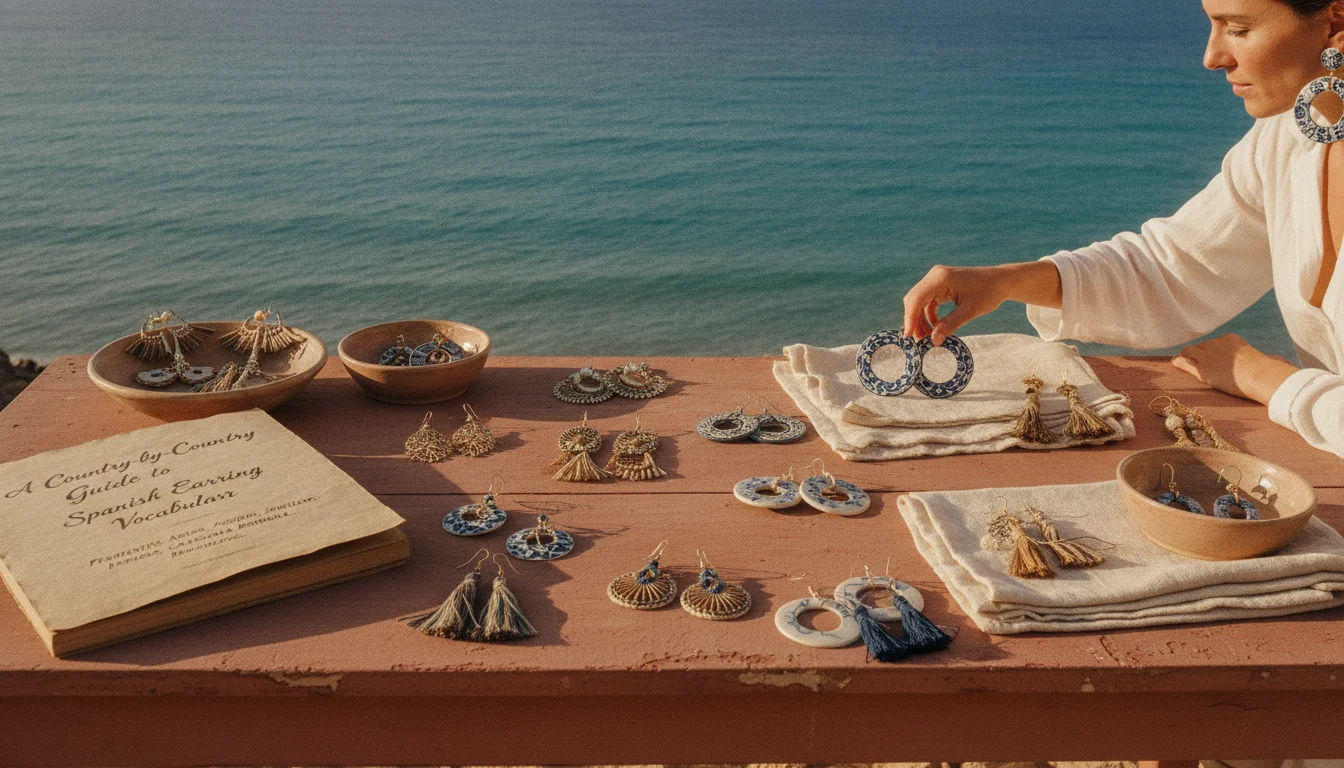
Because Spanish is spoken in more than 20 countries, a single English word can map to many local terms. The list below organizes the most common dictionary-recognized and everyday words for earrings in Spanish by country or region.
Mexico, Honduras, and Argentina
Mexico uses aretes as the everyday word. Honduras and Argentina also use aritos, the diminutive of aros, for small earrings. In Argentina, you may hear aritos even for standard earrings because the diminutive is common in everyday speech. If you are in Buenos Aires, aritos will feel more natural than pendientes.
Spain and Venezuela
Spain uses pendientes for general earrings, and zarcillos is also accepted. Venezuela shares zarcillo with Spain, according to SpanishDict. A Venezuelan speaker might say zarcillo where a Mexican speaker would say arete. This overlap between Spain and Venezuela is one of the few cases where a European term crosses the Atlantic unchanged in everyday use.
Colombia, Nicaragua, Bolivia, Uruguay, and Puerto Rico
Colombia has topo for earring, along with candonga specifically for hoop earrings, a word with African roots according to Speaking Latino. Nicaragua uses chapa. Bolivia and Uruguay use caravana, which literally means caravan. Puerto Rico uses pantalla. These country-specific words are common enough that dictionaries include them, but they may not be understood elsewhere. A caravana in Mexico is a caravan or trailer, not an earring.
Pros and Cons of Learning Regional Earring Vocabulary in Spanish
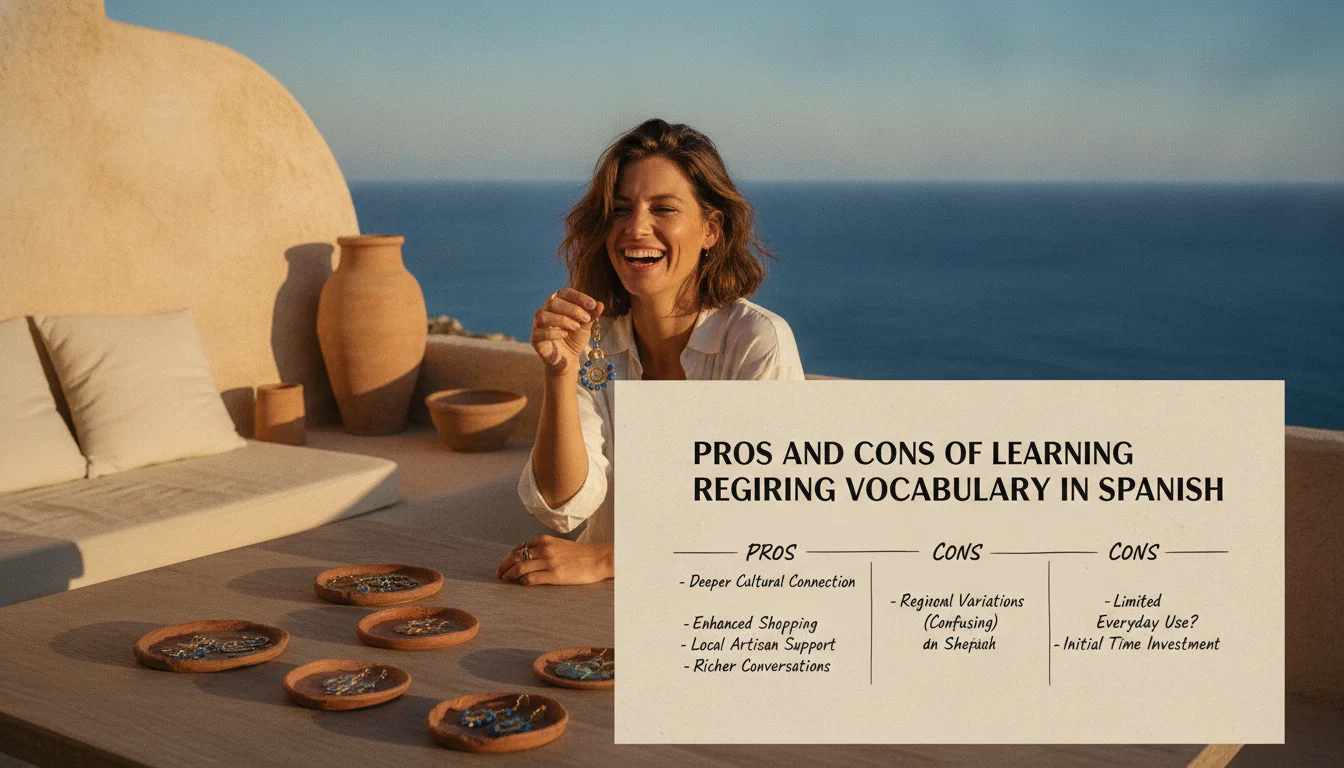
Pros
- You sound natural and culturally aware to native speakers in each country.
- You avoid false-friend mistakes, like using pantalla outside Puerto Rico.
- You can shop for jewelry, give compliments, and describe styles with precision.
- Knowing the Royal Spanish Academy’s four approved words gives you a reliable fallback anywhere.
Cons
- The sheer number of regional terms can feel overwhelming at first.
- A word that works perfectly in one country may draw blank stares in another.
- Slang and diminutives shift even within countries, so no list is ever fully complete.
Types of Earrings in Spanish: From Studs to Hoops
Beyond the general word for earrings in Spanish, the language has specialized vocabulary for different jewelry styles. Knowing these terms helps you shop more precisely and describe exactly what you are looking for, whether you are browsing a market stall in Cartagena or a boutique in Barcelona.
Hoop Earrings: Argollas, Aros, and Candongas
For hoop earrings, the most widespread word is argollas. Speaking Latino notes that hoop earrings are commonly known as argollas in Spanish, and that many Latinas grow up seeing mothers and grandmothers put on hoops daily. Aros can also mean hoops or rings, while candongas is a Colombian term for hoop earrings with African roots. Collins includes the sentence There are a zillion hoop earrings out there, illustrating just how beloved the style is across cultures.
Stud Earrings: Dormilonas and Pendientes en Forma de Bolita
Stud earrings have their own vocabulary. Collins defines a stud earring as pendiente en forma de bolita, literally an earring in the shape of a little ball. Speaking Latino adds dormilona, a stud earring generally with a pearl or stone. Dormilona literally means sleepyhead, and it is used in several Latin American countries to describe a simple stud that stays in place, even while sleeping. There is something charming about a word that captures both the jewelry and the lifestyle.
Dangling and Chandelier Earrings: Arracadas and Pendientes
Dangling or pendant earrings are often called arracadas. Speaking Latino defines arracada as an earring with a pendant. The word pendiente can also mean an earring with a pendant in some countries, distinguishing it from a simple stud or hoop. Chandelier earrings, those long ornate styles that catch the light at a dinner table, may be described as pendientes largos or arracadas largas, though the exact phrase varies by region.
“Hoop earrings are commonly known as argollas in Spanish. It’s tradition in many Latino communities for girls to have pierced ears from infancy, so earrings are a part of growing up.” – Speaking Latino
How to Choose the Right Word for Earrings in Spanish
Choosing the right Spanish word for earrings in Spanish comes down to four clear steps. Follow them and you will always land on the most natural option for your audience.
- Identify the country or region. If Spain, choose pendientes. If Mexico or Central America, choose aretes. If Puerto Rico, choose pantallas. If Uruguay or Bolivia, choose caravanas.
- Determine the earring type. For a hoop, say argollas or aros. For a stud, say dormilonas or pendientes en forma de bolita. For a dangling earring, say arracadas or pendientes.
- Match the formality and context. Formal writing tends to use pendientes or aretes, while casual speech may include aritos, topos, or chapas.
- When in doubt, default to aretes for Latin America and pendientes for Spain. These two are the most widely understood general terms for earrings in Spanish.
Step 1: Identify the Country or Region
The first question to ask is where your listener or reader is from. If the answer is Spain, choose pendientes. If it is Mexico, Central America, or most of South America, choose aretes. If it is Puerto Rico, choose pantallas. If it is Uruguay or Bolivia, choose caravanas. If you do not know the country, aretes is the safest broad Latin American option for earrings in Spanish.
Step 2: Match the Jewelry Type
Next, consider the style. For a hoop earring, say argollas or aros. For a stud, say dormilonas or pendientes en forma de bolita. For a dangling earring, say arracadas or pendientes. Matching the type also helps you sidestep the false-friend trap of pantalla outside Puerto Rico.
Step 3: Consider Context and Register
Formal writing and dictionary entries tend to use pendientes or aretes, while casual speech may include local terms like aritos, topos, or chapas. In a jewelry catalog aimed at a broad Latin American audience, aretes is widely understood. If you are writing for a specific country, use that country’s local word to sound natural and genuinely connected to your reader.
Pronunciation Guide for Spanish Earring Terms
Pronunciation for these words follows standard Spanish rules, but a few regional consonant differences exist. The following approximations will help you be understood in conversation.
How to Pronounce Aretes
Pronounce aretes as ah-REH-tehs, with the stress on the second syllable. The first a is a short ah sound, and the final s is pronounced in Latin America. The singular arete is ah-REH-teh. Because arete is masculine, you say el arete and los aretes.
How to Pronounce Pendientes and Zarcillos
Pronounce pendientes as pen-DYEN-tehs, with stress on the second syllable. In Spain, the d between vowels may soften, but the spelling stays the same. Zarcillos is pronounced sar-SEE-yos in Latin America and thar-THEE-yos in much of Spain, because the z is pronounced as a soft th in Castilian Spanish.
For pantalla, pronounce pan-TAH-yah. For caravana, pronounce kah-rah-VAH-nah. These cues are approximate, but they will get you understood in conversation every time.
Comparison Table: Spanish Words for Earrings by Region and Type
The table below summarizes the most common Spanish words for earrings in Spanish across Spanish-speaking regions. Use it when you are shopping, writing, or translating, and the right word will be one glance away.
Regional Variations at a Glance
| Spanish Word | Primary Region(s) | Type / Notes |
|---|---|---|
| aretes | Mexico, Latin America | General earrings; plural of arete |
| pendientes | Spain | General earrings; also dangling earrings with pendant |
| aros | Latin America | General earrings; also hoops or rings |
| pantallas | Puerto Rico | General earrings; literally “screens” |
| zarcillos | Spain, Venezuela | General earrings; literally “tendrils” |
| caravanas | Bolivia, Uruguay | General earrings; also “caravans” |
| topos | Colombia | General earrings |
| chapas | Nicaragua | General earrings; also “bottle caps” |
| argollas | Latin America | Hoop earrings |
| dormilonas | Latin America | Stud earrings, often pearl or stone |
| arracadas | Various | Dangling / pendant earrings |
| candongas | Colombia | Hoop earrings, African roots |
What the Table Does Not Cover
Slang and local diminutives can change by city or even neighborhood. The table focuses on dictionary-recognized terms and common everyday usage. If you hear a word not listed, such as aritos in Argentina, it is usually a diminutive or affectionate form of a base word.
Useful Phrases: Earrings in Spanish in Context
Knowing the vocabulary is one thing. Using it naturally in a sentence is another. Here are a few ready-to-use phrases that put earrings in Spanish into real conversation.
- Esos aretes de perla se te ven lindos. (Those pearl earrings look nice on you.) – Mexico and Latin America
- Sus pendientes de diamante son hermosos. (Her diamond earrings are beautiful.) – Spain
- Tiene tres pantallas en su oreja. (She has three earrings in her ear.) – Puerto Rico
- Mi novio me compró caravanas para mi cumpleaños. (My boyfriend bought me earrings for my birthday.) – Uruguay and Bolivia
- ¿Son de oro tus aros? (Are your earrings gold?) – Latin America
- Estoy tan triste porque se me perdió un zarcillo hoy. (I am so sad because I lost an earring today.) – Spain and Venezuela
Final Takeaways on Using Earrings in Spanish
What to Remember
The phrase earrings in Spanish resolves to multiple correct answers depending on region. Remember the four Royal Spanish Academy words: arete, aro, pendiente, and zarcillo. Then layer in country-specific terms like pantalla, caravana, topo, and chapa for the conversations that call for them.
Common Mistakes to Avoid
Do not assume pantalla means earring outside Puerto Rico. Do not use caravana for earring outside Uruguay and Bolivia, where it means caravan. Do not confuse aro with argolla: both can mean hoop, but aro is also a general earring or ring.
When in Doubt, Ask
If you are unsure which word to use for earrings in Spanish, ask a native speaker what they call them in their country. Spanish speakers are generally aware of regional differences and will often volunteer the local term. You can also use aretes as a neutral Latin American default and pendientes in Spain, and you will be understood almost everywhere.
As of June 2026, the best jewelry for any occasion starts with knowing exactly what to call it. Explore our full collection of statement earrings, delicate studs, and sun-kissed hoops at lexazi.com. Free shipping on orders over $75.
Frequently Asked Questions
How do Mexicans say earrings?
Mexicans say aretes for earrings. The singular is arete, and the phrase los aretes is the everyday Mexican Spanish translation, confirmed by both Memrise and Drops as the standard Mexican Spanish term.
How do you say stud earrings in Spanish?
Stud earrings can be called dormilonas or pendientes en forma de bolita. Collins uses pendiente en forma de bolita to describe a ball-shaped stud, while Speaking Latino defines dormilona as a stud earring generally featuring a pearl or stone.
What do Puerto Ricans call earrings?
Puerto Ricans call earrings pantallas. In other Spanish-speaking countries, pantalla usually means screen or lampshade, so context is essential when using this word outside Puerto Rico.
How do you say hoop earrings in Spanish?
Hoop earrings are argollas or aros across most of Latin America. In Colombia, candongas also refers to hoop earrings, a word with African roots according to Speaking Latino.
Is it aretes or pendientes?
Both are correct for earrings in Spanish, but the region decides which is natural. Aretes is common throughout Latin America, while pendientes is the standard in Spain. When writing for a broad audience, use the term that matches your reader’s country.
What is the Royal Spanish Academy word for earring?
The Royal Spanish Academy approved arete, aro, pendiente, and zarcillo as correct Spanish words for earring. This gives speakers four valid options that are recognized across the Spanish-speaking world.