Achilles heel meaning is a fatal weakness in something otherwise strong, drawn from the Greek myth of the warrior Achilles. That single vulnerable spot, hidden beneath layers of strength, has given English one of its most vivid and enduring expressions.
Key Takeaways
- The heel meaning describes a critical vulnerability in an otherwise strong person, system, or entity.
- Its origin lies in Greek mythology, where the hero Achilles was invulnerable except for one spot on his heel.
- The idiom entered English around 1810 and was formally recorded in dictionaries by 1839.
- The Achilles tendon was named by Flemish anatomist Philip Verheyen in 1693, linking myth to medicine.
- Recognizing your own this type of meaning in a personal context can drive real growth and smarter decisions.
The Mythological Roots of the Achilles Heel

The Homeric Account
Homer’s Iliad never portrays Achilles as invulnerable. He wears armor like every other hero, and his comrade Patroclus even borrows that armor to lead the Myrmidons into battle. Homer mentions no single weak spot. Instead, Achilles’ mortality is a central, deliberate theme throughout the epic. His death is prophesied but never shown on the page.
In Iliad book 22, Hector foretells that Achilles will be killed by Paris and Apollo near the Scaean Gates. That prophecy contains no reference to a heel or ankle wound, which confirms that the invulnerability myth developed in later sources, not in Homer’s original text.
Later Mythological Embellishments
The story of Thetis dipping the infant Achilles into the River Styx appears only in later Greek and Roman sources. Holding him by the heel, she left that spot dry and therefore vulnerable. Some versions replace the Styx with ambrosia and fire: Peleus, Achilles’ father, discovered Thetis holding the baby in the hearth flames, panicked, and interrupted the ritual before it was complete. According to research by Barbara Carè published in the Bulletin of the Institute of Classical Studies (2026), the myth originally pointed to the talus (the ankle bone, called astragalos in Greek) as the vulnerable point, not the heel itself. Ancient World Magazine notes that the first explicit connection between Apollo guiding Paris’ arrow appears in Virgil’s Aeneid, written in the first century BC.
The Role of Apollo and Paris
In the myth’s full form, Paris shoots an arrow, often described as poisoned, at Achilles, and Apollo guides it to the vulnerable spot. Whether heel, ankle, or torso, the wound proves fatal. The precise location stays ambiguous in early sources, which is exactly what allowed the phrase to shed its anatomy and become a pure metaphor for any hidden flaw.
The Emergence of the Idiom

Early Literary Usage
The this kind of meaning as a figurative expression did not enter English until the early 19th century. Samuel Taylor Coleridge used it politically in 1810, writing of “Ireland, that vulnerable heel of the British Achilles.” The Oxford English Dictionary cites this as the first known implied figurative use of the phrase, as confirmed by Wikipedia’s sourcing of the OED.
First Dictionary Entries
The idiom solidified in print by 1839. Merriam-Webster records its first known use as 1839, defining it simply as “a vulnerable point.” Early dictionary compilers recognized the phrase’s power to convey a singular, often hidden, weakness in a way that no plain synonym could quite match.
The Spread into Everyday Language
By the 20th century, the achilles heel had jumped from mythology and literature into everyday speech. Journalists, psychologists, and business analysts all adopted it. Today you’ll hear it applied to a tech company’s security flaw, a star athlete’s poor free-throw shooting, or a nation’s unguarded border.
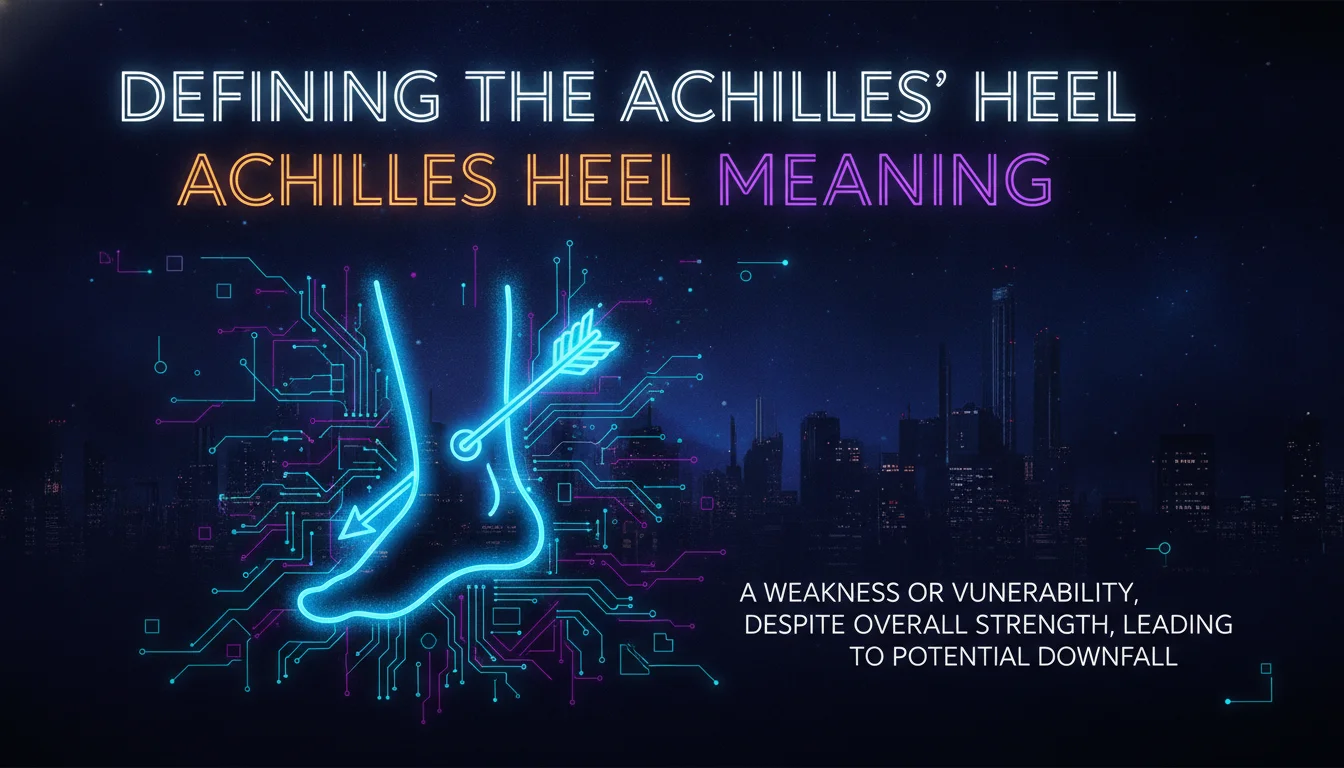
Defining the Achilles Heel Meaning
Dictionary Definitions Compared
| Source | Definition | Focus |
|---|---|---|
| Merriam-Webster | A vulnerable point | General weakness |
| Cambridge | A small problem or weakness in a person or system that can result in failure | Flaw leading to failure |
| Oxford Learners | A weak point or fault in somebody’s character, which can be attacked by other people | Character flaw |
| Collins | The weakest point in their character or nature, where it is easiest for other people to attack or criticize them | Exploitable weakness |
Though the wording differs, all four definitions circle back to one idea: a singular, potentially fatal vulnerability. The heel meaning synthesizes these nuances into a point of fragility inside an otherwise sturdy whole.
Core Elements of Meaning
Three elements define the achilles heel meaning across every context. First, the weakness is disproportionate: a small flaw can topple a giant. Second, it is often hidden or overlooked until someone exploits it. Third, it contrasts with overall strength, making the downfall more dramatic and more memorable. This combination explains why the idiom has lasted more than two centuries.
Synonyms and Related Terms
Synonyms include soft spot, fatal flaw, tragic flaw (from literary criticism), and single point of failure (from engineering). Each carries a slightly different shade, but none carries the same mythic weight as the achilles heel meaning does in everyday speech.
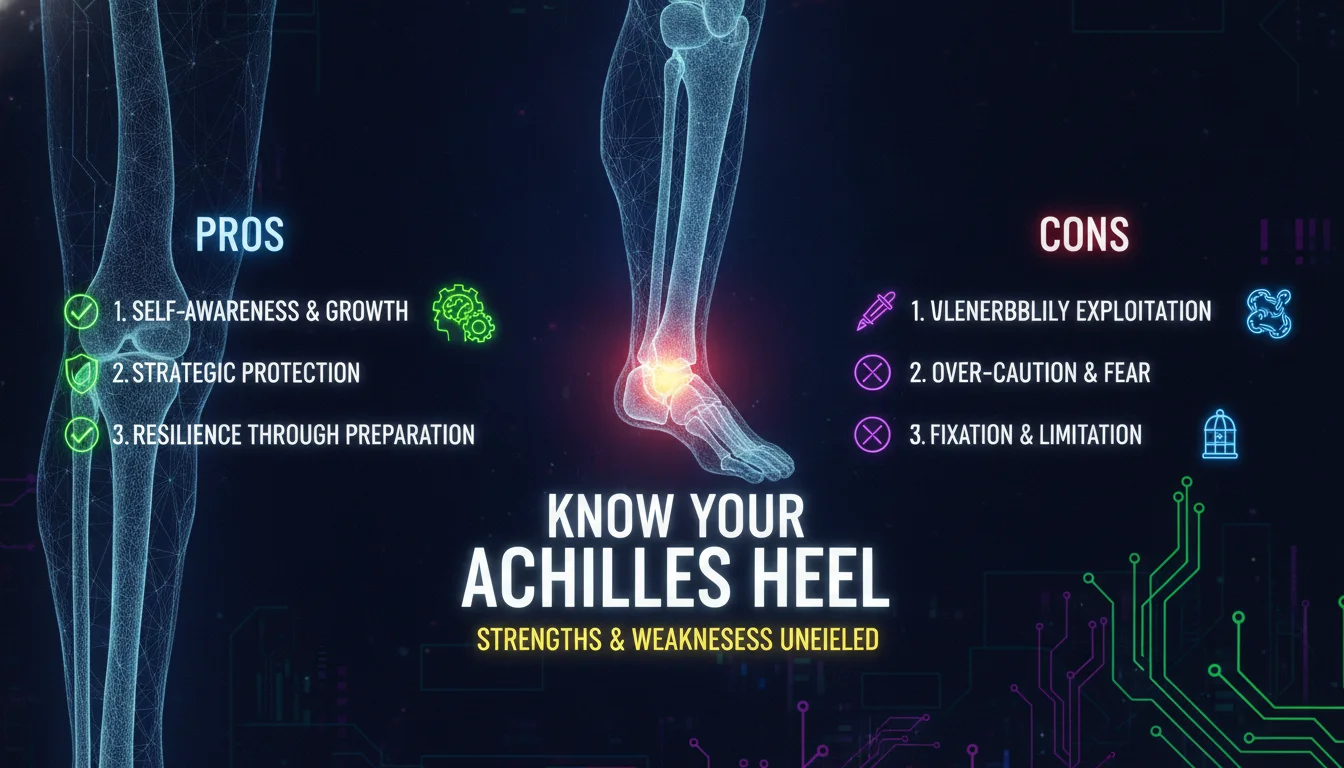
Pros and Cons of Knowing Your Achilles Heel
Pros
- Self-awareness lets you manage the weakness before it becomes a crisis.
- Acknowledging a flaw builds trust with colleagues, friends, and mentors who see your honesty.
- Targeted effort on one specific gap is more efficient than vague self-improvement.
- Research in positive psychology suggests that owning vulnerabilities builds authentic connections and resilience.
Cons
- Overanalyzing a single weakness can distract from genuine strengths.
- Publicly naming your achilles heel meaning in a competitive context can invite exploitation.
- Some vulnerabilities are deeply ingrained and resist quick fixes, which can lead to frustration.
The Anatomical Connection
The Achilles Tendon Explained
The Achilles tendon is the body’s strongest tendon, connecting the calf muscles to the heel bone. It enables plantar flexion, the motion that lets you stand on tiptoe, walk, and run. Its name dates to 1693, when Flemish anatomist Philip Verheyen described it as chorda Achillis in his text Corporis Humani Anatomia, according to the oldest-known written record of the name cited by Wikipedia.
Tendons are avascular, meaning they lack a direct blood supply. An arrow wound to this tendon alone would therefore be unlikely to prove fatal unless the arrow were poisoned, a detail that underscores the imaginative leap the myth requires. The physical vulnerability of the tendon, however, is entirely real: ruptures can sideline even elite athletes.
Why the Name Stuck
Verheyen’s naming choice was poetic, linking the body part directly to the legendary hero’s demise. Over time, anatomical textbooks cemented the term worldwide. This concrete medical usage adds a layer of literal truth to the metaphor, which is part of why the achilles heel meaning feels so grounded even when used figuratively.
Tendon Injuries and Vulnerabilities
Shore Physicians Group orthopedic surgeon Dr. Dante Marconi explains that the Achilles tendon is especially prone to degenerative changes with age. Tight calves and limited ankle mobility increase injury risk. A rupture often announces itself with a classic “pop” sensation, though it can also occur without warning. Treatment ranges from non-operative casting for partial tears to surgical repair for full ruptures, particularly in athletes aiming to return to elite competition.
“The Achilles tendon allows you to plantar flex, or move the foot in a downward motion away from the body. That movement is important for many actions, most importantly, everyday walking.” – Dr. Dante Marconi, Shore Physicians Group Orthopedic Surgeon
How to Identify Your Own Achilles Heel
Step 1: Reflect on Recurring Struggles
Think about patterns in your personal or professional life where you consistently stumble. Is there a task, relationship dynamic, or habit that repeatedly undermines your success? Honest self-reflection is the first step toward uncovering the achilles heel meaning in your own story.
Step 2: Spot Patterns in Setbacks
Look at your failures for common threads. Maybe you excel at big-picture thinking but consistently miss critical details, or you communicate brilliantly but crumble under time pressure. Charting your setbacks can reveal a pattern that points directly to your hidden weak spot.
Step 3: Seek External Feedback
Ask trusted colleagues, friends, or mentors for their observations. Others often see our blind spots more clearly than we do. Frame the request positively: you’re seeking growth, not ammunition. Their insights can be genuinely eye-opening.
Step 4: Formulate a Growth Plan
Once you’ve identified a potential achilles heel meaning in your own behavior, design a concrete strategy to address it. If it’s a skill gap, invest in training. If it’s a character trait like impatience, practice mindfulness techniques. The goal is not to eliminate the vulnerability entirely but to manage it so it never becomes a fatal flaw.
Real-World Examples of Achilles Heels
In Personal Life
“Math has always been my Achilles heel” is the Cambridge Dictionary’s own example sentence, and it resonates because it captures the achilles heel meaning perfectly: one stubborn weakness inside an otherwise capable person. Other common personal examples include public speaking, procrastination, perfectionism, and a short temper. These flaws can hold back otherwise talented individuals for years.
In Business and Organizations
Companies carry their own achilles heels. A reliance on a single supplier, an outdated technology stack, or a toxic leadership culture can cripple an otherwise profitable enterprise. As CNBC reported in July 2026, high award fees have become the achilles heel of a popular airline loyalty program, rising alongside fuel prices to the point where round-trip economy awards can exceed $400. FOX News noted in May 2026 that poor race starts were the achilles heel for Mercedes in Formula 1 this season, costing the team points race after race despite strong overall pace.
In History and Pop Culture
Historically, empires have been felled by their achilles heels: Rome’s overextension, the Maginot Line’s inflexibility. In superhero storytelling, Superman’s Kryptonite is a direct analogue. The phrase runs through film, literature, and boardroom strategy decks alike, cementing its role as a universal storytelling shorthand for the flaw that undoes greatness.
“An Achilles’ heel is a weakness despite overall strength, which can lead to downfall.” – Wikipedia, citing the Oxford English Dictionary and Merriam-Webster
The Deeper Achilles Heel Meaning in Psychology
The Vulnerability Paradox
Psychologically, our achilles heel can be a source of shame, yet acknowledging it often leads to greater resilience. The achilles heel meaning therefore encompasses not just weakness but also the potential for real transformation. When we own our flaws, they lose some of their power over us.
Growth Through Weakness
Research in positive psychology suggests that leaning into vulnerabilities, rather than hiding them, builds authentic connections and self-acceptance. A leader who admits their impatience, for example, often earns more trust than one who pretends to be flawless. Paradoxically, exposing your heel can become a source of strength.
Why We Hide Our Flaws
Evolutionary psychology argues that we conceal weaknesses to avoid exploitation, a behavior that once had genuine survival value. In modern contexts, this instinct can backfire, leading to anxiety and burnout. Recognizing this dynamic is the first step toward a healthier relationship with your own achilles heel meaning and what it reveals about you.
Embracing Your Vulnerabilities
From ancient myth to boardroom jargon, the achilles heel meaning has evolved into a versatile metaphor for the hidden flaw that can undo us. Whether it’s a literal tendon, a personality quirk, or a business blind spot, we all carry one. The wisdom lies not in denying it but in acknowledging it and managing its risks. So ask yourself: what is my achilles heel? The answer might just save you from a metaphorical arrow.
Frequently Asked Questions
What is the origin of the phrase “Achilles heel”?
The phrase originates from Greek mythology, where the hero Achilles was invulnerable except for his heel, which his mother Thetis held when dipping him in the River Styx. The expression first appeared in English around 1810 in a political writing by Samuel Taylor Coleridge, and Merriam-Webster records its first formal dictionary use as 1839.
Is it correct to say “Achilles heel” or “Achilles’ heel”?
Both are correct. “Achilles’ heel” is the traditional possessive form, while “Achilles heel” without the apostrophe is widely accepted and more common in modern usage. Cambridge, Oxford, and Merriam-Webster all recognize both spellings.
What does “Achilles heel” mean in the human body?
Anatomically, the Achilles tendon is the strong band of tissue connecting the calf muscles to the heel bone. Its name comes from the myth, as the tendon was associated with the site of Achilles’ fatal wound. Flemish anatomist Philip Verheyen first recorded the name in 1693.
Can an Achilles heel be a strength?
Indirectly, yes. Acknowledging a weakness can drive self-improvement and build humility, turning a vulnerability into a source of growth. However, the achilles heel meaning itself denotes a flaw, not a strength: the transformation comes from how you respond to it.
What is a famous example of an Achilles heel in business?
A classic example is Blockbuster’s failure to adapt to streaming, which became its achilles heel and led to bankruptcy despite its once-dominant market position. More recently, CNBC reported in July 2026 that high award fees have become the achilles heel of a popular airline loyalty program.
How do I use “Achilles heel” in a sentence?
You can say, “Procrastination is my Achilles heel,” meaning it is the one weakness that can undermine your productivity and success. The Cambridge Dictionary uses a similar example: “Math has always been my Achilles heel.”